SAFEGROWTH® BLOG
regular contributors
GREGORY SAVILLE · MATEJA MIHINJAC
GREGORY SAVILLE · MATEJA MIHINJAC
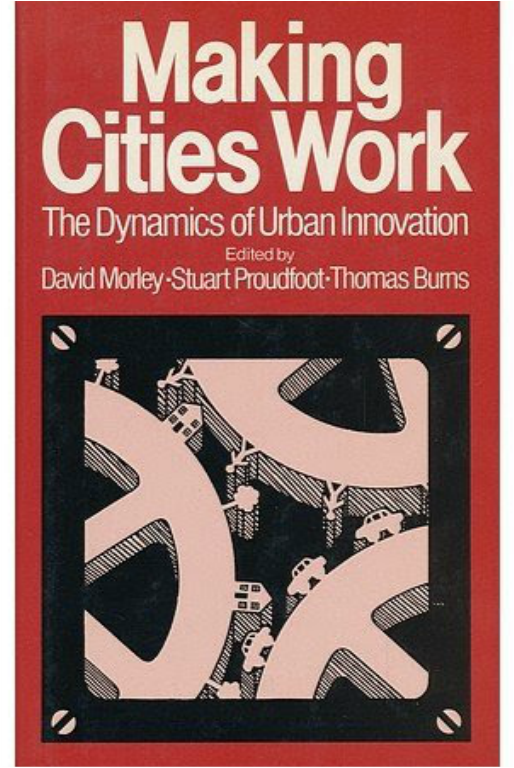 "Innovations involve imaginative leaps capable of carrying us beyond existing practice." - David Morley (1980) Today I have been reflecting on an old friend. So many prevention, policing and planning programs today seem like throwaway ideas in a sea of mediocrity. Few last long and even fewer work. Yet everyone has a shtick. Sadly most are just new gizmos and old ideas rehashed. As they say in Canada they are all stick and no puck. At a time when so many neighborhoods face the social turbulence that is crime and violence, where is the original thinking? Where is the creativity and wisdom? Long ago, when I began my graduate studies in planning, human ecology and environmental criminology, I met someone who taught and lived that kind of creativity. His wisdom changed my life. He is the friend I mentioned above and last week he died after a long bout with cancer. PROFESSOR DAVID MORLEY Professor David Morley was my supervisor at the Faculty of Environmental Studies at York University in Toronto. He was the smartest scholar I have known (I have known some greats). 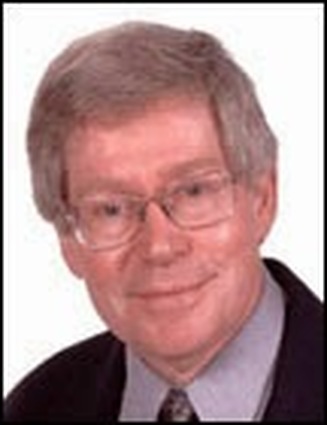 Professor David Morley Never shy of conceptual rigor, David was one of those who taught that an ounce of action is worth a ton of theories. His field was action research and action learning which included advanced methods of group collaboration and community participation, the very lifeblood of creativity. Thanks to David those methods are now embedded in SafeGrowth planning theory. He wrote profusely but for me his two best works were Making Cities Work: The Dynamics of Innovation (1980) and Planning in Turbulence (1986). ACTIVATING COMMUNITIES Both books are full of ideas on how to activate community groups and how to engage residents to change their own neighborhoods. There are no techno-fixes here - no CCTV, no anti-homeless spikes, and no burglary foggers. There is just hard work in community development. Today, thirty years after David co-wrote those books, we need those methods, and David's wisdom, more than ever. At a time when I had just decided to leave a career as a street cop, and I might have gone in many different directions to places of uncertain destination, David Morley gently and passionately taught me to think big, think important and, while riding the turbulent currents that carry us in life, never forget there are no spectators. Goodbye David and thank you for your gifts, guidance, and friendship.  "...perhaps only under the tension of threatening and uncertain environments are collective innovations likely." - David Morley, (1986)
0 Comments
 Montgomery's new book - Happy City - provides an antidote to dispersed cities During a hectic month of business travel with little time for blogging I read the recent book by Charles Montgomery, Happy City: Transforming Our Lives Through Urban Design. Montgomery says: "If we are to escape the effects of dispersal, then dense places have got to meet our psychological needs better than sprawl." That idea resonated during an afternoon walk in the prairie city of Brandon, Manitoba where I worked this week. Brandon is one of those mid-western cities with wide streets and sprawl suburbs. Yet even here I found an interesting (and dense) lower income multi-family townhouse project that Montgomery would appreciate. 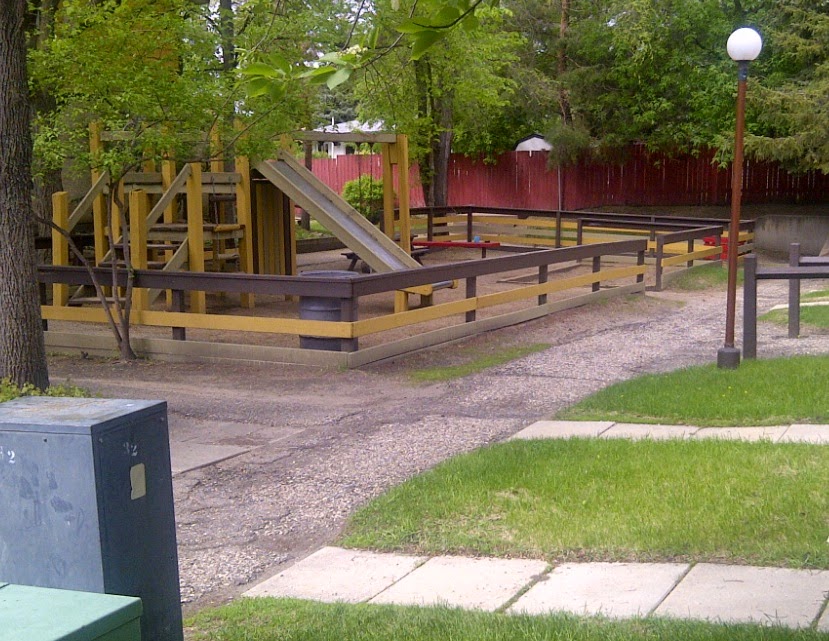 Play areas inside the lower income multi-family housing. Good visibility, easy access There is a tendency to think of low income, multi-family housing as crime-ridden. Yet this attractive, well designed multi-family complex had plenty of social mojo. Kids enjoyed a playground in clear view of nearby windows, walkways and grounds were clean, and dozens of people enjoyed their small front yards, barbecues, and common garden areas. 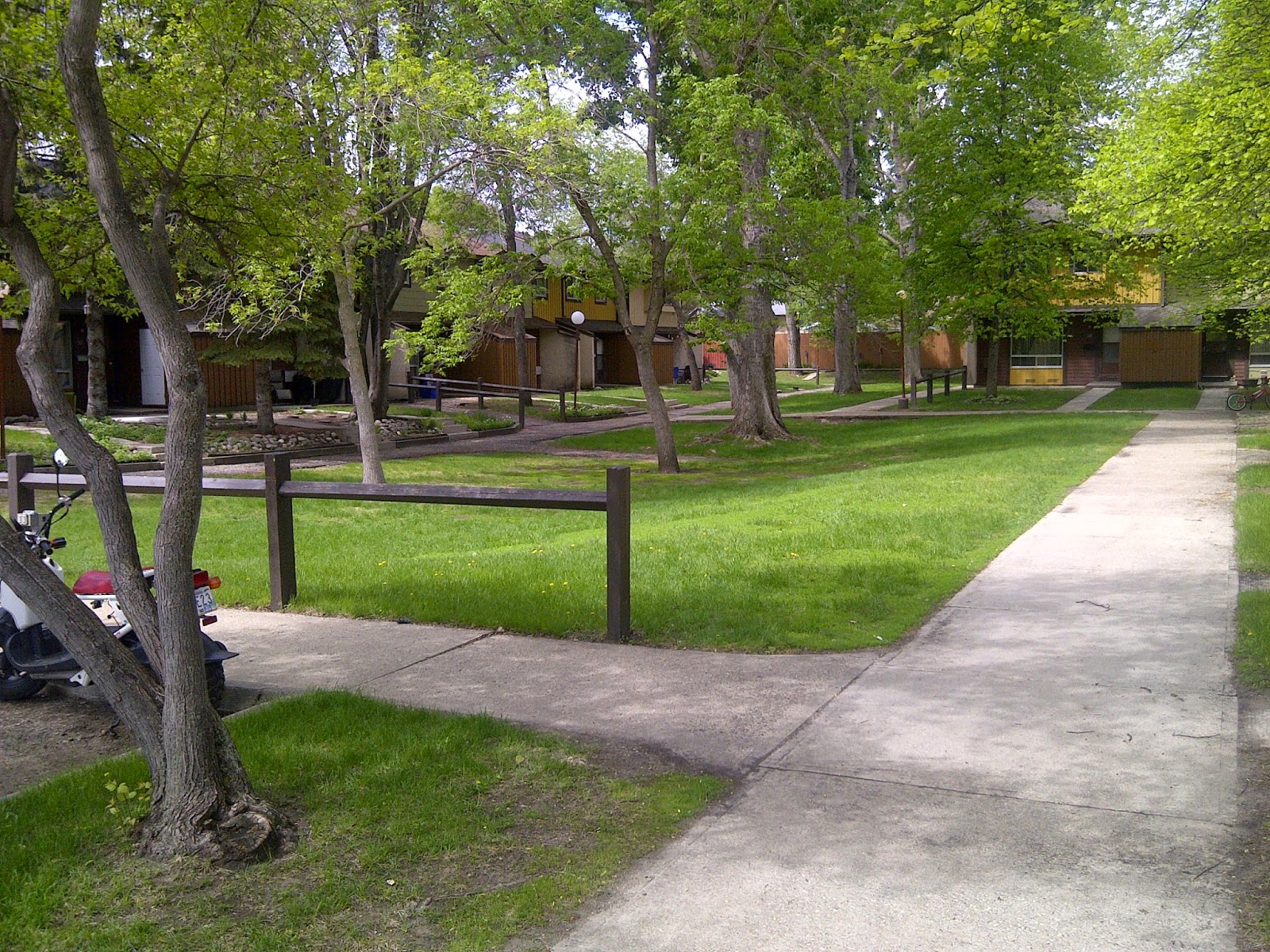 Interior courtyard, green and clean Police told me there were few calls for service here even though it housed 300 residents in a hundred units, very high density compared to the nearby sprawl. Nearby, as Montgomery might predict, a traditional suburb was vacant, graffitied, and sparse. In my hour-long walk there I uncovered only a few people, mostly working on cars. Few streets had sidewalks and I saw no one on their front lawns. 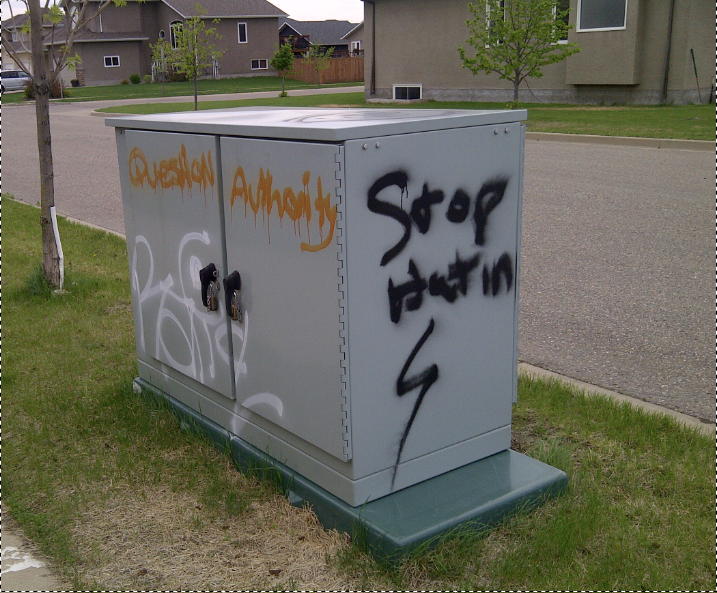 A few blocks away in a traditional suburb - Millennial messages The New York Times says about Happy City, "It was only a matter of time before someone figured out that if there were new things to say about happiness and a new interest in the evolution of urban life, the two subjects could be linked together." Montgomery has chapters on How to be Closer, Convivialities, and Redesigning for Freedom. They fit what I saw here. 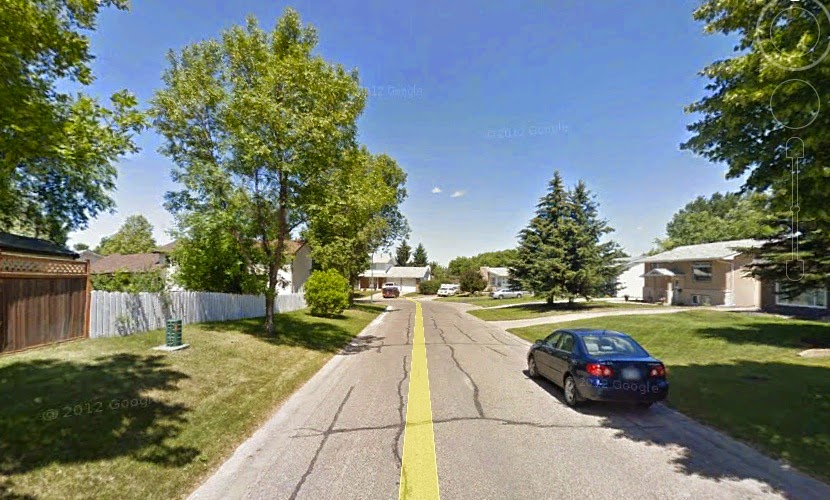 Adjacent streets - no sidewalks, fencing to isolate the road 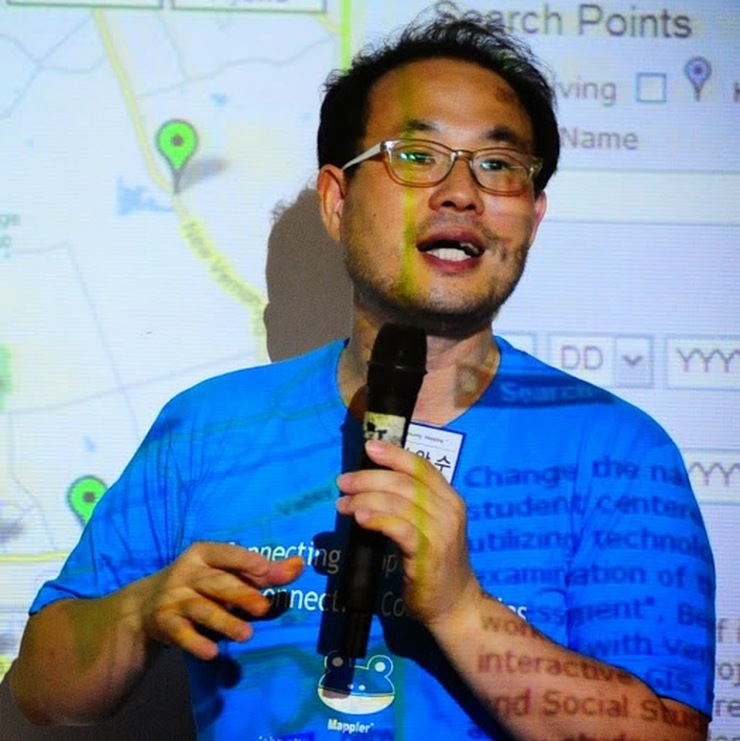 Community mapping guru, Dr. Wansoo Im My High Line Park post a few weeks ago happened because of my fascinating new friend and community mapping guru, Wansoo Im. He showed us High Line with the energy of an excited tourist, even though he is an area resident, adjunct professor in urban planning at Rutgers University and founder of inventive initiatives in community mapping. I discovered he brings that energy to his work everywhere. Wansoo is a pretty cool fellow. He has mapped safe routes to school for kids and helped residents use crowdsourcing to map potholes. Huffington Post describes how he got high school students to crowdmap emergency gas stations to help residents stranded during Hurricane Sandy. The New Yorker featured him using crowdsource mapping to solve the problem of finding public washrooms in New York. And now he's turning to community mapping of crime and fear. 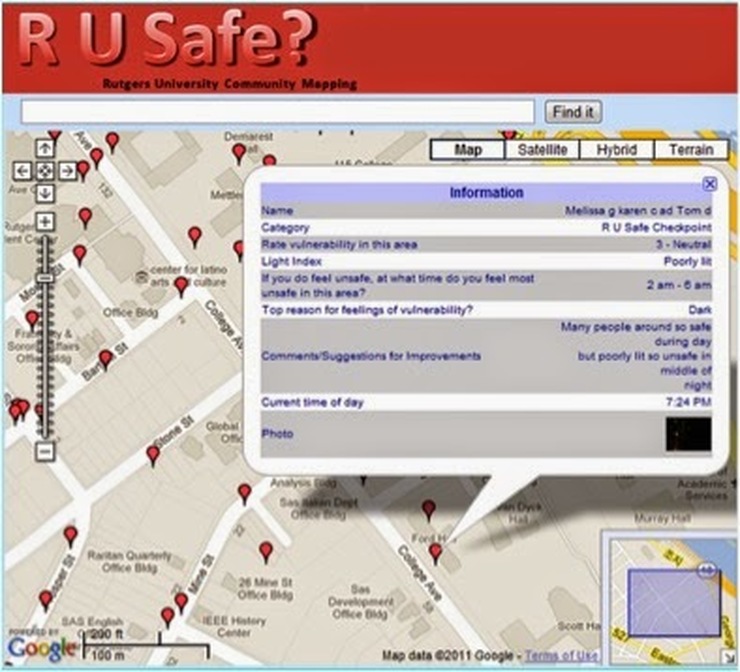 Mapping fear to diagnose community perceptions I met Wansoo at our New Jersey SafeGrowth training where he is testing his community mapping software called Mappler. It uses Google Earth and GPS and most importantly it doesn't rely on complex GIS mapping - the stuff crime analysts spend months mastering. And it's dead easy to use. Mappler technology works as a smart phone app. Our class was able to input Safety Audit fear data directly from their observations and view it in real-time on neighborhood maps. Pretty cool stuff. Community mapping may be the way to tap into engagement in a direct way. And for Millennials growing up as Internet natives it offers a new way they can use their considerable talents to solve community crime. 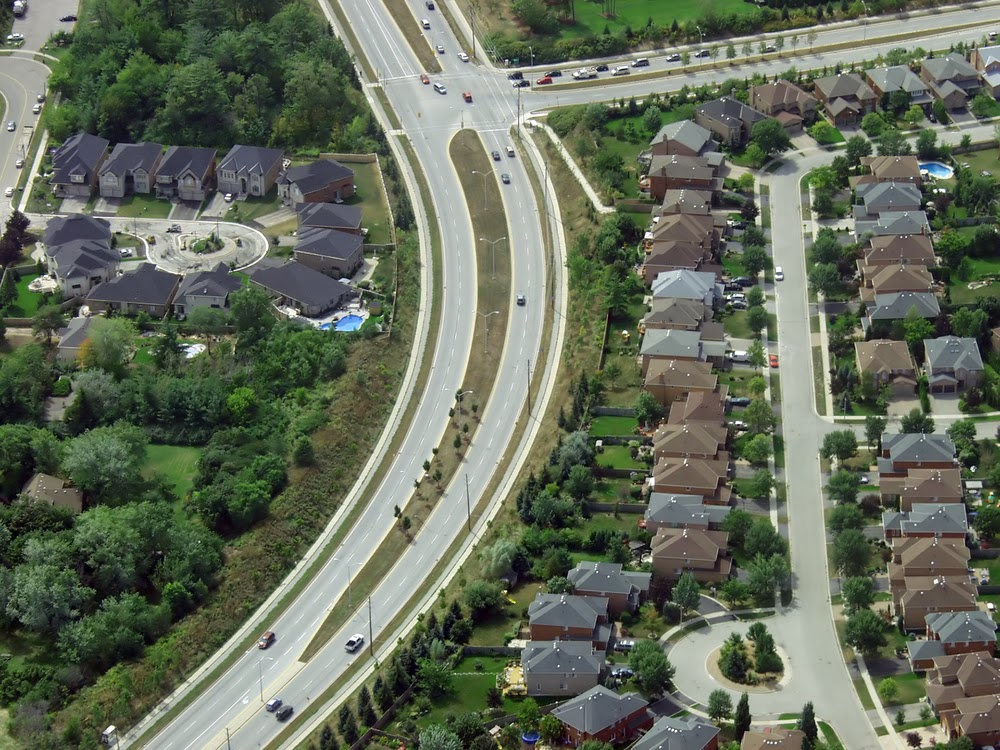 Road design and crime? A recent email from a planner friend asked about reconfiguring a roadway: "I am working on rightsizing a suburban arterial. There have been some assaults and break ins. There is some speculation as to whether converting it from 6 lanes wide setbacks to 4 lanes with buildings up to the street will change this dynamic" It made me think of other 6 lane, car-dominated cities. It also brought to mind some environmental criminology (EC) research supporting cul-de-sacs. The EC crowd is generally critical of New Urbanist designs for grid streets and increased neighborhood permeability. The New Urbanism version goes like this: If we narrow the streets and avoid wide boulevards to slow car traffic we will encourage a more walkable street. If we use grid designs versus cul de sacs we can better provide walkable locations for people, activate neighborhoods, and make them safer. The EC version goes like this: Grid layouts increase permeability and let more strangers through and that increases the risk of crime. That's why corner houses have more crime! Cul-de-sacs have less crime than grids for the same reason. Not exactly. Environmental criminology and burglary What most EC studies actually show isn't patterns of crime. They show patterns of burglary. In fact the preponderance of EC studies (at least in the early years) were on burglary and theft versus robbery, interpersonal violence, shootings, gangs or drug crime - the crimes people fear most. Still, EC's burglary-obsession should not detract from the point. Tantalizing answers emerge elsewhere; within the library of Problem Oriented Policing projects. The POP library lists hundreds of projects on a wide variety of crimes. They describe both physical place-based prevention combined with social prevention. In most cases it was not physical tactics - design-out-crime - that did the trick. It was the holistic ones that did, tactics that carefully considered context first and design impact second. 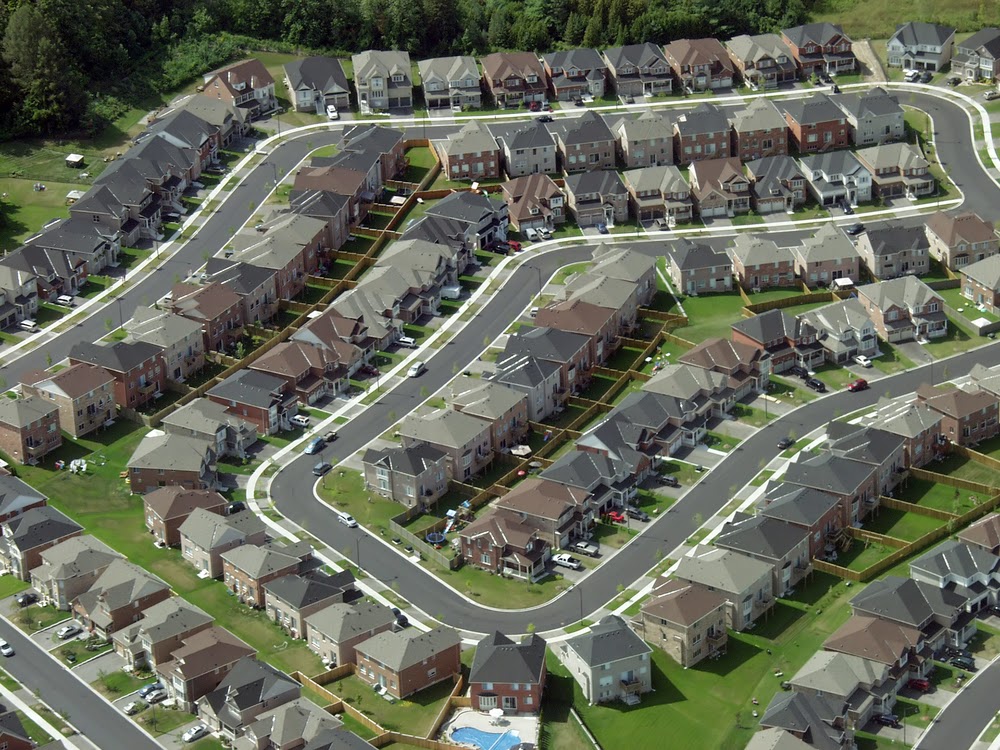 Curvilinear suburban road design - where do you walk? Interestingly, one EC reviewer says this about context: "Today, interior spaces within the home are dominant, and are commonly filled with electronic multimedia technologies and entertainment (also providing more opportunities for crime). The interior is now defined as the ‘leisure action space’ for both adults and children. This has led to exterior/public spaces being less used and this withdrawal has led to them being re-labeled and re-defined, often as ‘dangerous’ spaces." Exterior spaces less used and defined as dangerous? If ever there was ever a context for New Urbanism, there it is! Good design Good urban design should make exterior spaces less vacant, boring and unfriendly. It should create interesting walkable streets, places to go within walking distance, and a lively outdoors with ample social spaces for diverse people to socialize. Urban guru Enrico Penalosa, and former mayor of Bogota during its widely-acclaimed redevelopment, finishes the thought: "The most dynamic economies of the twentieth century produced the most miserable cities of all. I'm talking about the U.S. of course - Atlanta, Phoenix, Miami, cities totally dominated by private cars."  "The most miserable cities are dominated by cars" - Penalosa 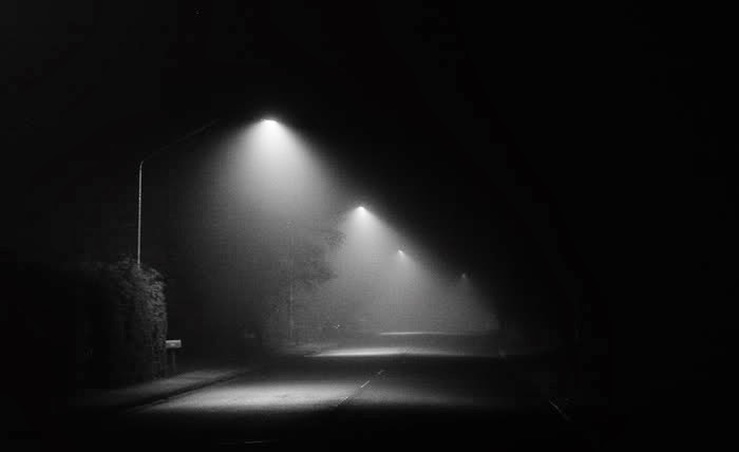 A half century after an infamous New York murder: Have we learned anything? It was 3AM and the short walk from the train station to her front door was lit by a few streetlights. There may have been music from radios escaping partly opened apartment windows. Some neighbors were still awake. She'd walked home from work on this route before and it probably seemed familiar and safe. It wasn't. Suddenly a stranger walking down the street chased and accosted her. Over the next half hour, newspapers later wrote, 38 people saw or heard her cry out as the murderer repeatedly stabbed, raped and then killed 28-year-old Kitty Genovese. This happened in 1964 only 3 years after, and 12 miles east, of where Jane Jacobs wrote about street safety in Death and Life of Great American Cities. This month two books commemorate the 50th anniversary of the tragedy: Kitty Genovese: A True Account of a Public Murder and Its Private Consequences and Kitty Genovese: The Murder, the Bystanders, and the Crime That Changed America. Few cases have spawned so many theories and books. I've blogged on this, particularly in relation to the CPTED concept, natural surveillance. Environmental psychology now calls it the bystander effect or the Genovese Syndrome. In short, if people can surveil an area but do nothing about crime, eyes on the street mean nothing. True, some offenders may still desist if they think they are being watched. But even this surveillance deterrence has limits. It won't apply to psychopaths, drug addicts, or the inebriated, a big list in the possible offender category. The latest research by Timothy Hart and Ternace Miethe examined the National Crime Victimization Survey (NCVS) and discovered a bystander was present in 65 percent of the violent victimizations reported in the survey. Environmental psychology research produces replicable results showing the by-stander effect. The fact is this: If most people do nothing, natural surveillance means nothing. Politicians look for the simple answer. Good Samaritan laws - forcing by-standers to act under penalty of law! Legal thinking often boggles the mind! In emergencies people don't think of penalty for inaction. They think of escape. Fortunately, there are better solutions. Since the 1980s we've known social cohesiveness increases the power of people-caring. Social cohesiveness, research confirms, increases the power of natural surveillance. Eyes that care take action. When people know each other, know their area, have a sense of connectedness and can clearly watch their neighborhood, natural surveillance works. In recent SafeGrowth classes we saw firsthand why pairing social cohesion strategies with natural surveillance is crucial. Students tell me that some 1st Generation CPTED instructors still fail to properly teach 2nd Generation CPTED. There is no excuse for ignoring these essential lessons. Read about the Kitty Genovese tragedy. Let’s not repeat history! Sir Leon Radzinowicz was a giant in criminology. Escaping from the Nazi’s in WW2, he founded the first-ever department of criminal science at Cambridge in 1941 and then the world famous Cambridge Institute of Criminology in 1959. He wrote some of the most influential works in criminology, spoke multiple languages and was knighted for his excellence in British criminology. In 1999, a year before he died, I watched one of his last lectures. He was formal, insightful and he spoke with such élan! He was remarkable! His topic: the increasing repressiveness in the justice systems around the world. That was before 911 security laws, exploding US prison populations and the ascendency of the combat cop over the community cop. Radzinowicz was a latter-day soothsayer. He nailed it! USELESS STUDIES I thought of Sir Leon this week regarding another trend he feared: the increasing paranoia by new scholars to publish simply to keep their jobs. In his last interview (below) Radzinowicz spoke of the then new publishing climate where studies provide little value and where statistics are overused and say nothing. Then I read a recent study about reassurance policing, an academic fad with UK academics regarding so-called signal crime, or how disorderly behavior disproportionately increases crime fears. Kind of a BBW…Brit-Broken-Windows. Their study examined how well mall shoppers identify cops and security guard uniforms from photos of cops and security guards. Their goal: find out whether different uniformed patrol officers patrolling in shopping malls created “different effects on feelings of safety about crime.” The results? Uniform police officers might foster anxiety among some members of the public because they suggest crime is a problem, basically what Wendy Sarkissian reported in her guest blog last year. But they also found uniformed police officers reassure other members of the public because they signal formal "guardianship" (I’m not making this up! Honest!) Sir Leon, please forgive us! I can just feel him cringing. ANOTHER WAY? How about we actually make the community safer and involve the community doing so? Maybe they can co-design their spaces with designers, co-manage the space with property managers, and take some defensible space ownership of their shopping venue! That way they would be safe and they would feel safe since they would have a hand in making it that way. It would be “reassurance policing” without so much formal “guardianship”, fancy uniforms and more useless studies! And then we can let Sir Leon rest in peace. Awhile back I wrote about the murder rate gap between BC and Washington State and listed a few theories to explain it: An aging crime-prone demographic; handgun availability. There was one theory I missed or, rather, ignored. The Wall Street Journal, however, didn't: "In medical triumph, homicides fall despite soaring gun violence". Murder is down, says WSJ, due to a buffet of medical morsels; better medicine, quicker paramedic responses, the spread of trauma centers. WSJ spares no marvel in the new buffet: doctoring skills brought back from the Afghan and Iraq wars; helicopters to ferry patients to emergency wards. A week ago CBC Ottawa joined the chorus. Apparently, says CBC Ottawa, murders are declining even though gun violence is up. For proof just look at jumps in attempted murder rates (I did). Those are the victims saved in the emergency wards by better medicine! As Star Trek engineer Mr. Scott says in another fantasy show, "It's a fine bit of reasoning, indeed!" Except it's wrong. The numbers don't add up to support the medical theory. Statistics Canada rates for murder and attempted murder follow similar paths. The theory suggests they shouldn't. Look at the patterns. 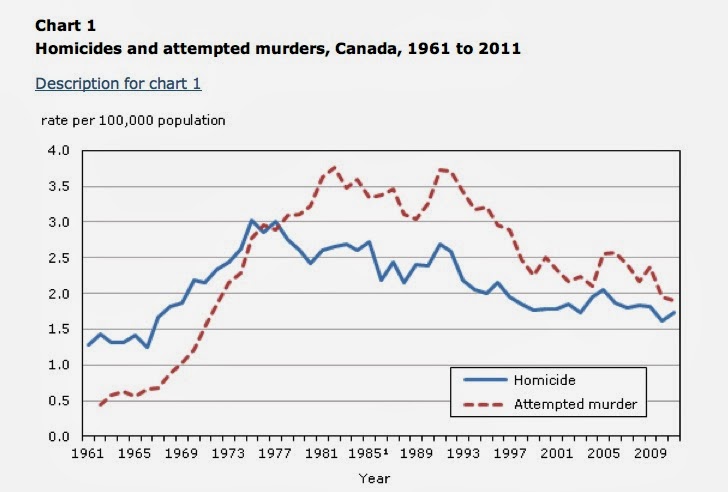 Source: Statistics Canada There might be something valid in 1975 when the rates crossed paths (but not accounted for in this theory about "recent" medical improvements). Afterwards, as one dips so does the other. If the medical theory was right the gap between murder and attempts should widen. It doesn't. In fact the gap actually narrows since the late 1990s. Is medicine cutting those murders but having no impact on attempts? Only if police are not recording attempted murder victims, perhaps hiding them somewhere else in the stats? That's unlikely and the data do not support it. I crunched the Ottawa crime stats to look a bit closer. Again, the data tell another story. Check out the chart. 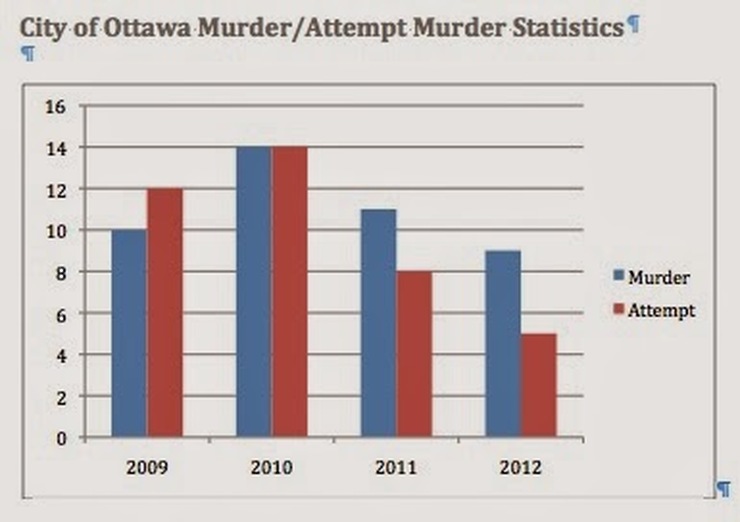 Ottawa murder and attempts decline together As murder drops so do attempts. Murders ebb but attempts don't flow as the theory predicts. There is something very rotten in the medical buffet. As the UNC School of Government blog concludes; "Medical progress, probably. Medical triumph, I doubt." Medicine has improved. Better doctors and technology is incredible. That's good news. As well, we have methods to cut crime; SafeGrowth, CPTED, Ceasefire, problem-oriented policing, neighborhood reinvestment. That's good news too. But confusing matters with unproven theories is neither scientific nor helpful. When will reporters and their editors start chasing facts and stop chasing slick headlines? No wonder the public is so ill-informed about policing, crime and its prevention. 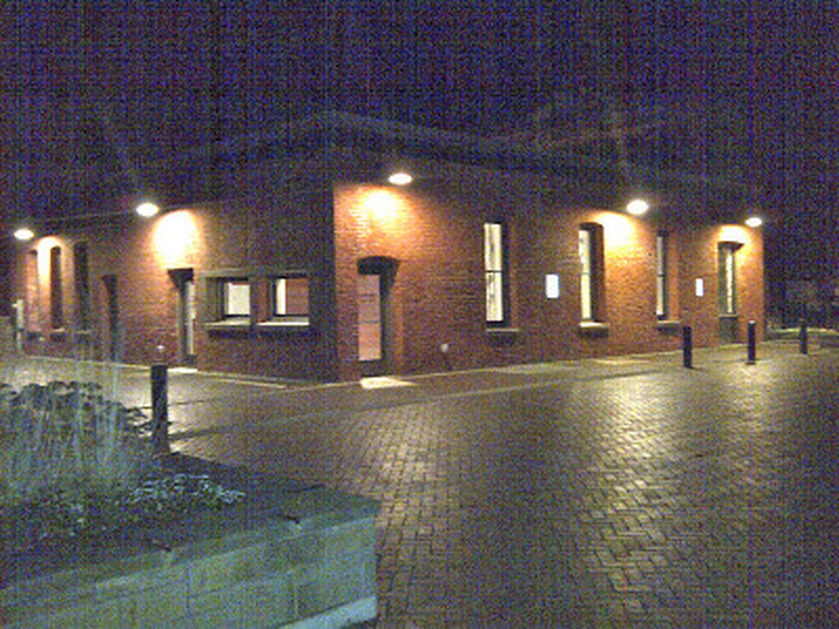 Our community center last night at the end of the street Since 1970 the light source of choice in most cities has been sodium vapor, those yellowish streetlights you see glowing everywhere. Sodiums are an efficient light source but many lighting engineers despise their color. According to one New York lighting designer "There is this negative subliminal response…the connotation is crime." Says another: "Yellow light muddies the colors of surrounding neighborhoods and makes people feel less secure because the colors around them are not true." In fact there is very little actual research showing any of that. Most research says nothing about light color, only light quantity. Regardless, it was only a matter time before a new lighting kid showed up on the block. In this case it was the LED - light emitting diode. For example Seattle, like most North American cities, is converting to more cost efficient LEDs. They might be more efficient but they they produce a harsh, sharp image on everything. A decade ago I was guest editor of a publication on lighting and CCTV. My thoughts then: If street lighting enhances architecture where pedestrians can appreciate the facades and details of downtown buildings, there may be problems lighting a downtown so bright it detracts from the aesthetics. Whenever I see downtown LEDs they remind me I was probably right. The photos in this blog demonstrate downtown sodium lighting. They show how well-placed sodiums provide adequate lighting and highlight the beautiful textures in downtown architecture. 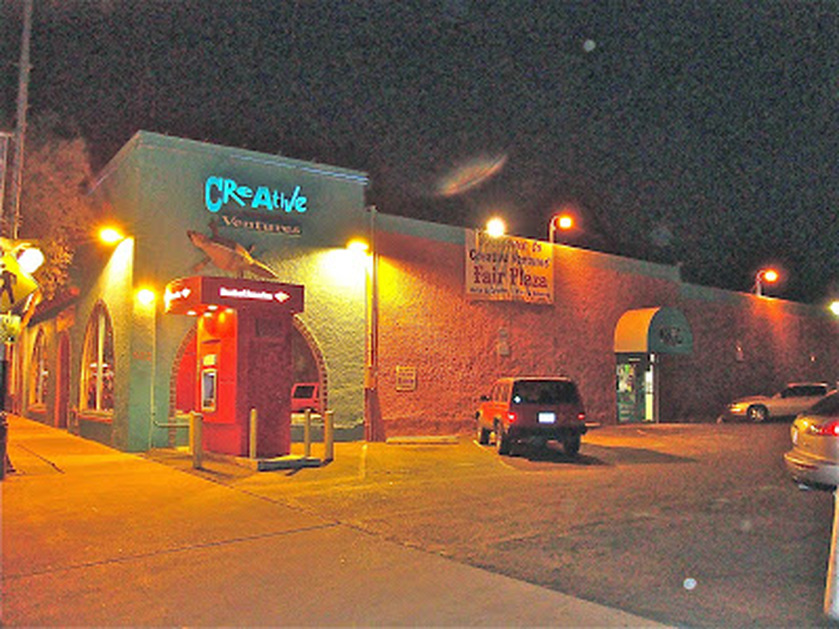 High risk facilities like automated bank machines can be well lit with sodium In none of these photos did sodium lighting detract from prevention or turn people off. There are no people in the photos because, at least in the photos I took, I had to wait for them to move aside in order to show the effect. Obviously, sodium lighting did not make them feel less secure. In fact, the opposite. We know very little about the impact of color on night time behavior, especially crime. And since no one is apparently paying attention to the crime and social impact of LEDs, I hope we don't learn, too late, that brighter isn't always better. The perfect way to start a new year is to take a big picture look at our future trajectory. For that, one book stands above all others - Steven Pinker's Better Angels of Our Nature. This summer I linked to a TED Talk by Pinker when I first described his work in my blog Rising above the swamp. I've just re-read Better Angels and it's terrific. Pinker shines a beam of analysis through the dark media images of "breaking news exclusives" and instant access to every hell-in-a-hand-basket story in every corner of the globe. In doing so he reveals that violence world-wide is on the decline. Contrary to media stories, things are getting better, not worse! Pinker is no slouch waxing eloquent. He is an award-winning, Harvard based, Canadian-born experimental and cognitive psychologist. Twice nominated for the Pulitzer Prize, Time Magazine named him one of the world's 100 most influential scientists. Peter Singer's review says it all: "The central thesis of “Better Angels” is that our era is less violent, less cruel and more peaceful than any previous period of human existence. The decline in violence holds for violence in the family, in neighborhoods, between tribes and between states. "  Pinker's book Better Angels of Our Nature reexamines the history of violence Enter the naysayers: Edward S. Herman and David Peterson's On The Alleged Decline of Violence. First they say Pinker ventures too far outside his field of expertise. Now there's an irony-drenched slam (Herman is a professor of finance and Peterson a journalist). Then they claim Pinker "completely ignores the kind of violence that is built into the structure of social relations and shows up…as unequal life chances…such as the savage global class war of the 1 percent against the other 99”. Wandering so blithely onto the thin ice of political polemics, I wonder how long it would take their "savage global class war" to crash through the frozen pond of cultural relativism upon witnessing the bloody genocidal slaughter of the Mongol invasions or a half million murdered during the Christian Inquisitions? Perhaps the long-term decline of violence will not persist. Perhaps war will break out over environmental collapse or an empty island in the East China Sea. There are plenty of problems to fix, especially the environment! And crime still persists. But I'm a bit weary of the cynical, sky-is-falling crowd…when it isn't. Stewart Brand says "It is sometimes fashionable to despise modernity. A more appropriate response is gratitude." I agree. A new year is upon us. Let's take a breath, appreciate our remarkable historical progress, and then reset our sights on our many remaining problems. Including crime. Happy New Year! 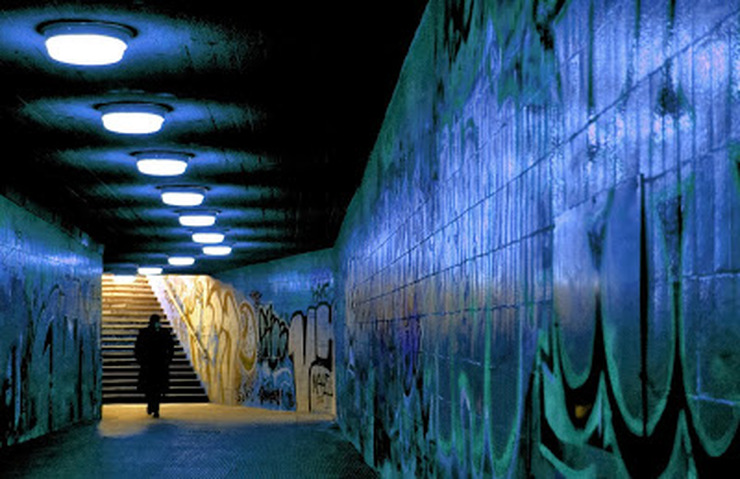 We still allow places of high crime risk. We can do better. Last week New Orleans mayor Mitch Landrieu announced early results from their homicide reduction program. Unknown at the conference, this creates a fantastic new opportunity. It all starts with the following hypothesis: Neighborhoods infused with SafeGrowth will help violence reduction strategies like Ceasefire to cut crime more effectively and longer than neighborhoods without. New Orleans homicide strategy includes the Chicago-style Interrupters, blight reduction and other SafeGrowth-like programs. It also includes David Kennedy's anti-gang violence program called Ceasefire. It's this latter program that caught my eye. 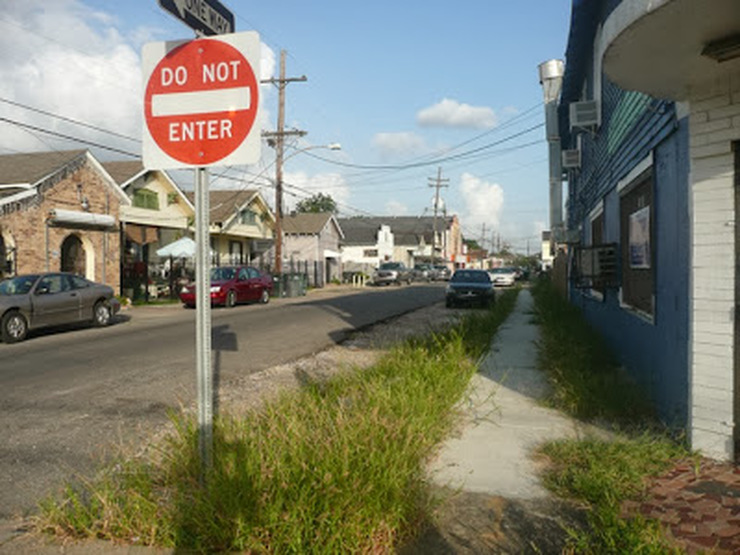 New Orleans' Hollygrove neighborhood - photo Megan Carr For years I've been a supporter of David Kennedy's Ceasefire. And David is still on the job in places like New York. Ceasefire tackles neighborhoods wracked by violence by calling-in gang members and giving them a choice between arrest and targeted sanction or job training, counseling, housing, and social help. The message to gang members: We care about you because you are part of our community, but the violence has to stop! As Mayor Landrieu said at the press conference, "the laws of engagement on the streets of New Orleans have changed." He credits Ceasefire with a big reduction in homicides. ALEADY IN HOLLYGROVE Here's the thing; New Orleans' Hollygrove neighborhood already had a huge decline in homicides when residents and AARP instituted SafeGrowth and other programs a few years ago. Murders declined from over 24 to less than 6 with no Ceasefire whatsoever. That's not to slam Ceasefire - it's a good program. True, there has been some criticism that Ceasefire doesn't work or just fizzles out. But now we have the perfect storm for a researcher, an ideal opportunity to test the hypotheses that SafeGrowth creates conditions for programs like Ceasefire to sustain lower homicide rates longer than in other neighborhoods! I gave up my own evaluation research years ago. Practitioner work takes too much time. But I always encourage researchers to dig in. This meets all the conditions for a natural experiment...a perfect holiday gift for an enterprising criminologist. It could help communities everywhere. Merry Christmas! 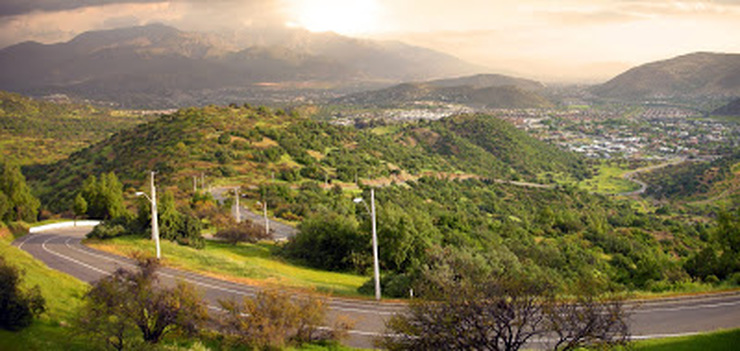 Santa Martina, Chile - Latin America contains a half billion residents and some of the most beautiful geography anywhere - photo Roberto Contreras Nowhere do lessons of urban safety, CPTED, and SafeGrowth apply more than to the half billion residents of Latin America. Amid one of the world's most dynamic and expanding regions, it has some of the most beautiful geography on the planet. It also contains three of the worlds most violent countries. In September, International CPTED Association vice-president Macarena Rau-Vargas gave an impassioned presentation at the (now global) Ted Talk in Buenos Aires, Argentina. Students of Latin American culture know very well the long list of social reformers who have worked and written about positive change in that region over the decades. Macarena is the latest in that impressive progeny. As her Ted Talk illustrates she is as imminently practical as she is unwavering, a fact she illustrates when she describes having a gun pointed at her head by a gang member. Macarena's Ted Talk video is below (english captioning is available on the menu). I have worked alongside, and been impressed by, Macarena for years. I am also lucky to call her a friend. Watch the Ted Talk and you'll see why.  Is more security cutting crime rates? I cautiously stepped into a glass chamber at a recent security trade show to test a unique anti-burglary device. At the simulated moment of alarm activation I was blasted by a non-toxic, non-staining fog blanketing the chamber. I could see nothing. It's supposed to scare off burglars who cannot see their way to the loot. Devices like burglar foggers supposedly contributed to crime declines. So I'm told. My last blog, Line on a Map, asked why the murder rate is so different in Washington State versus British Columbia (2.9 versus 1.5 per 100,000 - a ratio of 2:1). The answer to that is buried somewhere in falling crime rates; falling under liberal and conservative governments, falling in peacetime and war. Until recently, falling like a stone in all but a few places. Criminologists have multiple theories. Few agree. Some say it is better security devices like burglar fogging or just more private security generally. Unfortunately, while more security might explain some of that, the "better security devices" theory cannot explain declines in domestic violence, sexual assaults, and schoolyard bullying. Few of those victims are protected by better technical devices. Yet those rates too are also falling. MORE COPS, MORE PRISON Some say it is more police per capita, new policing tactics like Compstat, stop-and-frisk, or stricter prison sentences? During the 1990s, the first crime decline decade, those were American tactics. Canada had no changes in sentencing, no Compstat, no stop-and-frisk, and no more cops. Crime in Canada dropped just the same. OLD FOLKS Aging population? That works better than other theories since older populations span most countries with crime declines. Since young males dominate prisons and court dockets, when they decline as a proportion of the whole population, crime drops. So the theory goes. Yet none of that explains the Washington/BC gap until you factor that it is murder that is higher in Washington; property crime, especially burglary and theft, are not. HANDGUNS Then factor that most Washington murders involve handguns, in abundance in US cities and scarcer in Canada. True, crooks can always get guns on both sides and responsible gun owners don't leave their guns unsecured (gun rights folks…chill)! Still, there are just more handguns around. For example, when a burglar breaks into a Washington home with a 1 in 20 chance of finding a handgun versus a 1 in 500 chance in BC, that handgun gets into more abundant criminal circulation. It then shows up more frequently during robberies and assaults. More shootings result in a much higher murder ratio in Washington vs BC - in this case a ratio of 2:1. Gun advocates who think more guns will protect them are in a burglar fog. Look north for proof that they won't. Nothing - not demographics, per capita police, economics, nor security devices - explain that difference better than handgun availability. It truly is that straightforward. Solving it, sadly, isn't.  Seattle and Vancouver on the Pacific west coast - dueling cities Years ago a police chief told me he planned to hire a renowned criminologist to compare the murder rate in Vancouver to Seattle. He was tired of hearing Vancouver was so much safer. He knew there was a gang war in Vancouver and didn't believe the numbers. Both cities are similar in size, economic wealth, relative policing strength, and age demographics. They are only a 3 hour drive apart. A murder gap? No way. That criminologist never showed. Depending on whose version of the story you believe, either the data wasn't available, the criminologist wasn't available, or the study was done but unavailable for public view. I have a simpler explanation for the Vancouver-Is-Worse-Than-Seattle theory. It isn't! Nor is BC versus Washington State. British Columbia has a population of 4.6 million; Washington State 6.9 million. In 2012 BC suffered 71 murders (1.5 murders per 100,000 people) while Washington State suffered 203 murders (2.9 per 100,000, twice that of BC). On the U.S. side of the border lies majestic snow capped Mount Baker. The view is magnificent from both Vancouver and Seattle. For hundreds of miles beyond the border posts, BC and Washington are separated by only the 49th Parallel - nothing more than a line on a map.Yet if you view Mount Baker from the U.S. the stats suggest your risk of being murdered doubles. Why? Washington State has a history of innovative prevention programs. The Office of Crime Victims Advocacy and Community Mobilization Program (defunded next year due to cutbacks) are considerably more advanced than what BC offers by comparison. True, BC's CPTED is deeper (Washington lags considerably) and BC's Royal Canadian Mounted Police officers receive more advanced basic training called problem-based learning. But can that explain the homicide gap? Next blog: Why the difference  Today banks of fog rolled in one after the other formed by moist fall-time air blowing over cold ocean currents out in the Straight. Echoing through the quiet streets of our neighborhood, a maritime foghorn accompanied our walk through the mist, no doubt replacing the clop clop of horses hooves on cobblestones as Sherlock Holmes raced off to solve yet another murder mystery… At least that's the image our misty walk conjured in my mind. In all, it was a magical evening for a seaport town. Obviously none of this is possible unless walking is made easy, fun and safe. And walkability is not only important for activating streets and keeping crime in check, it's a very big deal for quality of life too. In Walkable City author Jeff Speck describes how some cities kill walkability. In such places fog is just a roadway hazard. Those cities rob their citizens of the interesting or necessary places to walk - a grocery, park, coffee shop, playground, or a corner store. We've seen plenty of micro examples on how to improve walkability: lifestyle malls, bright paint, better designed laneways, or planting strips along sidewalks. Speck reminds us there are macro lessons too. URBAN DENSITY To Speck urban density holds the key to a better quality of life. Low density cities breed less healthy people because they walk less and accumulate more health related ailments. For example, he says 14 people die for every 100,000 residents in low density Tulsa, Oklahoma. It's 23 in Orlando. But in high density cities like New York and Portland it is only 3. Crime doesn't correlate so neatly, yet the walkability links on the right of this blog show street activation makes a difference. Check out Jeff Speck and the Walkable City on this Ted Talk. 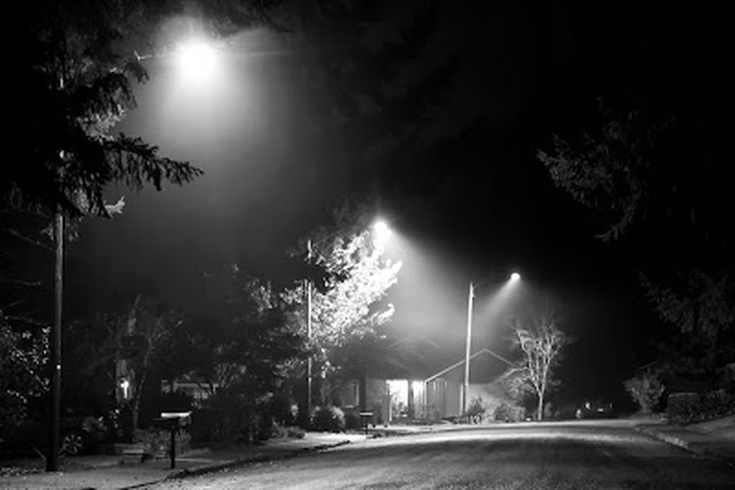 "It was a dark and foggy night in the neighborhood where nothing really happens…so there goes that drama". Caption from photographer Celine Chamberlin's photo There is a TV show worth seeing and a book worth reading. The TV show because it is excellent. The book because I think it's wrong but I also think it is excellent. It's an intelligent counterpoint to the depressing malaise in the US body politic, an aspirin to the headache that passed for Congressional politics this past week. Controversial author and professor in urban development, Joel Kotkin, uses the suburb to tell the story of America in 2050. The Next Hundred Million describes the suburbs of the future. To Kotkin they are a place of hope. Says Amazon: "Suburbia is the future, but not the wasteful lonely suburbia of the 1950s. Instead we must fashion a new kind of suburban landscape, one that selectively borrows the successful and vital elements of big city life and uses them to make more vibrant small cities." Maybe. But what will happen with the increasing number of suburban poor, spikes in suburban crime, and the class gentrification in American downtowns? A new TV show called Continuum points in another direction. This new cop thriller is a well-acted and brilliantly made Canadian sci-fi (with outstanding FX) filmed in Vancouver (Showcase network in Canada and the SyFy channel in the US and UK). The Continuum storyline pushes Occupy Wall Street, government shutdowns, and corporate greed to a very different place than Kotkin. Check them both out. Knowing different futures helps us choose more wisely. .jpg) Curtailing UK crime prevention funding - photo by IgnisFatus, Creative Commons GUEST BLOG Calvin Beckford is one of the founder members of the UKs Designing Out Crime Association. He joined the London Metropolitan Police Service in 1978. He was one of the UK representatives for a European project on good practice models of crime prevention across Europe. In 2005 he joined ACPO Secured by Design, a police initiative for designing out crime. He currently runs The Crime Prevention Website. **** The Metropolitan London police now employs 32 Crime Prevention Design Advisers, one per London Borough, and there are perhaps 6 or 7 'old fashioned' Crime Prevention Officers left. Crime prevention advice is now delivered by way of leaflet, website (including mine as they link to it) and by a visit from a Police Community Support Officer, who try their best, but are largely untrained. The economic depression, I think, simply speeded up the process of downsizing the police crime prevention service here, but I'm still not entirely sure why it's happened. My own experience seems to have been different from my contemporaries insomuch that I had tremendous support from my Commanders and essentially became one of the 'right-hand men'; especially in respect to partnership working with local authorities and other partners. THE ROT The rot really started during my 5 years working for ACPO's Secured by Design (2004 - 10). During that period most of our supportive senior commanders across the country began to retire and the ones coming up behind seemed to know next to nothing about the positive effects of CPTED or even good old fashioned Situational CP. Then the depression hit and then we had a change in government to a Conservative led coalition who don't like anything to stand in the way of making money. For example, in spite of our efforts and evidence that building secure (SBD) homes was profitable they only see SBD as an obstruction to house building and have been less than supportive. They got rid of a raft of planing guidance (which included our CP stuff) and I know that SBD are fighting a rear guard action to keep crime prevention on the agenda. DESIGN OUT CRIME While this was going on the Community Safety Departments at our Local Authorities have been stripped to the bone. When I worked in Camden in central London I had two planning officers assigned by the local authority to help me 'design out crime' across the Borough - we did a huge amount of work, which I know has prevented a lot of crime. These positions are long-gone. How can our government do this? Well they have the current luxury of falling crime figures, which I am sure has a lot to do with reduced opportunity, so this is the very moment they can do these things. These are difficult times.  Nobel-prize laureate Malala Yousufzai - Photo Creative Commons by Southbank Center This week I watched Malala Yousufzai speaking to the United Nations, the brave 16-year old Pakistani student whom the Taliban attempted to murder because she promoted education for girls. She is inspirational and, though a victim of violence, offers welcome respite from news of violence. Whether Islamist fanatics killing young Muslim girls or fundamentalist Christian ideologues attacking abortion clinics, Malala Yousufzai reminds us political nutcases will always surface. Tragic also is how they are sensationalized in the putrid swamp that passes for contemporary news reporting. That may be as much the fault the media as it is the fault of the extremists themselves. News reports of violence The same can be said for stories of murder, rape and violence that find their way into headlines. Is there validity to the claim that by airing such atrocities we raise alarm, show disgust, and shame local authorities into taking action? Does media attention allow us to hear the Yousufzai’s of the world? Perhaps. Putting aside for a moment recent blips in crime trends of a few cities, (possibly due to the Recession) new research suggests the trend for worldwide murder, mayhem and violence is actually on thedecrease. Yes, things are getting better (though you wouldn't know it from the media)! This according to a number of respected journalists who rise above the putrid smell of info-tainment, for example Joe Schlesinger’s recent article on CBC titled You do know, right, that the world is getting better? Steven Pinkers 2007 TED.com presentation “The Decline of Violence” Schleshinger cites Steven Pinker’s book, The Better Angels of Our Nature. Pinker reveals a dramatic decline in violence rates around the world. The Middle Ages - the so-called Dark Ages - were particularly brutal and violent says Pinker.
He should know. Ever since criminologist Ted Robert Gurr wrote the historical classic Rogues, Rebels and Reformers in the 1970s (showing the same downward trend from ancient times until the crime explosions in the 1960s), few historians have looked so exhaustively at the topic. Pinker has compiled the most comprehensive historical data on homicide to date. "Even for the 20th century as a whole, with its two world wars, revolutions, genocides and man-made famines, the violent death rate was down to 3 percent…a marked decline from the 15 and 10 percent rates that he documents for prehistoric times and the Middle Ages." It is left to Malala Yousufzai, a victim of violence, to show us that even in a swamp there are flowers. Social media = social cohesion? Today during the LISC sponsored Twin Cities SafeGrowth training we heard some terrific planning projects to enhance safety on the new light rail Transit Oriented Development in St. Paul. Among the presentations was an idea to incorporate social media and Facebook into one of the neighborhoods as a 2nd Generation community cohesion strategy. Cool. Then I came across this: The City 2.0 crowdsourcing project from the 2012 TED Prize. It's a new website with a platform to "surface the myriad stories and collective actions being taken by citizens around the world. We draw on the best of what is already being discovered by urban advocates and add grassroots movers and shakers into the mix." I especially found the City 2.0 Safety part of the website fascinating. It expands to show Gallup's new poll on quality of life conducted over the past 3 years and mapped with categories like nighttime safety, community satisfaction, and stress. The future is being written as we speak.  Walking and texting late at night in a Calgary alleyway - photo Randall Atlas Strolling downtown late at night after Calgary's ICA CPTED conference we came across this young woman walking by herself in an alleyway. What struck us was not how she was dressed or that she was alone or that the alley was well lit. What amazed us was that she texted the entire time as she walked down an isolated alley quite oblivious to her environment. It seemed risky. Then I thought about the Slutwalk phenomenon launched after the victim-blaming remarks by Toronto police constable during a 2011 crime prevention presentation. "I've been told I'm not supposed to say this – however, women should avoid dressing like sluts in order not to be victimized," the constable commented to a group of women at York University. He later apologized for his remarks but they led to city-wide (and later world-wide) annual Slutwalks. The phenomenon has been both lauded and criticized by others, including feminists. One motive for Slutwalks is the persistent and idiotic views on the topic. According to Huffington Post one Manitoba judge "condemned a rape survivor for wearing a tube top, no bra, high heels and makeup which he implied led her to sexual assault." The judge also implied "the assailant had succumbed to inviting circumstances." That thinking is absurd. It is also still alive and well. None of which changes the fact that mindless oblivion while texting late at night in an isolated alleyway is just not a good idea. Simulation of Saint Paul's new Transit Oriented Development light rail Few CPTED or community development types think about Global Warming or climate change when they do their craft. That is a mistake. Plan B tells us why. Plan B is an axiom in environmental studies meaning we cannot afford to wait before airborne carbon - a greenhouse gas - destroys our ability to sustain cities. Global Warming triggers food shortages, diminishing freshwater, extreme weather, and water and air pollution with all the associated illnesses like emphysema or cancer. Crime matters little if we cannot eat, drink, breathe or walk without fear of some threat to our mortality from the environment. In fact, desperation for those things might trigger more crime (as we saw in New Orleans during Katrina). Plan B suggests that doing nothing is suicide. Plan B recommends making changes to our urban growth and transportation habits like reducing car dependency. This means Smart Growth planning (after which Safe Growth is fashioned). Introducing: Transit Oriented Development. TODs are one type of Smart Growth and they may be our future. They connect mixed use high density residential and commercial land uses and then cluster them within a half mile of a transit node, usually light rail. This encourages easy access to transit use at all times of day, high quality pedestrian connections, and amenities like local grocery stores. That reduces car dependency, increases walking, and builds social connections. At least that’s the theory. The truth is that high urban densities, TODs and Smart Growth neither promotes nor prevents crime. The devil is in the details. Where do people walk and recreate? Do they have local opportunities to know each other as friendly neighbors? How does the design treat lighting and sightlines. And what about security and safety? 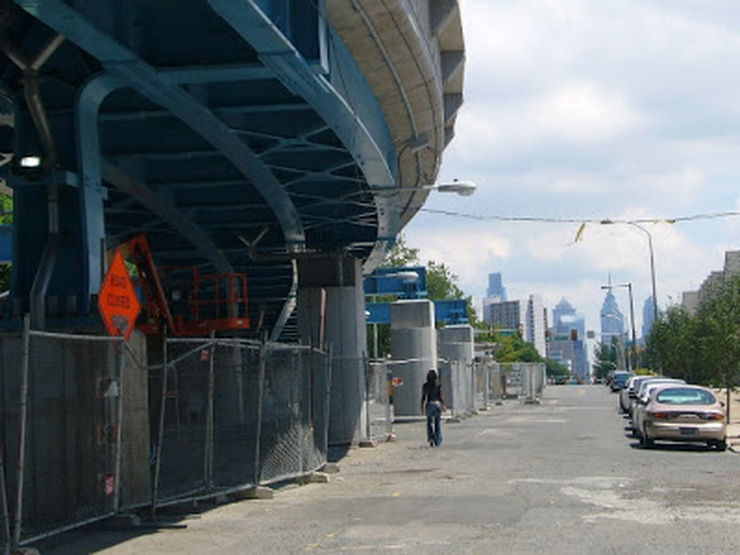 Unsafe or unsightly urban design will kill TODs - Photo Seth Budlick We’re running a SafeGrowth program in Saint Paul, Minnesota (shown in the simulation video above). Participants are working on SafeGrowth plans on that city’s first TOD development, a light rail in a city that does not have one. Safety and security on and near that line will determine the economic success of the system. Success in safety will increase transit ridership, decrease car ridership, and provide one more tiny step to save the planet and our children. A win-win. Not much pressure! Who said CPTED and SafeGrowth was simple? 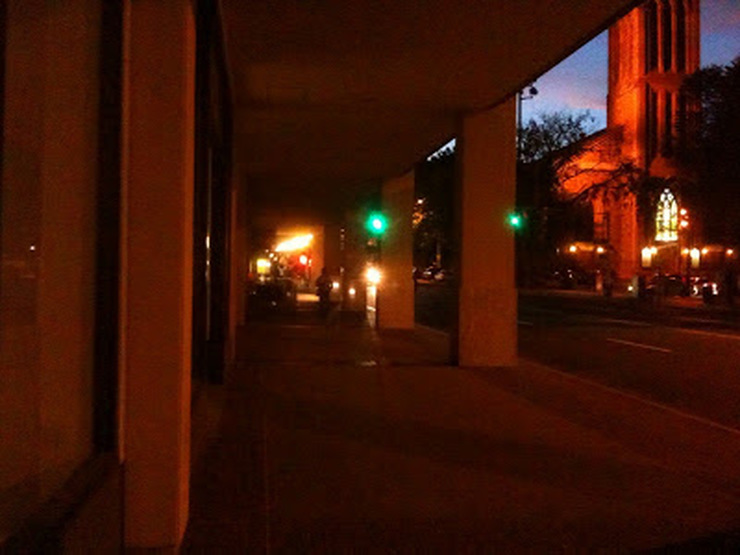 Newhallville lighting before changes - photo David Nyberg, Safe Streets Coalition GUEST BLOG I just received an interesting link to a recent article published on the website of the Federal Reserve Bank of Boston. It offers strong contrast to Wendy Sarkissian's experience in New Haven CT reported here last month. In this excerpt from their article, Julia Ryan and Andrea Pereira, community developers extraordinaire of the Local Initiative Support Corporation (LISC), offer a remarkable story of success in Newhallville after our SafeGrowth training. **** A collaborative approach to addressing crime can yield remarkable, sustained reductions in crime. It also can produce new housing, businesses, and parks in places where such investment was previously unthinkable, transforming troubled places into vibrant, connected communities. The strategy is quite straightforward. To tackle crime from multiple angles, you need a team and a plan, preferably one founded on solid information about the genesis of a problem and the conditions keeping it alive. As team members act on the plan, they need to hold each other accountable. NEWHALLVILLE TURNAROUND Historically, the Newhallville neighborhood has seen some of New Haven’s worst violence. In early 2011, four of the city’s 10 homicides occurred there. Local leaders recognize that the crime challenges stem from the interconnected problems of blight, fear, drug dealing, and gang activity, so they are pursuing an array of mutually reinforcing solutions. To guide their diagnosis of Newhallville’s problems, the New Haven team has drawn on training provided by international crime prevention expert Gregory Saville, with support from LISC. SafeGrowth champions a process by which neighborhood leaders, planners, police officers, and others work together to weigh how factors in the physical, social, and economic environment might be altered to make places safe and vibrant. As part of SafeGrowth, NHS team members have conducted multiple safety audits of problem spots. They have convened residents to talk about persistent issues and have invited input from a journalist familiar with the area. The information complements traditional crime data in painting a picture of problems, including hints at why crime in Newhallville has not yielded to prior interventions.  From website of NHS - Neighborhood Housing Society Using that framework, NHS and its partners are focusing on Lilac Street, a particularly troubled block. The team’s actions have already contributed to a 50 percent drop in crime by improving lighting and sight lines on Lilac Street. Recently members secured an agreement with the City to add another 230 lights—a sign of how well joint community-police plans are received by municipal decision makers. In addition, members are exploring new organizing strategies, including a neighborhood watch and walking groups that increase “eyes on the street” and on properties slated for NHS rehabilitation. New Haven Police are backing the effort with beat officers assigned to Newhallville. To those who might say that such approaches are too complex to be realistic in resource-strained times, LISC’s response is: Can we affordnot to leverage each other’s strengths, especially given the interconnected nature of safety and revitalization? This past week, following a police shooting, a civilized Sweden erupted into days of rioting from the immigrant suburbs of their capital city. In fact, streets are burning now as I write this. In 2005 this happened in the underprivileged immigrant suburb of Chichy, Paris. In 2011 it started in Tottenham, the immigrant suburbs of London following (yet again) a police shooting. In every case a police related death of a local resident sparked the riots. Is the European experiment unravelling when it's immigrant suburbs live such a fragile thread away from chaos. Is European immigration really that different from the US and Canada? Canada has immigration rates higher than European cities. Yet Canada's occasional hockey riots or student tuition protests seem petty by comparison and - forgive my petulance - more the stuff of privileged millennials. Recent Canadian First Nations native protests have far more legitimacy in my biased view (though native people are neither immigrants nor suburban). Richard Florida has been prophesizing about new urban geographies following the Great Recession - especially the suburban poor. I don't think he expected the explosion to start in Europe, and certainly not in peaceful Sweden.
The European conflagrations are not your typical Mayday riots spawned by rabble-rousing anarchist-communist radicals. Suburban immigrant riots, police shootings, and race issues are a very different thing. In so many ways it reminds me of the urban American riots during the turbulent 1960s, except this time it is suburban and immigrant-based. I wonder if suburban poverty and crime in North America will take us back to that future? If Boston proves anything it proves we need more CCTV, right? Yet police, CCTV, and the community working together caught the terrorists, not CCTV alone. We presume CCTV will cut crime and make things better. Crime might drop (which is good), but things don’t always get better. The CPTED 3-D method (I don't teach it) states the design of a place should reinforce its designated use so that "illegitimate" users are kept at bay. Yet Jane Jacobs wrote that, if given the chance, people make spaces work in their own unique ways. That is what makes them safe. Similar questions were posed a decade ago in Keith Hayward’s "Space, the final frontier: Criminology, the city and the spatial dynamics of exclusion." SPACE: THE FINAL FRONTIER Hayward threw down the gauntlet to the Criminology of Place crowd- situational crime prevention, environmental criminology and by association (not mine), CPTED. Unfortunately Hayward wrote in the gibberish of post-structural"Foucauldian" prose, an academic fad popular among a small group of academics in the UK and Canada. Tragically it delivers little to those preventing crime except unreadable text. That's a shame because Hayward has a brilliant mind with important things to say. He attacked theories of the then-emerging community of crime analysts and crime mappers. Today crime analysts populate every major police department. They desperately need this message.  Top down crime maps and CCTV can distract attention from what matters most One part of that message: Spatial patterns - robbery hotspots, burglary densities, crime displacements - miss the point. More accurately, they are such a small part of the point that they distract attention away from the keys to prevention - causes behind criminal behavior. SECOND GENERATION CPTED Hayward's corrective is theoretical: link the individual experience of victims, offenders, and other citizens with the urban, social and cultural facts that create conditions for crime. I think it is simpler. It’s the corrective Gerry Cleveland and I offered a decade earlier in Second Generation CPTED. Blogs on descriptive symbols and articles on Second Generation CPTED spell this out in detail. 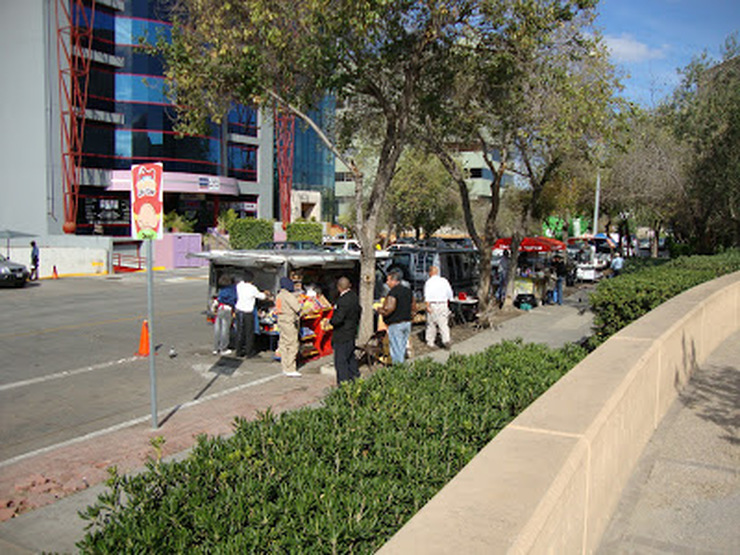 Street life in Tijuana, Mexico - center of a narco-war? Here are some starting places:
A friend of mine likes to quote T.S. Eliot: "We had the experience but missed the meaning." Let’s not miss the meaning of Boston. 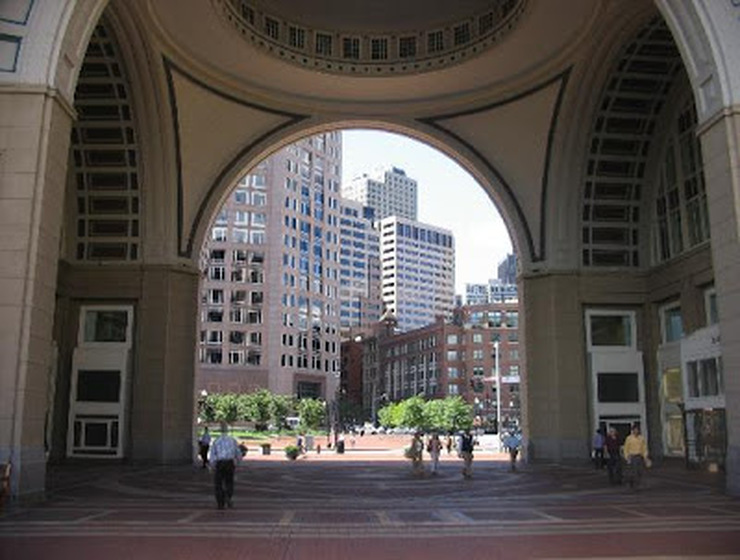 Downtown Boston Last week’s terror bombs in Boston were designed to cause fear. In this extended guest blog, social planner and ethicist Wendy Sarkissian describes recent walks in Boston and New Haven. Wendy discovers fear is not always what it seems. **** As we mourn for those killed and injured in the bombing at the Boston Marathon this week, it’s important to remember that good work is being done in Boston. Good crime-prevention work. As a woman, a CPTED practitioner and planner, I feel as though I have eyes in the back of my head. And what a contrast I experienced in the two universities of Harvard in Boston and Yale in New Haven, Connecticut - especially their urban contexts! In a month teaching at Harvard’s planning program I don't believe I saw police or security guards. They must have been there but I saw no obvious presence. I asked about the security of the projectors in the lobby of Gund Hall where I was teaching and was told that a security guard sits there at night. 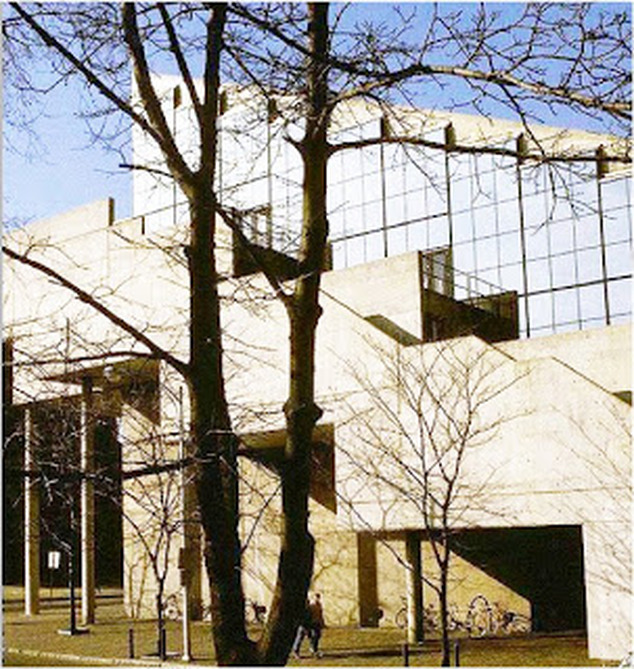 Harvard's Gund Hall school of design I did not see that person or sense that they were required. I often walked the 15-minute walk alone to Harvard Square at night -- as late as midnight -- and did not feel nervous or at risk. I also noticed the brilliant intervention, at the edge of Harvard Yard by the Science Center -- of a skating rink open til 9 pm Tuesday to Sunday -- with free skating classes and skate rental for $5. Harvard Skate, surrounded by tables and chairs, is open and free to all members of the Harvard community, their family members and the general public. ACTIVATING STREETS WITH SKATING The custom-made, 40-by-60-foot Harvard Skate rink in front of the Science Center was built atop the newly paved Science Center plaza, which is undergoing renovations. The installation represents the beginning of the plaza's transformation into a vibrant space that joins campus and community. It reminded me of the idea of putting a carwash in a parking garage. A brilliant Second-Generation CPTED intervention. 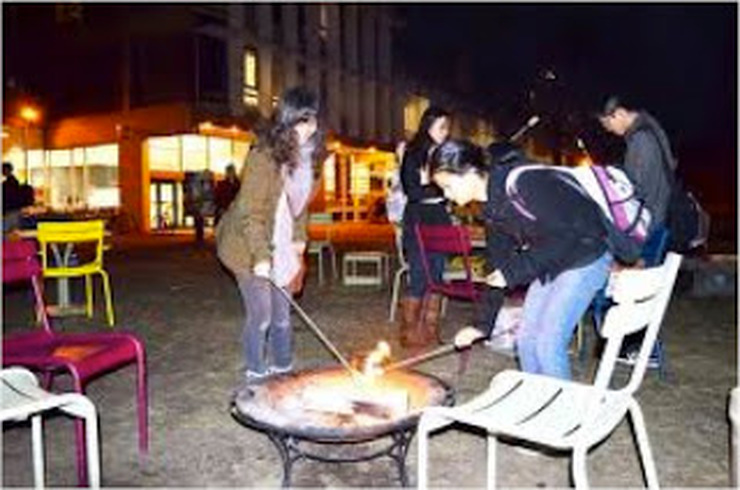 Free hot chocolate at skate rink In Cambridge and Boston, the buses, the trains and the stations were clean but did not seem to have a great amount of security. I felt safe and comfortable at all times, day and night, weekdays and weekends, travelling to and from the Harvard campus by public transit. By contrast, a day in New Haven had me powerfully frightened. I took the train from Boston and arrived mid-morning after a gorgeous trip through snow-covered New England countryside. I had not lived in New Haven since the mid-sixties, so it was a nostalgic journey. DRUGS AND FEAR? I was met - at the train station and throughout the downtown - by a strong odour of grass. As one might expect, there were a lot of unsavoury-looking characters hanging around the train station. They were also hanging around the downtown on a weekday (which I did not expect). They did not seem to be doing anything and, from what I could tell, were not dealing drugs. 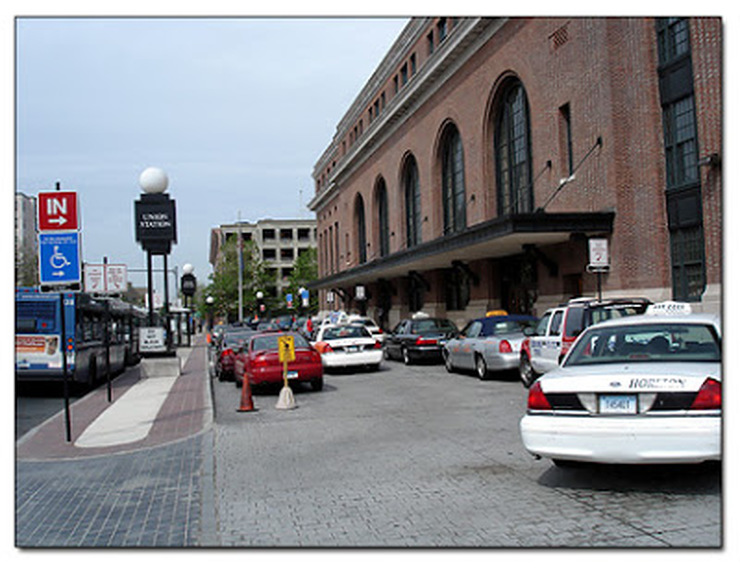 New Haven's Union Station The whole place smelled of grass and I felt uncomfortable. That is funny to say for a person who lives in the drug capital of Australia! I spent the day walking though residential areas where I had lived in the sixties and then working in the Yale Archives. I emerged from the library as it was getting dark and by 6:30 pm I was seeking a taxi to go to the best pizza parlour in the United States: New Haven’s Frank Pepe's Pizzeria, where I had enjoyed their signature pizzas in the sixties. I'd come 17,000 miles for my pizza and I wanted lots of time to savour it. 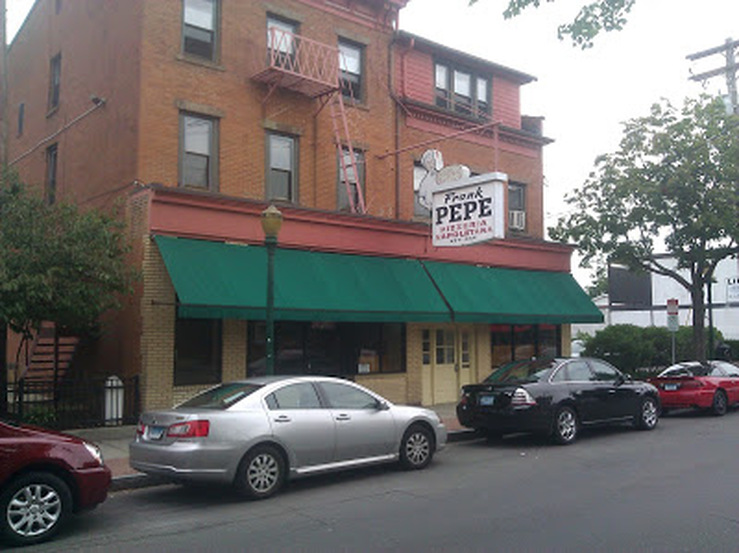 Pepe's Pizzaria, New Haven CT As I stood waiting for a taxi I found myself hailing vehicles with lights on the top, only to discover that they were either Yale University security vehicles or New Haven police cars. On every corner in the centre of the campus there seemed to be at least one, often two or more police and security personnel on foot or in vehicles. They were everywhere. That did not make me feel safe. Failing to find a taxi, I thought about walking (it was cold but not unbearably so) to a nearby urban neighbourhood with a few more restaurants, as I was on the edge of the Yale campus. But I thought better of taking a back route, fearing that perhaps all this security and police presence meant that the back streets (with fewer eyes on the street) might be dangerous.  Increased police numbers in New Haven - photo NBC News What was happening? Why so much security and police? Had there been a violent incident recently? A rape? As an older woman, I began to wonder. Would I find a taxi? Am I in danger in the middle of the city - in the middle of the campus? The pizza faded from my mind and fear crept in. At 6 pm on a week night in the centre of the city. What was going on? POLICE PRESENCE AND FEAR? These two experiences made me think about the messages that a strong police and security presence sends to a non-native. In New Haven, I knew the geography and could remember where things were. I identified landmarks and felt I had a reasonable cognitive map of the central area. In Cambridge, I had none of those advantages but was able to navigate the streets because the main routes were well-lit and well trafficked. Even late at night, there is lots of activity in Harvard Square. 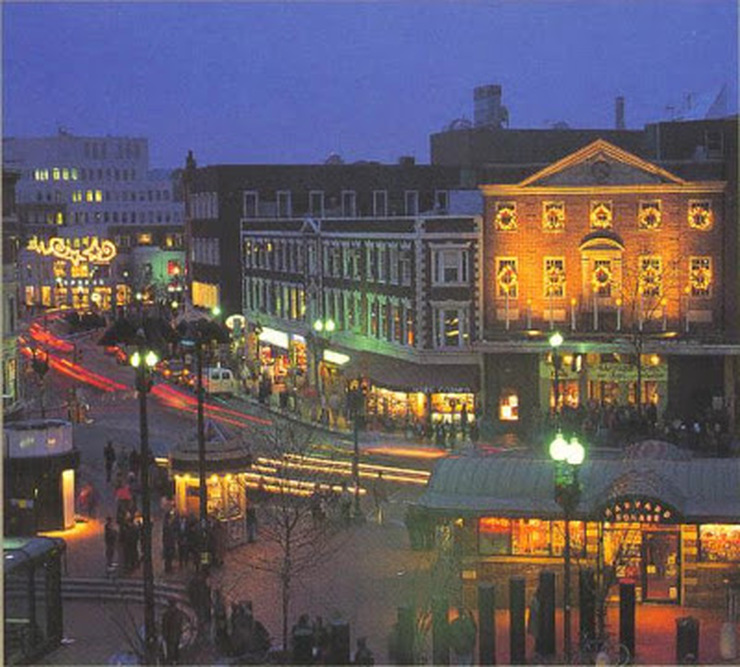 Night at Harvard Square A TALE OF TWO CAMPUSES Reflecting on my short visit to New Haven I feel that such an intense security and police presence sends a message that a place is unsafe. It did not make me feel safer; it heightened my sense of vulnerability. On the other hand, on the Harvard campus, aware of the inherent dangers of campuses generally for pedestrian safety, I was careful. I stayed on the beaten track and I kept my wits about me. I felt safe. Whatever is happening at Yale and in New Haven, it's not working! Not for me. Not for me as a non-native pedestrian. And at Harvard, whatever they are doing - subtle interventions and careful management - it is working well. Frank Pepe’s pizza – when a taxi finally materialized -- defied description. My pizza-loving self will never forget it. But it’s not just about the pizza My CPTED practitioner self will never forget the brilliant CPTED intervention of Harvard Skate on the plaza outside the Science Center. A tale of two campuses and two cities. And I can tell you which one I'd like to visit, alone at night, again. That quote above is by Robocop from the classic 1987 sci-fi by Paul Verhoven. I have written about the Pythonic thinking driving UK police privatization and the transformation of police culture from community cop to combat cop. Lately things have accelerated into an economic and social earthquake for policing. Am I the only one noticing? I don't see it in the press. The blabbering heads on Talk TV/Radio are too IQ-starved to notice. Then I thought of a story: In a not-too-distant dystopian future Gotham City faces financial ruin. The national economy is in shambles and municipal budgets to pay for skyrocketing costs of overtime, pensions, and medical expenses are gone. Represented by unions clinging to 19th century collective bargaining dogma, cops are being laid off in droves. Fears of crime cause thousands to hide behind the walls of gated communities and metal bars on windows. Their homes are prisons where they cower, too afraid to walk downtown at night. The police chief advises people to arm themselves. Sound like Robocop? Nope. It's us. Evidence? Proof #1: The municipal financial crisis trickling down from the Great Recession. Consider thousands of police layoffs in the US and police privatization in the UK. Consider how this whole mess heads north as the Canadian economy tanks. Proof #2: Police layoffs in; East Greenwich, NJ, Lansing, MI, Cleveland, OH, Cincinati, OH. Miami, FL, Los Angeles, CA, San Jose, CA, Proof #3: Across California the FBI reports over 4,000 officers werelaid off from 2008 - 2011. Proof #4: Increasing numbers of municipalities are in financial ruin such as Detroit, or claiming bankruptcy such as Stockton, CA. And now the latest aftershock; Due to police layoffs a Sheriff in Milwaukee is advising residents to purchase guns and take safety courses. Is it just me noticing this or has visionary leadership truly gone AWOL? |
CONTACTSafeGrowth.Office@gmail.com
|

SafeGrowth® 2007-2024
|
SafeGrowth® is a philosophy and theory of neighborhood safety planning for 21st Century.
|