SAFEGROWTH® BLOG
regular contributors
GREGORY SAVILLE · MATEJA MIHINJAC · ANNA BRASSARD
GREGORY SAVILLE · MATEJA MIHINJAC · ANNA BRASSARD
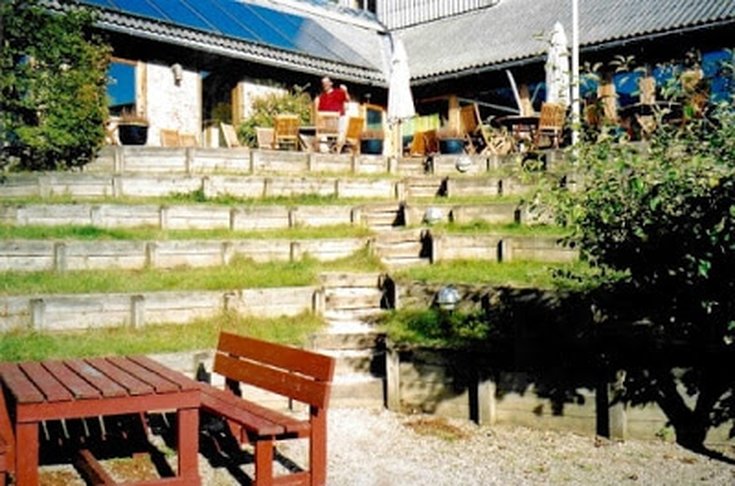 Common outdoor gathering area in Danish cohousing by Gregory Saville Fifteen years ago, I visited Skraplanet in Denmark, one of the world’s first cohousing communities and spent an afternoon with architect and founder, Jan Gudmand-Hoyer. In 1964 Hoyer gathered with friends to figure out how to purchase homes in the pricey Copenhagen real estate market. Home purchasing then – as today - offered few real choices of importance. Hoyer and friends discovered house architecture was boring and designed by someone else. Land developers already answered (or ignored) the critical questions of neighborhood living before residents even showed up:
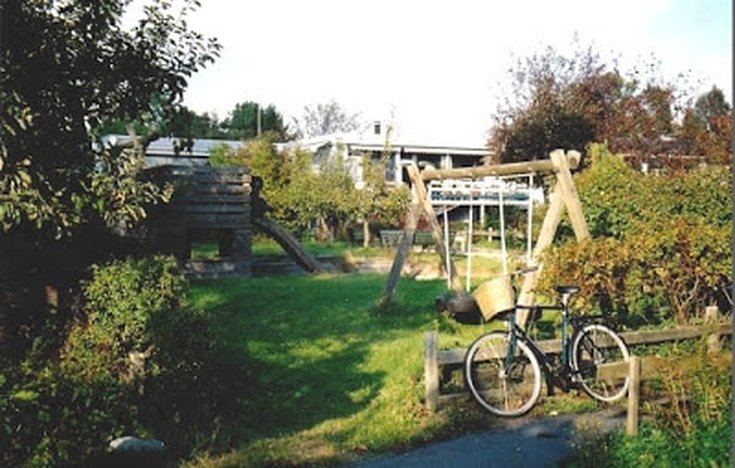 Children's play area designed by residents at Skraplanet cohousing Hoyer described this in his 1968 article The missing link between utopia and the dated one-family house. The result was cohousing – a new type of village, a style of intentional community in which residents form their own development company, hire their own builders, and create their own neighborhood. When cohousing migrated worldwide in the 1980s, it offered a unique form of equity housing and village living - usually within or nearby existing cities.  Private residence at Skraplanet with balcony and private gardens Ultimately, cohousing became a safer and more sustainable housing option. It has appeared here numerous times in An alternative future and Avoiding a wire-esque future. 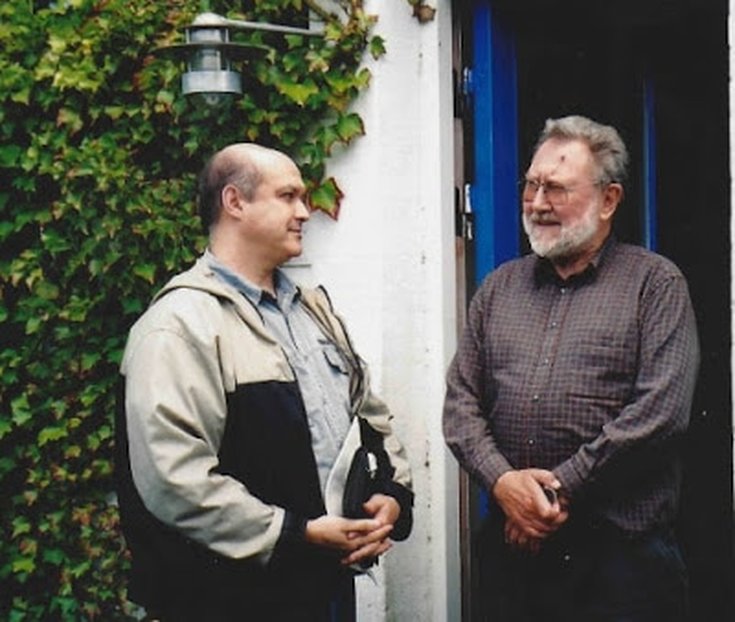 Posing with Jan before our tour at Skraplanet TOURING WITH THE MASTER Jan Gudmand-Hoyer taught me the nuances of cohousing planning. He proudly described some of the clever design techniques unique to this housing form. His community, Skraplanet, used modernism, an architectural style popular in the 1960s. At the time of my visit, the community was 20 years old and had found a green niche in the surrounding forest. Jan died yesterday at 81. He and his cohousing pioneers offered the world a new kind of village for the 21st Century. Thank you, Jan. May we live up to your dream!  Modernist design with plenty of window views and greenery
3 Comments
Bystander intervention videos help provide prevention guidelines by Tarah Hodgkinson There were six educated, relatively privileged, Canadian women sitting at that table. And yet not one of us was free from the experience, or the fear, of victimization, especially on university campuses. Last year I attended a Take Back the Night event with several women in downtown Vancouver. We took over the streets protesting women’s inequality and violence against women. A few of us gathered for dinner beforehand and began to discuss the issue of victimization and sexual assault. Soon the stories about each individual’s experience, the experience of her friends, her sisters, her cousins, her colleagues and other women came to light. I realized how many of my female counterparts had been sexually victimized in one way or another and how much of this seemed to happen in and around our undergraduate degrees. SCOPE OF THE PROBLEM Recently Mateja blogged here about safety and prevention in elementary schools. We also need to discuss sexual assaults occurring across North American college and university campuses every day. Until recently little attention has been paid to this issue. CBC News has tried to gather data on campus sexual assaults across Canada. They found that over 700 women had reported in the last few years, but this fails to acknowledge that more than 65% of women do not report sexual assault to officials. This is not surprising considering less than one percent of reported cases result in formal action. Several schools in Canada also reported no sexual assaults in spite of the fact that research indicates almost 40% of women over the age of 16 have experienced sexual assault. Comedic videos offer another way to humanize sex assault statistics Unlike the U.S., who has passed a federal law that all universities must report ALL crimes on campus, Canadian colleges and universities are not required to publish reported crimes like the number of sexual assaults. Several universities across Canada have surveyed students and drafted new sexual assault policies in the wake of recent high-profile cases. But far too little is being done on the prevention side. While some universities have developed poster campaigns or coffee cups messages to draw awareness to the issue, few seem to have any active prevention policies. Universities may claim that it is not their responsibility to address prevention and that the police or other agencies have that responsibility. However, the U.S. Department of Justice found that college-aged women (18-24 years of age) have the highest risk of sexual victimization of any group of women. PREVENTION Prevention can involve many things. Many argue that first we need to change rape culture and they are correct. However, these strategies will take time and in that time women are being victimized. Some steps are already occurring. At Western University in London, Ontario, there is a dedicated CPTED expert who reviews buildings and grounds for potential crime opportunities. In Quebec, Bishop's University requires sexual violence prevention training for all incoming first-year students. The University of Toronto also offers something similar. Several other universities across the country offer blue-light posts/poles in public areas that allow potential victims to hit a button and speak with security or notify them of their whereabouts. Others offer walk-home services, in which a male and female volunteer will walk a student home late at night. 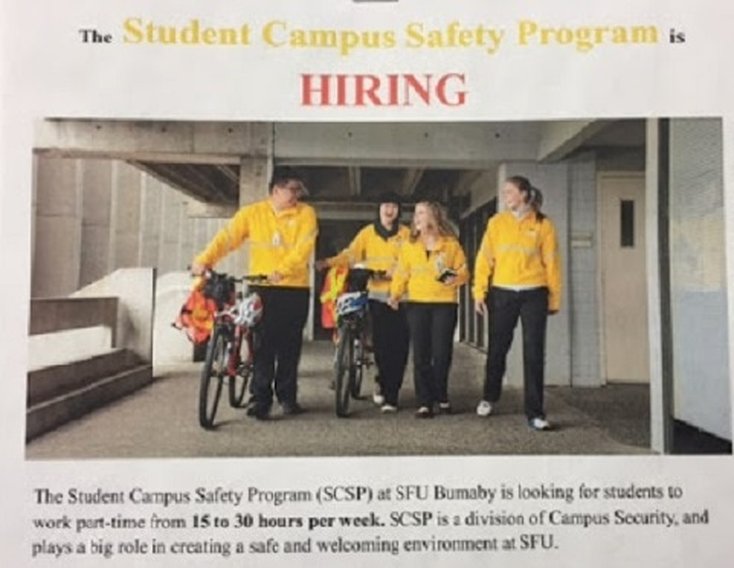 Campus student patrols - a fixture at many universities Some action has been taken, but these strategies are merely band-aid solutions. If universities are extensions of our neighborhoods, perhaps instead, we need to create places where this conversation can be expanded further? For example, on university campuses, many women’s centers exist, yet there are no centers for men. Many criticize men’s centers by claiming that all places are men’s places but these centers could be headed by trained feminist men, in partnership with women’s centers, who can encourage nonjudgmental and open conversations about proper consent, among other things. A non-university example of this kind of culture jamming center called the Dude's Club, already exists in Vancouver. This may be a better way to change the cultural narrative by creating a safe space to learn to act differently in public spaces. .JPG) Tokyo from the top of the SkyTree - World's largest city - photo by Yokalica (C) Creative Commons license by Greg Saville There is a remarkable story in today’s Guardian newspaper titled “How Japan has almost eradicated gun crime”. It says in 2014 Japan had “just six gun deaths compared to 33,599 in the US.” Six gun deaths? In the entire country of 130 million people? The US averages 10 gun deaths per 100,000 persons (both felonious and accidental). Canada is less than 2. The UK and Australia under 1. Japan's number is so low it doesn’t register! Ah, say the naysayers, that may be six gun deaths but you cannot compare the two countries! Raw population size alone accounts for the difference! Right? Nope. Both countries have large populations: Japan is the 10th most populous country and America the 3rd. At 130 million, Japan is just under half the US population of 325 million. Ah, say the naysayers, there are lots of other reasons why you can't compare. Let's consider them... POVERTY? Does the US have more poverty? Nope! The US reports its relative poverty rate at 13.5%. Japan posts its relative poverty rate at 16%. CULTURAL DIVERSITY? America is far more diverse and Japan is far more culturally homogenous. True, that probably leads to shared social attitudes about non-violence in Japan. But it is a fact that most of American urban violence is not between different racial groups but rather within them (a truism ignored by fact-free politicians). HISTORY? Perhaps American history, with a civil war and multiple overseas wars, fuels a culture of violence? Nope, Japan isn't that different! Consider Japanese militarism following the Meiji Restoration, the Sino-Japanese wars, the Russian-Japanese War, and of course WW2. URBANIZATION? Perhaps there are more frustrated people who live in dense American cities and that drives them to crime (the US is 81% urban)? Nope! Japan is 78% urban and the world’s largest city - Tokyo - is one of the densest and most urban in the world. It is also among the safest. SECURITY TECHNOLOGY? The latest in criminology is to explain global crime declines via increases in security technology, DNA fingerprints, predictive policing, CCTV computer algorithms, etc. Nope, that doesn't work either. DNA fingerprinting works after a crime, not before. It might get a chronic offender off the streets. But given DNAs investigative scarcity around the world, claiming it accounts for crime declines stretches the logic gap to Grand Canyon proportion. Predictive policing has not been around long enough to register on statistical radar screens. And CCTV? Every time I turn on the nightly news I watch an "exclusive report" of a robbery "caught on tape"? If CCTV is so great cutting crime, why do gun robberies keep showing up on the nightly news? Obviously, research on CCTV effectiveness is spotty. Security tech isn’t the answer. GANGS and GUNS  John Hancock Observatory Night View Chicago had over 700 homicides in 2016 - photo by Allen McGregor (C), Creative Commons license Stats are hard to come by, but rough estimates suggest there are 1.4 million gang members in the US and 100,000 Yakuza in Japan. That’s a whopping difference of .4 to .07 percent of each country’s population respectively (almost 6 times as many criminal gang members per capita in the US). The gang theory makes some sense since Yakuza are not only fewer in number but far more disciplined that their US counterparts. But the obvious explanatory elephant in this room is simple. Guns! CARNAGE IN FLORIDA, AGAIN After years of blogging about mass murder, guns and gangs in places like Orlando, Connecticut, Los Angeles, and too many others, I’m not going to harp on gun control or the long-proven crime causation theory behind it. For clear thinkers, it is study-laden and it is obvious. It is also a theory well understood in places like Canada, Australia and especially Japan. So the American carnage continues. Yesterday there was yet another mass shooting on US soil by a madman triggered by “voices” (said the FBI). This latest mass murder was a lone gunman at the Fort Lauderdale airport and in 80 seconds he shot and killed 5 and injured 11. That is more than all those killed by guns in Japan for an entire year. Six.  Dawn or dusk in 2017? We’re told it’s been a terrible year. Proof: The Force left Princess Leia! The death of the Princess, or rather Carrie Fisher’s passing four days ago, was one of many sad events in 2016 that might easily get lost in the cacophony of civil wars in Afghanistan, Iraq, and Syria, political unrest, and environmental decline. Against that backdrop our fictional Leia was a symbol of hope against evil and bedlam - just the kind of dystopian pap we’re fed by the popular media and the pundits who feed on it. The truth (uncomfortable as it is with simplistic drivel) is more nuanced, at least from a crime perspective. In fact, in much of the developed world, this year was unexceptional for crime. Except for an explosion of gang violence in Chicago, crime continued its decades-long decline. There was a slight uptick in a few cities this year (Boston had 46 murders this year compared to 40 last year), possibly a symptom of cartel-fuelled opiates and heroin on city streets. Still, most cities reported stable or lower crime rates. MOST CRIME IS DOWN New York City had 4% fewer homicides, putting the lie to the idea that crime is rising due to the Ferguson Effect. In fact, New York's 330 murders this year are pale compared to 2,260 in 1990. 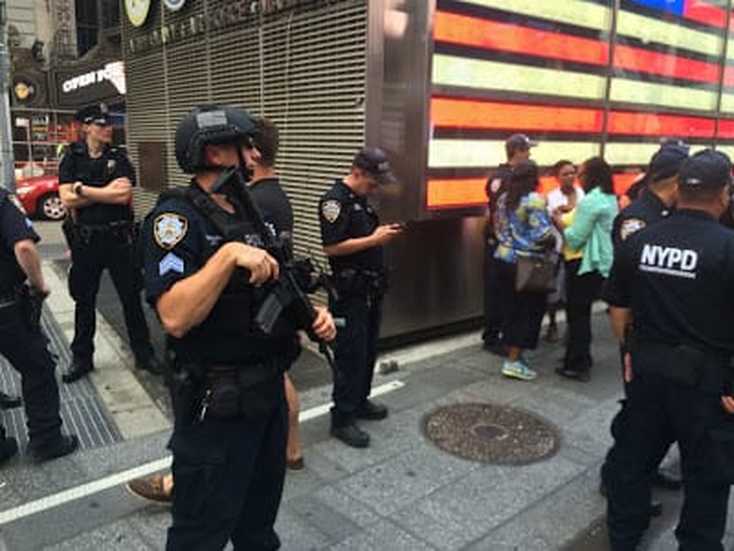 NYPD anti-terror officers - the new reality of police departments in 2017 Murders in Montreal declined to 19 this year while (as in the US) a few Canadian cities did have slight crime blips. Yet on whole the 2016 crime story is uneventful. So what of the headline bedlam? Maybe it’s the global story that bleeds? Nope. It is true that narco-crime continues to torture too many places, especially Central America. But consider the UN Millenium Development Project. Over the past decade project success is staggering:
Ill-informed politicians tout the mantra of gloom and social doom but they are not the brightest lightsabers in the galaxy. Others conceal their own agenda but don’t be fooled! 2016 has seen tragedy, yet there are great things underway. With condolences to our beloved Princess, the Force of positive change is with us if we choose it. Here’s to 2017. Happy New Year!  Removing external threats does not remove internal threats by Mateja Mihinjac In The Republic, Plato asserted it is absurd “a guardian should need a guardian”. Five Centuries later the Roman poet Juvenal rejected this and claimed guardians do not always behave ethically and should not be trusted. Incidents of child sexual abuse by school personnel, estimated in some studies between 3.7% to 4.1% (almost 1 in 20), suggest that Juvenal may be right. While increased focus has been placed on external threats such as school shootings, children remain largely defenseless from internal threats of sexual abuse by staff. I was recently tasked with investigating whether child-safe schools can be designed to prevent child abuse by school staff. This led me to dig deep into the literature, while remaining skeptical the solution to this social problem was physical modification.  Too often internal threats are hidden and remain a secret The first step required understanding the contextual factors leading to abuse. Some of the findings revealed:
Exacerbating the problem is inadequate legislation, unsatisfactory institutional policies and procedures, inadequate awareness, institutional blindness, and inability to centre strategies on child welfare. All that leaves children vulnerable to abuse by those who should be protecting them. PREVENTION The second step was research into preventive strategies, revealing the problem needs a holistic multi-level approach. These include:
 Schools must offer safe environments for study and play Design Out Crime strategies proved ineffective for addressing the intricate problem of institutional child sexual abuse. Instead, responses should embed child safety at individual, organizational and systemic levels while also giving children a voice in the matters affecting them. As Juvenal might suggest, trusting guardians is not simple and responsibility for preventing child abuse falls to wider society at all levels including neighborhoods, parents, and schools. 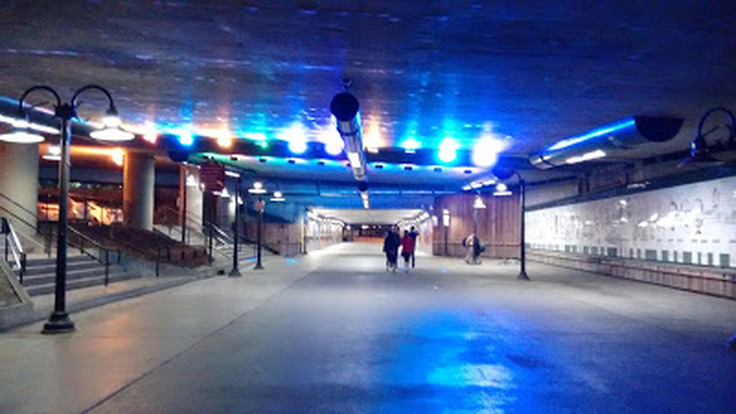 Who will keep watch in isolated places? I have been pondering the security technology encroachments into public life, particularly regarding CCTV monitoring. There was a time, it seems now very long ago, that the UK was awash in CCTV. Hundreds of millions of dollars, and over four million (and counting) CCTV cameras later, the UK is the most surveilled society on earth. We were assured that would never happen in the US, or other developed countries. Violate our civil rights? No way cried the libertarian and democratic pundits in unison. Still, if you have nothing to hide… Today, London and Beijing have over 400,000 CCTV each (proving politics is no guarantee either way). In the US there are over 30 million CCTV cameras, mostly in private hands. But there are now CCTV on streets in every major US city (Houston and Chicago lead the way with over 14,000 in Chicago alone) and public support is growing.  Will the brain behind the camera soon be an intelligent computer? APPLAUDING OR BOOING? On one hand, we applaud when police apprehend the Boston terrorists due in large measure to public CCTV. We also later watched those same terrorists as they planted and exploded the devices - prevention was not a result of those cameras. I always applaud traffic intersection CCTV to cut car crashes, especially in my city where drivers spend more time in narcissistic self-obsession beating the red light rather than watching where they are going. 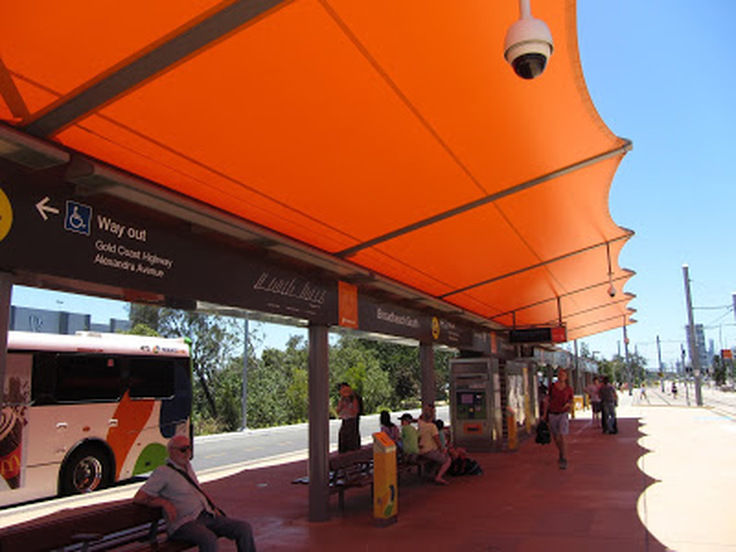 CCTV in public spaces is not new THE NEW REALITY Recently I’ve been reviewing the latest in CCTV analytics, intelligent tracking and real-time scene analysis - CCTV on steroids. The thing is no longer motion detection or auto tracking (so old school). The latest is intelligent video analytics, a major evolution from facial recognition software in yesteryear. Video analytics is made possible by exponential increases in processing power and so-called ‘intelligent’ algorithms. And now it is part of security and public safety, watching for suspicious movements, packages, behaviors. Watching you! How does the computer know what to look for? It uses algorithms based on past behavior. In future, it may use artificial intelligence to learn on its own. And that is where things get interesting. Wired magazine puts it this way: “voice, image, and motion recognition will transform human-computer interfaces into a seamless interaction between the user and all the computing devices in that person’s life.” A few years ago I blogged about economic theorist Jeremy Rifkin, his forecasts, the Internet of Things and his predictions for disruptive technologies. It seems he was right. Should we be worried? - Gregory Saville 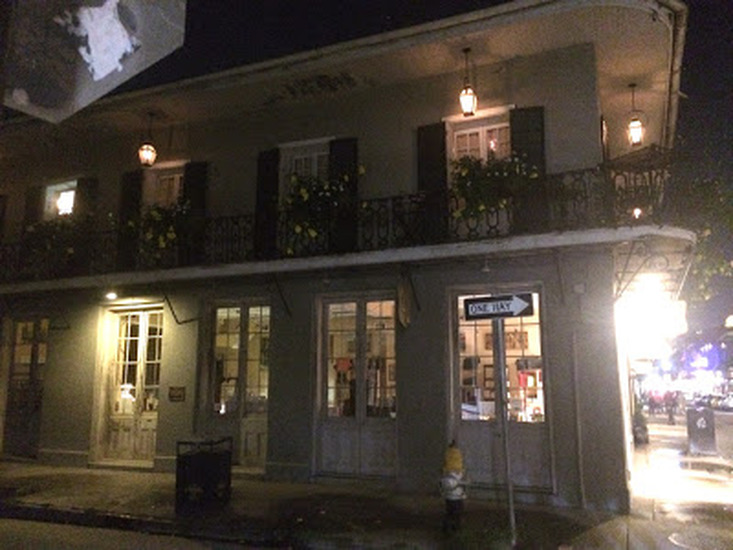 Search Conference participants enjoyed the French Quarter after sessions GUEST BLOG - TARAH HODGKINSON Tarah is a senior researcher in the Integrated Risk Assessment Instrument Research Group in Vancouver, Canada. She is a certified SafeGrowth Advocate and is completing her PhD in criminology at Simon Fraser University. **** Two weeks ago, the ever expanding SafeGrowth program, in partnership with Louisiana AARP, held our third SafeGrowth Summit. Six teams from across the country joined us in New Orleans, including Chicago, Los Angeles, Birmingham, Baton Rouge, Los Angeles and of course New Orleans. Our week included a very special visit from Nobel Laureate for Storytelling, Katrice Horsley from the UK, who was an incredible addition to our team (this will be the focus of an upcoming blog). Suffice to say, many of us walked away with a plethora of new skills for neighbourhood development. 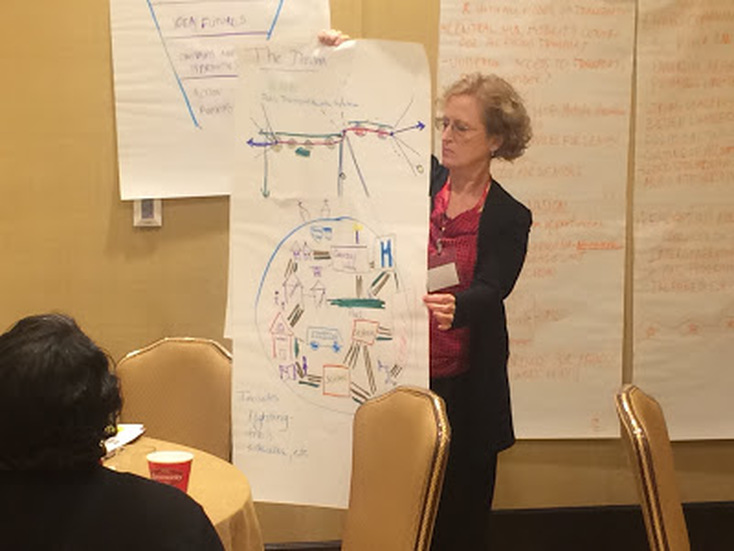 One conference participant presenting preliminary SafeGrowth plans As always, the search conference involves a stage of visioning. Sometimes this part is as important as the action plan. Participants envisioned a future where people could work, live and play in their neighbourhoods. They envisioned places that were no longer car dependent. They envisioned extensive public transit networks, renewable energies, and neighbourhoods full of festivals, diversity and acceptance. The results of this session were inspiring and resembled similar results from other search conferences. We realize that today, when groups are asked to envision a desirable future, what emerges are ideas for walkable, diverse, multi-use, and sustainable neighbourhoods. The results of the planning stages of the search conference included numerous plans for changing each of the neighbourhoods represented at our event. 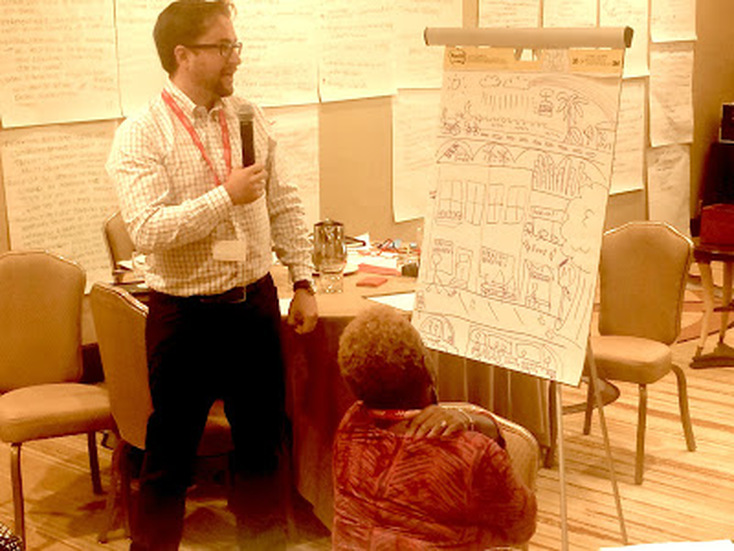 Additional work occurred throughout to refine plans In one city, discussions focused around expanding community engagement strategies on a new metro transit system. In another, engagement included safety on possible shuttle service and a Rails-To-Trails project. On yet another, sidewalk and intersection safety initiatives are leading to the possible development of a cross-city neighborhood exchange program to help build social cohesion between different neighborhoods in the city. FUTURE PROSPECTS By the end of the event the teams began to incorporate tactics to work with neighborhoods, residents, and stakeholders early in the planning stages. They saw the value in directly involving neighbourhood organizations before moving forward with any changes. The concept small is beautiful resonated throughout. Finally, the conference highlighted the storytelling skills of Katrice who entertained with her unique way to share lessons of change and hope. We agreed that this will definitely become an important feature of SafeGrowth in the future. 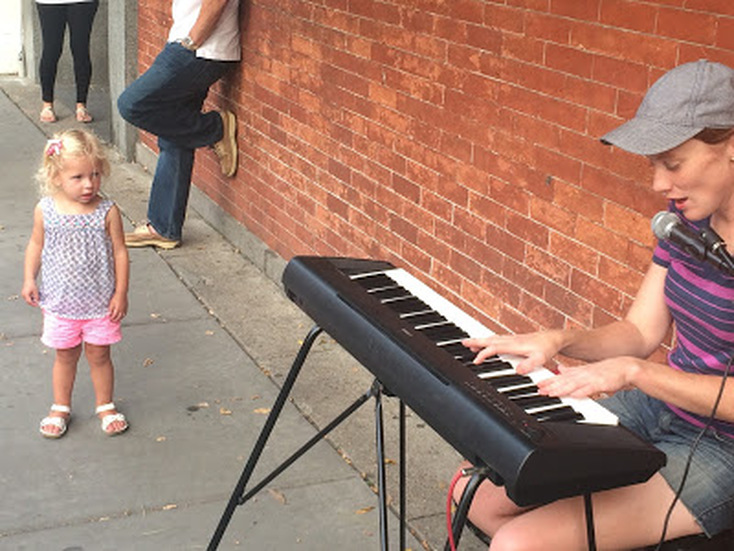 Street musician amazes and entertains in New Orleans Traveling across the country in recent weeks I enjoyed street musicians from one coast to the other. They came in the form of brass jazz bands in New Orleans to piano players on the Venice Beach Boardwalk in Los Angeles. Every urban center in the world features street musicians - also called buskers - those performers who provide entertainment for handouts. In France, they are Troubadours and in Mexico Mariachi bands wander the streets and beaches. Buskers have been part of city life for centuries, probably dating back to antiquity. England’s Henry VIII first licensed them as minstrels. And among their numbers, you can count Benjamin Franklin, Josephine Baker, Tracy Chapman, Rod Stewart and Guy Laliberte, the founder of Cirque du Soleil. Many cities license buskers, such as Toronto and London where they must audition to play on subway platforms. Most cities regulate them to ensure they are not a nuisance or hazard.  Venice Beach Boardwalk street entertainers - a top tourist destination in LA From a street safety point of view, they offer the opportunity to bring some legitimate eyes onto isolated areas and activate dull spaces with interesting life. A few years ago Steve Woolrich blogged here about the successful Red Deer, Alberta street piano. Little attention is paid to busking in the crime prevention literature. But our experience suggests that properly applied to key areas, street musicians can activate public places and make them safer. If anything it is usually the buskers who are victims of theft, not the other way around. ENTER THE IPNAS My concern in recent years has been the over-regulation of buskers like street musicians, especially considering the UK’s newest law, the Anti-Social Behavior Crime and Policing Bill. Under the oddball acronym IPNAS - Injunctions to Prevent Nuisance and Annoyance - the new law heaps a cornucopia of rules on everything from irresponsible dog ownership to border security and terrorism. And like all omnibus bills, they are a Genie out of the bottle once they get into the hands of local authorities with bizarre predispositions (aka Ferguson). 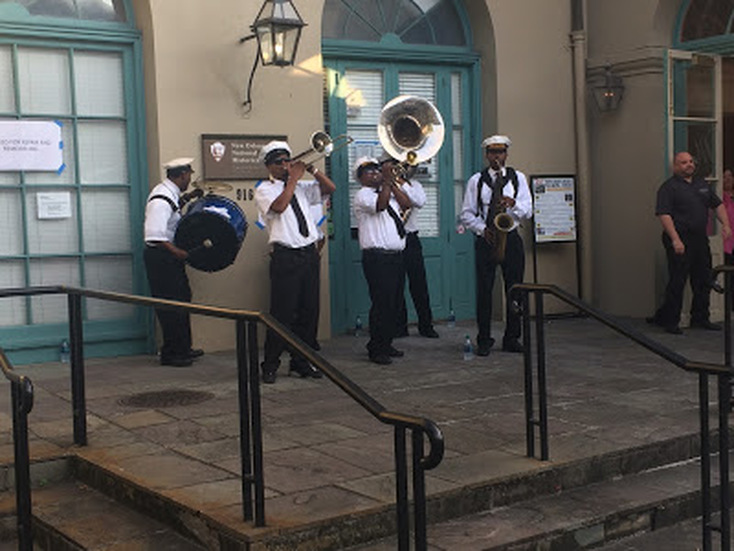 New Orleans brass jazz band - a beloved local tradition I understand attempts to cast a wide net of hyper-regulation over the streets of UK cities, especially when threatened by street thugs, drunks, and hooligans. But for every action, there is a reaction. This action could also limit the ability to activate streets with human entertainment and instead replace it with cold, mechanical CCTV eyes with the promise of a safe viewshed on downtown streets, a strategy with mixed empirical results in the UK and even more questions in the US. Then I found a review of the IPNAS laws in The Guardian. It brought to mind the stories of some of our greatest cultural contributors, Benjamin Franklin, Rod Stewart, Tracey Chapman and Guy Laliberte: These laws will be used to stamp out plurality and difference, to douse the exuberance of youth, to pursue children for the crime of being young and together in a public place, to help turn this nation into a money-making monoculture, controlled, homogenised, lifeless, strifeless and bland. For a government which represents the old and the rich, that must sound like paradise. 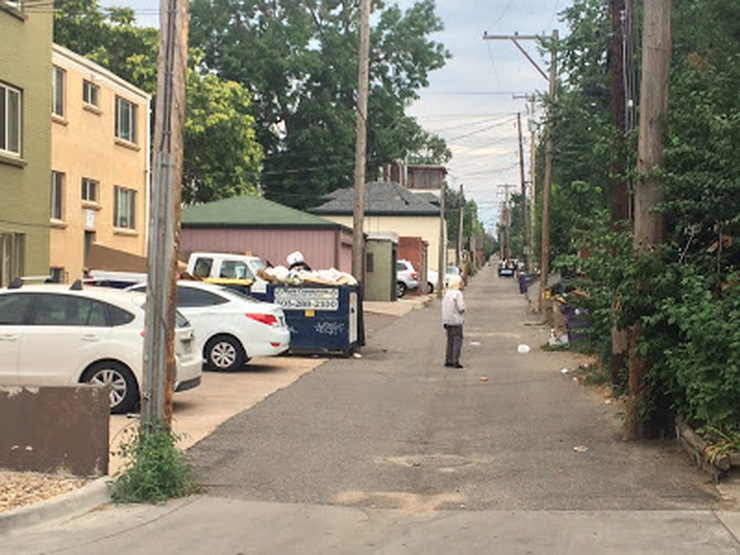 Navigating most urban laneways is an unsafe and unappealing journey A recent walk in some urban laneways brought to mind mystery stories of Sherlock Holmes’ chasing murderers lurking in dark, foggy alleys. In real life, laneways are a hidden and complex urban landscape we seldom consider in our formulations for safer cites. We write about them in our stories, but not until the New Urbanists reintroduced them as a modern feature of their residential street design did we refocus on them as a crime location. Most experienced beat cops walk downtown laneways, especially at night, because that is where things happen. Burglars frequent them because they offer easy access to the rears of homes. And kids vandalize and steal from cars in them because laneways are traditionally hidden from view. 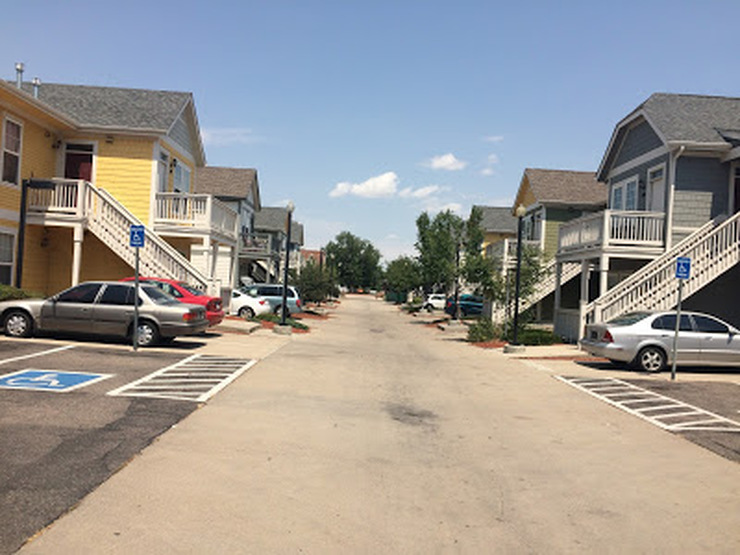 Attractive laneway design providing more than trash pickup As I compared some lively laneway designs with others that were not (the top photo), it was obvious poor laneway design is not inevitable. Laneway research is emerging revealing other options. I have posted blogs on laneway life, laneway chic, and permeable fine grain design. 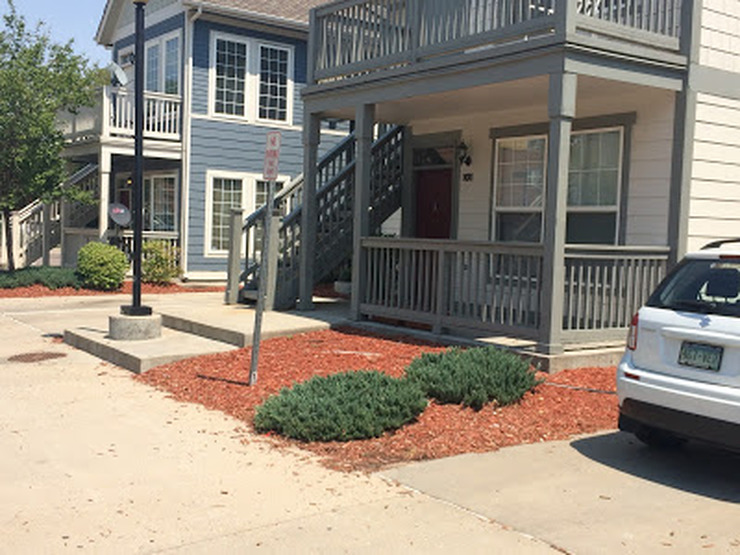 Landscaping and porches at the rear laneway - no chain link fences needed One Australian study on laneway crime suggests designers pay more attention to width/length, visibility from the ends, and the number of residences. But our work in SafeGrowth, and my recent walks, suggests something different: laneway activation is much more than physical size and shape. It is also about creatively figuring how to retain car parking and trash disposal uses, while at the same time creating interesting places for socializing.  Territorial marker at the end of the laneway - a community garden That might sound unappealing at first. Yet the cool laneway in these photos features streetscaping, decorative lighting, a community garden at the end, and rear door porches to encourage laneway socializing. If designers provide an interesting option that residents need, they will use it and also keep it safe. 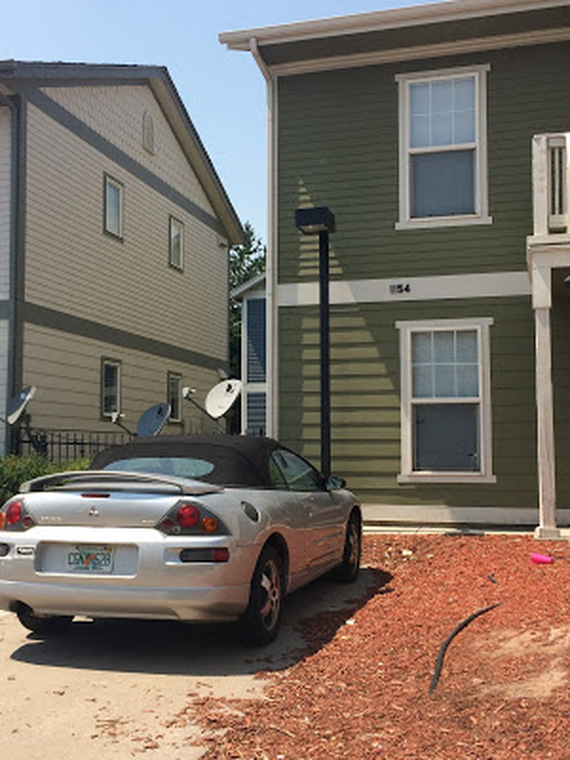 Providing lighting and window sight-lines to protect vehicles  Sunset over New York Public housing is an enigma in the fabric of the city. On one hand, most public housing is decent, safe and important. It provides an invaluable service offering affordable housing to those who, for various reasons, are left out. On the other hand, far too much public housing results in the projects, unsafe warrens of drug dealers and crime. In some ways, the worst side of unrepaired and ignored public housing emerges as a shadowland across the modern city, places that breed gang activity and fear. Our early SafeGrowth work began in such a place in Toronto. The original defensible space writing of Oscar Newman was based on public housing in the 1970s, much of that in New York.  Public housing in Manhattan along the Hudson River I recently spent time working in New York City. Anyone who studies or practices crime prevention will know the work of Oscar Newman, a Canadian-born, New York architect who created defensible space theory - also known in some circles as crime prevention through environmental design - CPTED. Jake Blumgart’s Next City article about public housing in New York highlights the work of Newman with the New York City Housing Authority. It discusses his early conclusions about design flaws and crime opportunity - the basic principles of 1st Generation CPTED. It also describes Newman’s conclusions about the larger role of social structure of public housing - concentrating poor residents in one project, youth-to-adult tenure policies, and percent tenants on welfare. Those familiar with the Second Generation CPTED will recognize those as the Capacity Principle. Second generation strategies in public housing have had considerable promise, as reported by DeKeseredy. 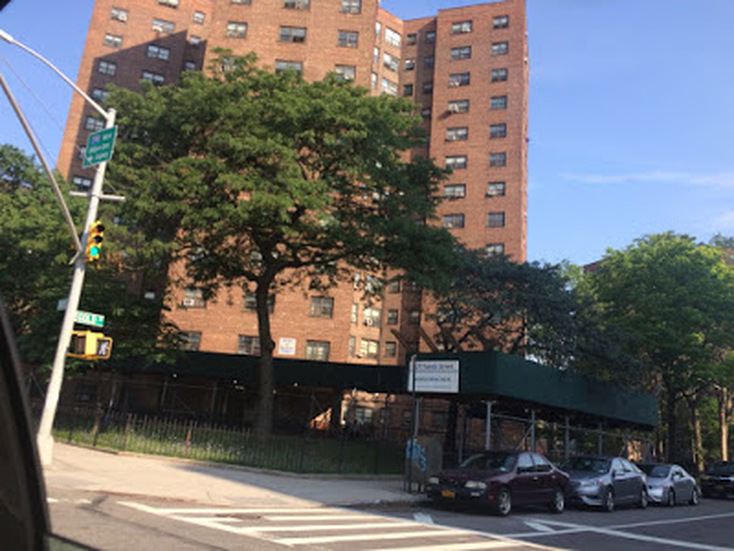 Repairs underway at a public housing apartment in New York COMMUNITIES OF INTEREST A careful reading of early Newman’s Defensible Space, and especially his later Community of Interest reveals that he always considered design only one part of the crime opportunity equation. He was saying this as early as 1976: "Research on residential crime patterns in 150,000 New York City public housing units has established that the combined effect of the residents' social characteristics and the projects' design affects the crime rate." Still, I doubt that Newman really calculated all the complicated shadowland equations of public housing. There is much work yet to be done.  Toronto neighborhood corner store - re-imagined Today is America's Independence Day - the time for celebrating a government by and for the people. Local governance seems a long way off this election season. So for solace, I turn to local governance on the street in the form of placemaking. There are plenty of amazing street designs, laneway experiments, and examples of tactical urbanism that enliven and activate the street. The more people who walk and enjoy what Jane Jacobs called the street ballet the easier it is to humanize our neighborhoods and reduce fear and crime. This is the magic that is placemaking. But did you ever notice how some versions of placemaking seem too expensive for the average person? Who has the time or money to redesign a laneway or install fancy lights, landscaping and pavement treatments? LOOK TO THE LOCALS An answer surfaced on recent trips to Toronto and Colorado Springs. The former took form in a small corner convenience store in a Toronto residential neighborhood.  Sitting areas, barbeques, relaxing space for socializing - A corner store with a purpose After suffering a burglary last fall and installing window bars, the owner decided to explore some inventive placemaking of her own. She transformed the front and side of her shop into a mini-market and outdoor gathering place. Inside the store she brings in local artists and artisans with samples of their work. With a vested interest in seeing their own work, and the chance to visit with others, locals and families frequent the corner store and create their own neighborhood nexus with very little cost to the storeowner.  Space for local artists to show their stuff - free of charge! LANEWAY LIFE Another answer appeared along a downtown laneway in Colorado Springs. In this case locals used color and paint to enliven an otherwise dead space. 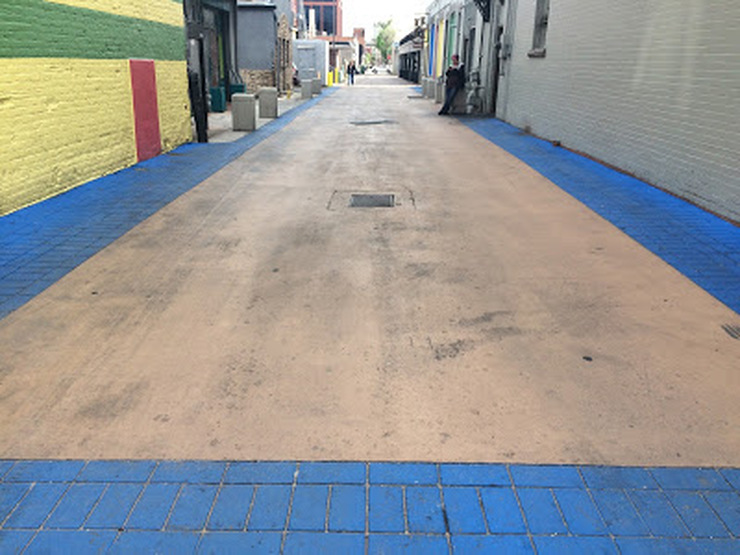 Colorado Springs laneway made fun with paint highlights Rather than an alley with dead spaces, poor lighting and droll walls, these shopowners painted walls, installed local art, and used overhead colored LED lights to bring some energy to the space. When a few people located their shops along the alley, the space turned into a social gathering place. 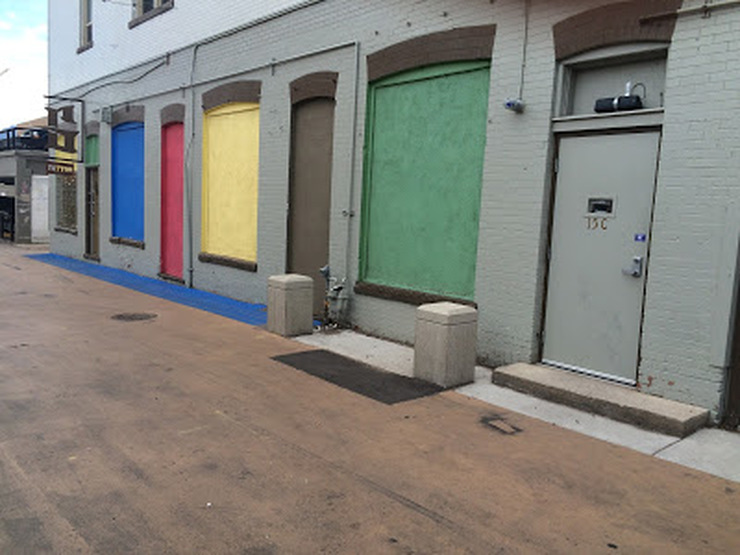 Dull wall space transformed with pain It really is not difficult to trust locals and work with them in coming up with ways to turn spaces into places. Jacobs said it 50 years ago: “Cities have the capability of providing something for everybody, only because and when, they are created by everybody.”  Adjacent restaurant getting in on some laneway action with colorful ad-art 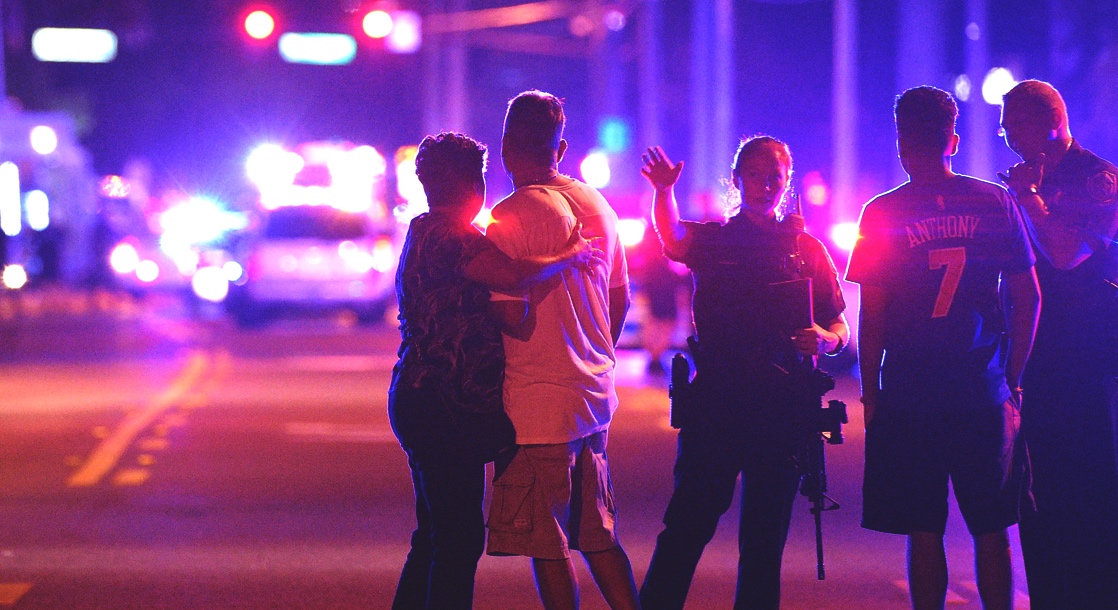 Our work to help neighborhoods tackle crime was overshadowed this week when 49 people were killed by a murderer, madman or terrorist in an Orlando nightclub! Two weeks earlier that murderer sauntered into a local gun store and shopped an assault rifle and handgun from a gun dealer who would later claim “I don’t make the law”. Mass murder is not at all the same type of preventable crime as other crimes that we tackle. On one hand it accounts for a tiny minority of violent incidents each year. Yet taken on whole, the annual American mass murder toll is mind-numbing
DOMESTIC VIOLENCE By my own calculations, since 2014, the number killed in mass murders (more than 4 killed at a single event) totals 694 victims! That is less than 3% of total of homicide victims in those years. About 14,000 people are murdered in the U.S. each year. To be clear, most murders are not mass murders but rather domestic violence killings and gang and drug shootings. Still, mass murders are the most gut-wrenching. And most mass murders have nothing to do with terrorism. Over 90% of mass murders since 2014 resulted from domestic violence or criminal madmen. None of which solves the problem. It is difficult for me to ignore the same arguments of reason and evidence against off-the-shelf assault rifles that I offered four years ago after the Newtown, Connecticut school murders. MISSING THE MARK Instead pundits blather on about terrorism, background checks, LGBT hate crimes and mental illness. They dismiss gun control, probably because with millions of firearms in private hands, gun control is a hopeless genie long out of the bottle. We are left to watch President Obama delivering his 15th mass murder speech. And in spite of it all, the American gun/murder formula continues to produce yet more atrocities year after year. It’s like a nightmare that won’t end.  There is a group I call the storytellers-in-the-sky. They are researchers who tell stories of predicting and analyzing crime from the vantage point of far above the reality on the street - usually employing Big Data to slice and dice stats and find some mysterious crime patterns that will, presumably, help us resolve crime. We’re still waiting for that last part. In the meantime there are others who do street research - action research - the hard work that makes a difference block by block. Evaluations of this action research is slower to arise and tedious to collect. But it is promising and shows real results. Now and then, the sky-people and the street people meet up. Such was the case with some decent research lately uncovering what street research types like SafeGrowth and CPTED practitioners have been saying all along! If done properly, two-way streets cut traffic speeds and crime at the same time. TWO-WAY STREETS A recently published online study in the Journal of Planning and Education Research shows how to reverse unsafe conditions on city streets. And even though traffic flow increased on the two-way converted street, traffic accidents went down. The study, Two-Way Street Conversions discovered road safety improved with two-way streets and simultaneously revealed impressive crime declines in both auto thefts and robberies by over 30 percent. 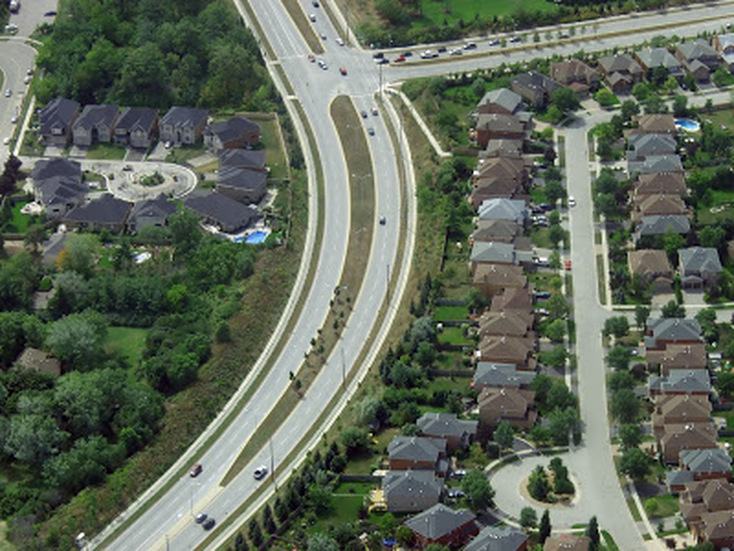 Two-ways vs one-ways to cut crime Action-based research like that is exactly what we need to transform neighborhoods. We don’t need more macro, sky stories, for example research trying to figure out if crime is a social epidemic. The epidemic hypothesis is simple, if duh-inducing: A high crime area infects nearby neighborhoods like a virus which, if untreated, spreads to other neighborhoods. It’s the obvious implication that gets sky-like: To fix the situation we need to come up with a vaccine to protect unaffected neighborhoods. Presumably we then treat the sick neighborhood with some preventive cure. I’m not sure if that’s exactly how the sky-plot goes but if so, I’m reminded of Sheldon’s line from Big Bang: Bazinga! CRIME BY INANIMATE OBJECTS Sadly, sky-storytellers see crimes as inanimate objects with no social history. They call them crime generators and crime hotspots, presumably to better measure such things and remain objective like the scientist studying the lab rat. Hotspots and crime generators are real things of course, but they definitely do have a cultural and social history not to be ignored. More to the point, crime generators are places like fast food restaurants frequented by the indigent and drug addicted looking for cheap food. Crime hotspots are places like taverns frequented by the poor and jobless looking for alcohol-relief. The message lost on the storytellers-in-the-sky is that the conditions creating such places are the very conditions that trigger both crime motives and opportunities in the first place. That’s the message of action-researchers and it’s as simple as a two-way street. Last week the New York Times ran an article called Remembering Kitty Genovese, a haunting story about the young woman murdered late one night in 1964 in front of her home as she returned from work. According to news reports plenty of people witnessed or heard Kitty’s murder, but they did nothing. I blogged about this a few years ago in A cry from the dark. In CPTED this is known as the by-stander effect and it refutes natural surveillance as a form of guardianship to prevent crime. 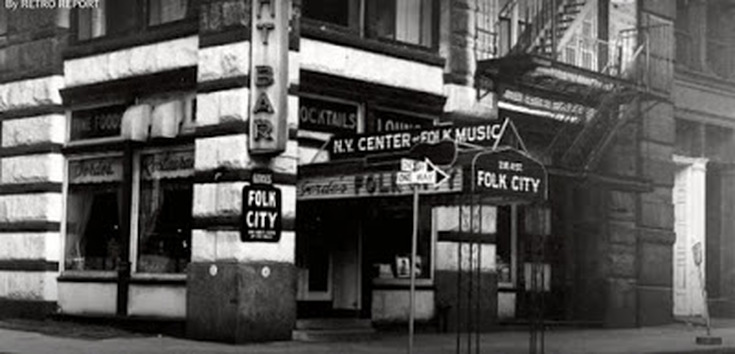 New York bar scene in 1963 - screenshot from Remembering Kitty Ironically, journalists eventually discovered one witness did in fact call police and another initially hollered at the murderer, but none of that mattered to Kitty nor to public sentiment. As the Times story said: A paradigm of danger and indifference in an anonymous city had taken hold. THE CRIME THAT CHANGED AMERICA Studies in environmental psychology now confirm the by-stander effect. In CPTED today we know natural surveillance is but one small part of a much bigger prevention story. Second Generation CPTED teaches us that eyes on the street are not enough if they are eyes that don’t care or belong to people too afraid to act. Creating a genuine sense of connection between neighbors is how guardianship through surveillance works best. Without that social cohesion there is no community for people to care about. Research has also demonstrated how social cohesion cuts crime. 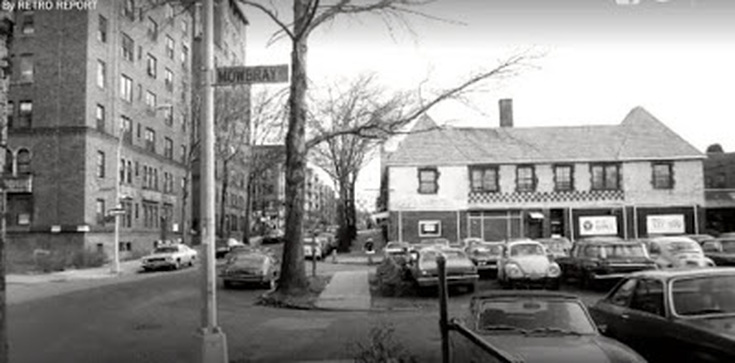 Parking lot where Kitty Genovese parked the night of her murder - screenshot from Remembering Kitty THE AFTERMATH Murderer Winston Moseley died in prison two weeks ago. Kitty’s brother Bill published a letter to the Moseley family that said: …my family’s better angels do now express our condolences to the Moseley family. What do we owe to all our fellow beings? … Let us join with the hope of shared egalitarian equanimity. Last October The Witness premiered at the New York Film Festival, a documentary following Bill Genovese’s efforts to examine Kitty’s life and speak to Moseley in prison prior to his death. Bill Genovese is right; Egalitarian equanimity - probably through social cohesion - should become our rallying cry in the 21st Century neighborhood. That much, at least, we owe to Kitty.  Cities everywhere have Infernos - usually invisible from downtown towers The quote above is from a 14th Century poem by Dante in which the first part is called Inferno, a hell in which the author makes his way past unimaginable, underworld horrors towards salvation. In urban parlance Dante’s Inferno is an allegory for skid rows, ghettos, and high crime neighborhoods where drug dealers and gang bangers rule like medieval war lords. I spent the past week in a pretty rough neighborhood – it doesn’t matter where since it could be any large city. I was working with an amazing community group to transform their neighborhood into something better. 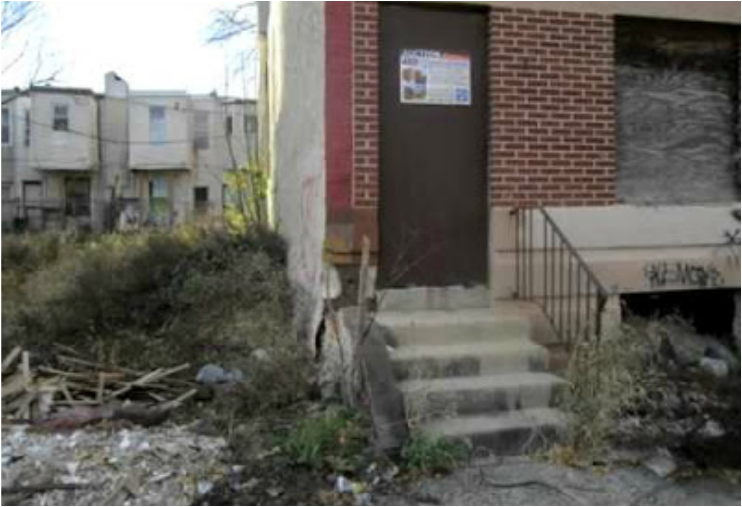 Dilapidated housing, drug addicts, high crime - the modern Inferno INFERNO Part of our week included visiting one portion of that neighborhood, for all intents an Inferno of open-air drug markets, among the worst anywhere. It is always sobering to visit such places, though sober isn’t the right word to describe the hundreds of addicts who call it home. Surely a place strewn with heroin syringes, dense with garbage and litter, and blighted with the effluent of a drug shooting gallery is not a place for children. Yet there they were, coming home from school, walking past their drug dealing older brothers hanging on the corners of dilapidated sidewalks, waiting for inevitable customers from both far and near. 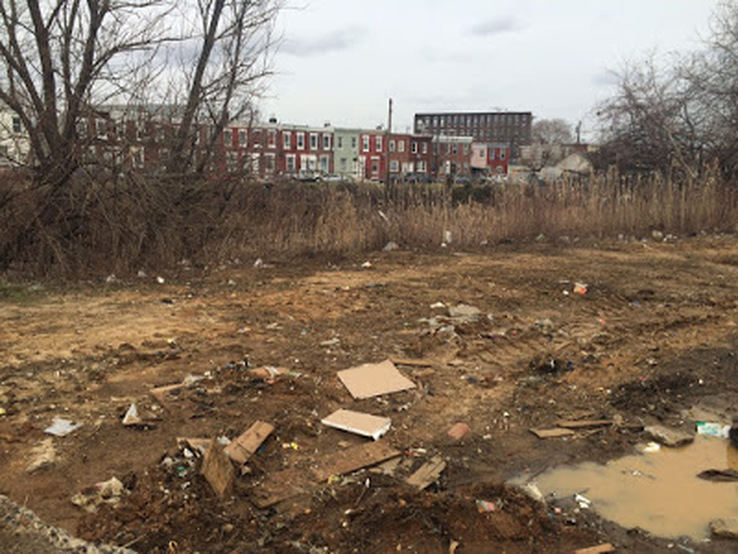 Children do not belong here, yet there they were So many violent deaths from deals gone wrong! So many indigent addicts testing out some new strain of heroin while indifferent dealers wait nearby to see if their latest product kills or turns a profit. Unlike other parts of the neighborhood, residents in the Inferno barely eke out a living. Many are afraid but haven’t the means to leave. Crime is rampant, but rents are cheap. RESIDENTS To the emergency doctors, beat cops, paramedics, social workers and community development specialists who work in such places, Infernos are a workplace where they learn the full measure of frustration. To the addicts, homeless, and poverty-stricken trapped in the deprivation and disparity that replaces life with survival, Infernos are the prisons that shame the modern democracy. To the drug dealers, their handlers, traffickers and their cartel overlords, and all the criminal parasites who pocket the urban fabric like the boils of the Black Plague, Infernos are their retail store and, in some ways, their prison too! 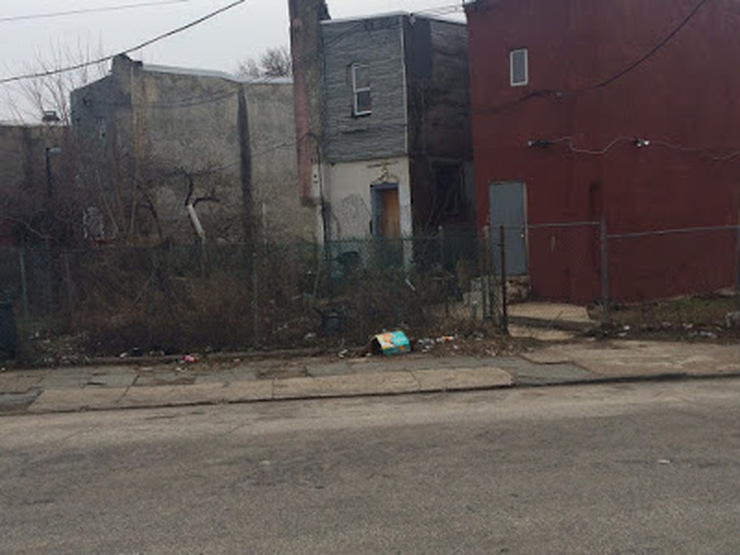 Waiting, very carefully, for clandestine photos away from ever-present drug dealers Traveling through Inferno, Dante discovers that sin is a product of desire – an irony here given the preponderance of drug addiction. But eventually, through hard work and a wise, caring guide, Dante is led out of Inferno. The labor of my colleagues this week was inspiring. Their goal is to guide their community with wisdom, courage and hard work, away from Inferno and toward something better. They live the words written by Dante 700 years ago; “and we came forth to contemplate the stars.”  North Battleford, Saskatchewan - photo Creative Commons This week we delivered SafeGrowth training in North Battleford, Saskatchewan, a Canadian city of about 15,000 in central-north Saskatchewan. Over the years North Battleford has had its share of troubles, including a top crime ranking for Canadian cities a few years ago. This week city officials, police, and residents teamed up to expand their crime prevention and community development work. SafeGrowth training is now underway in a range of projects throughout the city. As well, representatives from three other nearby northern cities joined the training - the cities of Lloydminster and Prince Albert in Saskatchewan and Red Deer, Alberta.  SafeGrowth training class - photo Steve Woolrich My co-instructor Elisabeth Miller and myself worked with this impressive bunch, committed as they were to learn how to improve community life. Next month we will see what they produce. I grew up in a northern Canadian city and I have a soft spot for the people who call them home. The best northern places boast a strong sense of community, industries like mining and lumber with well paying jobs, and outdoor adventure activities in unspoiled forests. The worst northern places suffer high unemployment with boom/bust economies, social unrest, substance abuse and the high crime so often accompanying that social dysfunction.  Walking out to winter parking on the morning commute to SafeGrowth training SOMBER REMINDER There was recently a somber reminder about the seriousness of crime prevention work in northern communities. One week ago in the small aboriginal town of La Loche, 300 miles north of North Battleford, four people were gunned down in a multiple murder - two were teachers at the La Loche high school. A few years ago a gang shooting killed one resident directly across from the La Loche RCMP police detachment. Perhaps lessons from the SafeGrowth work in North Battleford will ripple out to other northern communities suffering violence and crime like La Loche? We can only hope. Clearly, there is much work to be done!  Abstract paintings often have a Kafkaesque feel As we end 2015, the term Kafkaesque comes to mind. It describes some hopeless struggle against bureaucratic, sometimes malevolent, machines. Since this is a future we want to avoid, the following cautionary tale seemed an appropriate year-end story. Franz Kafka was a 19th Century German writer with books about“surreal predicaments and incomprehensible bureaucratic powers” in which his characters descend into alienation in the face of absurdity. Think of films like The Trial by Orson Wells, Mulholland Drive by David Lynch or the futuristic crime dystopia by Stanley Kubrick, A Clockwork Orange. POLICE INNOVATION Kafkaesque thoughts surfaced when I read the 2013 and 2015 programs of the Police Innovation Conferences. These conferences were not really about police innovation as you might expect. Rather they were technology conferences offering a tech version of police innovation with some very cool gizmos such as drones and robots, brain fingerprinting, and body cams. The gizmos look cool and I’m sure they have useful applications. However in today’s police environment there is a much bigger picture. If this were one single technology conference it would be a fun curiosity. But today policing is inundated with so many conferences of similar themes, they detour rather than direct us to a sustainable, post-Ferguson future. A small sample:
CANDLES IN THE DARK I have yet to see conferences about innovations in police training, such as basic academy courses that teach cops how to work with urban planners to build safer, CPTED-sensitive parking lots before carjackings and car thefts unfold. Where are sessions on innovative methods to help get cops out of cars and into neighborhoods to work with social activists and faith groups to cut the roots of gang membership before the shooting starts. There is little available about emotional intelligence skills that arm officers with better conflict resolution and situational awareness tactics to disarm offenders without killing them, or risking officers lives. To be fair, there are a few candles in the dark - conferences focused on practical, grass-roots police work such as this year’s Problem-Oriented Policing conference in Portland. There are also a few small conferences such as this year’s Police Society for Problem-Based Learning in Madison or the International CPTED Association conference in Calgary. But these conferences do not command the policy discourse. What does? The Armadillo! ENTER KAFKA One session at these tech conferences was “Empowering the community - low tech crime prevention”. This session was about how police retrofitted an armored combat military vehicle called an Armadillo with video cams, audio surveillance, and so forth. The goal? Deploy the Armadillo... “to high crime areas or places that have experienced a spike in public nuisance type events. The Armadillo feels right at home when parked directly in front of a drug house or problem bar… a symbolic representation of restorative justice in places that have demonstrated public nuisance activity..” “At home in front of a drug house or problem bar?” No doubt there is honest intention here, yet you just know Kafka is rising from the dead! “A symbol of restorative justice?” Seldom was a more Kafkaesque phrase served up in the name of public safety. In the spirit of a more common-sensical and balanced future, may we dispense with tactics that awaken dead German writers and get on with the task of building safer, collaborative neighborhoods in 2016. Happy New Year!  Police mobilizing for Toronto's G20 summit in 2010 - photo Jeff Denberg Creative Commons GUEST BLOG: Tarah Hodgkinson is a senior researcher in the Integrated Risk Assessment Instrument Research Group in Vancouver, Canada. She is a member of the International CPTED Association and a certified SafeGrowth instructor. She is completing her Ph.D in criminology at Simon Fraser University. **** I dream of Canada as a country that significantly funds incredible local crime prevention programs like SafeGrowth that engage the community and police as partners. Programs that put our neighbourhoods in charge. I want a country that encourages our universities and communities to use what we already know about crime prevention and policing by putting it into practice. A few weeks ago I attended Public Safety Canada’s Economics of Policing and Community Safety conference in Ottawa. The conference started three years ago to respond to increasing policing costs in a time of fiscal constraint. However instead of frontline workers talking about innovation and partnerships with their neighbourhoods, or practitioners sharing tales of their work in crime prevention, the conference room was full of senior police and policy people. Where were the people driving change currently?  2015 Economics of Policing Conference in Ottawa, Canada's capital The final conference discussions came down to future research and plans of action. However research questions focused on building a national framework and studying efficiency and effectiveness. Despite several calls for it, action was lacking. Consider the vast amount of research on how such measures are useless because it is almost impossible to define efficiency and effectiveness without reducing them to response times and crime rates! Consider there has already been inconclusive police research about those very questions! Consider that a national research project is addressing this question already! A different future unfolding elsewhere
Why not discuss how to expand successful, and proven, local crime prevention and neighbourhood safety strategies in Canada such as SafeGrowth? Why not discuss more innovative ways that the police can support and collaborate with neighbourhood-led change? Or better yet, use those limited research dollars to implement and evaluate these strategies? I asked in frustration: “How can we talk about a national framework for Canada when we have a tiered policing system that ignores the size and role of private security and local non-police led crime prevention? How can we spend money on ANOTHER study on measuring effectiveness and efficiency?” “How can we not do something in our neighbouhoods NOW?” My questions may fall on deaf ears. But maybe that doesn't matter because here’s the more important question: Perhaps a different future must unfold elsewhere?  Zimring's 2006 book is still the classic explanation - available on Amazon News of armed regional conflicts around the world distorts the truth of local crime. That truth? Crime in developed countries continues a long plunge into lowly rates unknown for decades. As Vanessa Barker notes in her research, criminology has no idea why. Frank Zimring’s book on the The Great American Crime Decline does say why criminologists can't figure it out: “The knowledge gap in current social science understanding comes almost equally from the unavoidable weakness of a non-experimental discipline and from avoidable provincialism and ideological blinders.” Yikes. Crime plummets in places where police are underfunded, like the UK, and in places where police enjoy copious salaries, like Toronto. Crime plummets before, during and after the Great Recession (kind of puts the lie to the idea that economic downturns trigger it or abundant times stop it). It plummets with or without mass incarceration, like the US versus Canada. It plummets where security is abundant (vehicle immobilizers, gated communities) and also where security is scarce, like my own city where lighting is poor, gates are rare and burglar alarms a luxury. THE MEDIA WEIGHS IN The Economist Magazine says the reason crime plummets is that today’s crime-prone cohort, young males between 18- 34, are more civilized: "Young people are increasingly sober and well behaved. They are more likely to live with their parents and to be in higher education." Really? Well, in Better Angels of Our Nature psychologist Steven Pinker does suggest something similar he calls the civilizing effect. The Toronto Star quotes government statisticians who stir new police practices, reduced alcohol consumption and inflation into their causation broth in a frantic search for an answer. Ultimately they have no idea. 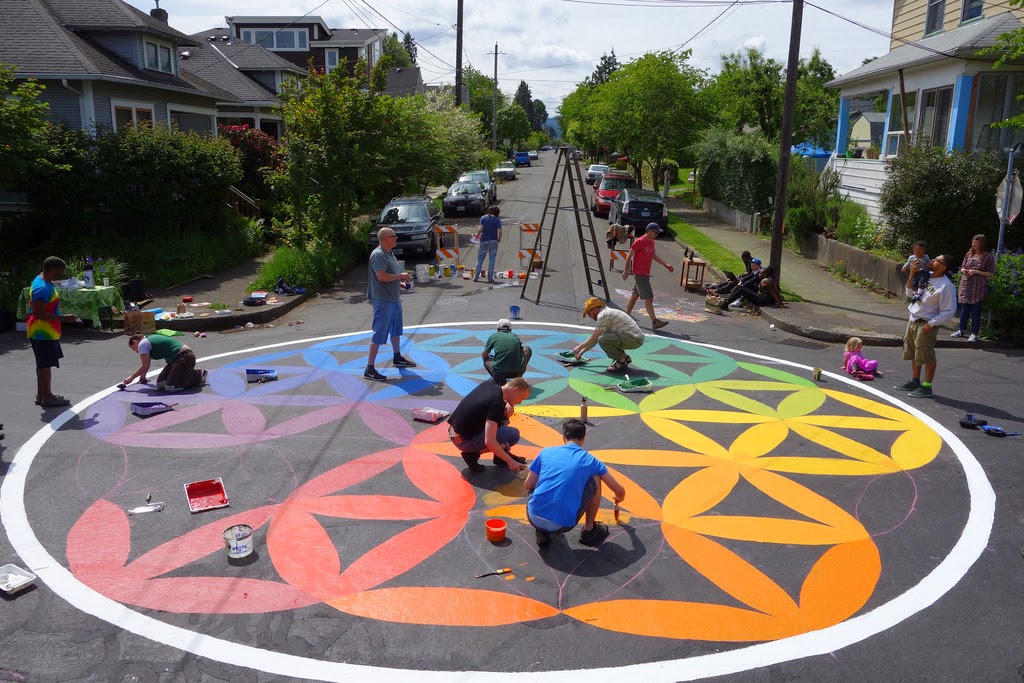 In Portland neighbors redesign their intersections to build cohesion - photo Greg Raisman THE SOCIAL COHESION EFFECT Through it all, two social cohesion ingredients persist:
The truth is crime has always concentrated in inner-city neighborhoods. It stands to reason improvements in the inner city - better housing, improved infrastructure - magnify the power that neighbors have to control problems through social ties, watching over each other and so forth (the social side of defensible space that Oscar Newman wrote about). Then add aging demographics together with the civilizing effect and neighborhood redevelopment and you have a workable recipe, a one-two-three punch in prevention practice. The social cohesion effect is good news in the 21st Century city, especially considering the persistent plague of urban homelessness, gangs and drugs. It’s especially positive for SafeGrowth practitioners and those who practice targeted community development such as LISC. It points the way forward.  A few weeks ago a police chief went ballistic online (it's now viral) and in a moment of anger told some harsh truths. It has been a gruelling few months for public safety. From controversial police shootings, protests, and riots to the bombastic vitriol of talking heads on mainstream media, saturated in opinion, starved in knowledge, devoid of balance. Then I received news of struggles by some SafeGrowth practitioners under attack from bureaucrats and politicians in a few different cities. For some of them political currents wane and crime slips from the Mayor's agenda. For others austerity budgeting undermines SafeGrowth as finances are redirected, typically to programs less effective and evidence-barren. STAYING ON MESSAGE Truth is when leaders lose focus it is easier for them to revive comforting myths from yesteryear - more cops, more technology, more CCTV, more generic social programs...whatever! These are myths with which they easily identify, myths their populations want to believe. Anyway back to the chief, his moment and a video gone viral! Disclaimer: I know and respect this Police Chief. Ed Flynn is Chief in Milwaukee, a police agency that supports SafeGrowth and, thanks to some help with our friends at LISC and some great beat cops, it's a city where SafeGrowth has been successfully applied to tackle neighborhood crime. Sometimes it takes leadership gumption and foresight to stick with what works, even if it's unpopular and doesn't grab quick headlines. Where are the leaders with that gumption, that foresight? When this video appeared I had my answer. In my view Chief Flynn speaks for everyone committed to, and working in, public safety everywhere. Note to self - So this is what passionate leadership looks like! Nowhere have I seen a better example of the gulf between combat cops and community cops than in these two recruiting videos. A friend recently sent them to me with the comment "Police recruitment videos speak volumes about livability of a place…" Yes, they do. Both cities are low crime and only one murder has occurred in either community over the past few years. Both have higher than average income levels with similar demographic mixes. Newport Beach, California has 85,000 residents and Decatur, Georgia has 20,000, although both are adjacent to large cities (Los Angeles and Atlanta). While Decatur is smaller, the relative police strength is similar with both cities under 200 officers per 100,000 residents. In social science this is gold! Social conditions are never the same and cross-jurisdictional comparisons are always imperfect. But it would be difficult to find two communities that are more apple-to-apple similar for comparing police services. Except they don't compare. At all! Who knows if policing reflects recruitment videos. But culture often shows up in videos like these. After all, each department had to approve them for public release so they obviously think these are the best images that represent what they are all about. That is a frightening thought! The Future of Police report reminds me of something Professor Herman Goldstein warned us about years ago - confusion about the ends over the means! The future that the public wants - the ends – is less crime and more public safety. They want to get there - the means – by more community-building, more inclusive problem-solving, and better relationship-building. I might be wrong, but I doubt the means that the public expects from police are the technology-drenched, algorithms suggested in Future of Policing. "These changes," says the Preface in Future, "are not just about finding new ways to reduce crime; they go deeper, to evaluating the basic mission of the police, and what people want from the police." GOING DEEPER Of course saying officers should “go deeper” is not the same as doing it. Nor is it the same as providing the training to teach them how. Unfortunately training programs that teach such things - problem-based learning, emotional intelligence, PTO field training – do not show up in Future (even though the COPS office and PERF promoted development of those programs). One quote by a LAPD supervisor suggests an escape from this institutional autism: “…when [officers] spend time in the high-probability areas, they need to be doing problem solving. There is something there that is attracting criminals; we tell officers to look for the magnets. The goal isn’t more arrests, the goal is crime prevention.” Very true! Except throughout 45 pages of text crime prevention was cited only 9 times and never explained fully. THE FUTURE? In Planning in Turbulence an author concludes: “our level of ignorance about social systems is quite astounding, yet our analytical approaches…assume away this ignorance outright through the specification of incomplete models based on incomplete or often inaccurate data.” That was 28 years ago regarding urban planning. I wonder...is police science any better or are we facing that exact same paradox? In SafeGrowth we overcome this by developing neighborhood teams who run their own prevention plans alongside local cops. LISC’s Community Safety Initiative publications describe how we do it. Another workaround emerges with street cops themselves who peek inside our communities. For example consider success stories in Camden NJ and Virginia Beach. CAMDEN N.J. Future of Policing describes the Camden NJ police using forfeiture funds in 2011 to purchase technology and form partnerships with other law enforcement. But a year later real change exploded. As the New York Times reported, fed up with a flood of crime, tired of strict union rules inflating costs, 30% absenteeism at work and overtime pay for basic duties, the City of Camden shut down their police force and started over. Without union rules they rehired 150 of the 200 old officers back and hired another 250 new officers. They instituted foot patrols, had volunteers walking the streets, and expanded youth programs. They properly staffed their CCTV and ran more enforcement. The result? Youth program involvement increased, response times plunged from 1 hour to 4 minutes, crime rates dipped and murders dropped from 21 to 6. 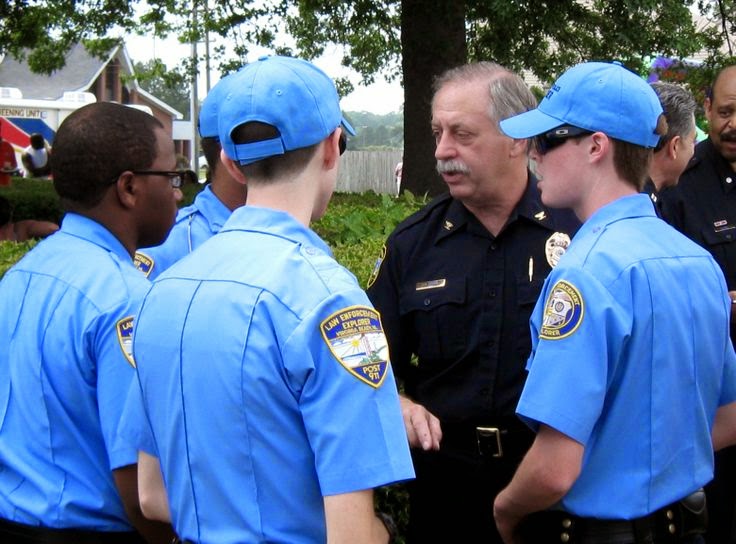 Virginia Beach police Chief Cervera talking to Boy Scout Explorers - photo VBPD VIRGINIA BEACH A national leader in both the PTO program and problem-based learning, Virginia Beach went one step further. The news clip "Ask a cop for coffee and some conversation" describes how. Once a year Chief Jim Cervera has his officers of all ranks walk neighborhoods and knock on thousands of doors to ask what residents think of their police. Says Cervera: "We want the surveys to prompt real conversations. There is nothing better than two people from different social, racial or ethnic backgrounds having a heart-to-heart discussion about a common goal." NEIGHBORHOOD GOVERNANCE No sensible person wants the mantle of anti-tech Luddite. Science is part of the way forward. But as Harvard’s Malcolm Sparrow makes clear in Governing Science, it needs careful watching. Those who champion science are not the new Lords of Truth. They are Tech Emissary’s with flashlights to find our way in the dark Turning crime around will mean a neighborhood planning system with three equal partners: carefully governed science and technology; active neighborhood groups working directly with their local police; and cops and residents co-trained in the kinds of problem-solving methods we know work so well. We've only dabbled in these things. Now it's time to deep dive. It's called neighborhood governance and it is our future. That also didn’t show up in the report. But it should have! Hot of the press: Future Trends in Policing from the COPS Office, PERF, and the Target Corporation. It is a report of a 2012 survey and summary of a one-day session with police leaders on the "Future of Policing."
It reveals what some police executives think might happen in future. Is it a prophesy we really want? TREND: COMMUNITY POLICING? The survey reported 94% of respondents said their agency was involved in community policing, 89% in problem-oriented policing (COPS). Good news, right? I've taught hundreds of police instructors over the past few years. Every time I ask them about COPS few, if any, admit to knowing anything beyond the superficial. Practically none of their agencies are doing anything beyond a small sprinkling of COPS specialists, less than 10% at best. Last month I asked again, this time whether they knew anything about problem-oriented policing. The class had instructors from the east coast, mid-west, Canada, and the south. Same results: Out of 25 police instructors only 1 knew what POP was and he was from Madison, Wisconsin (the home of the POP Center). 94%? Do police survey responders inflate whether they are doing COPS when they respond to a national survey on the topic? Saying one thing, doing another? TREND: SCIENCE TO THE RESCUE Future Trends had very little discussion of problem-oriented policing. In 45 pages of text it was cited only 3 times. I did however notice the report was awash in GPS, cybercrime, body cameras, facial recognition software, predictive policing algorithms and intelligence-led policing. My personal favorite was NG 911 - Next-Generation 911. [NERD ALERT: I love that stuff. Anytime I hear references to Star Trek - The Next Generation, my nerd-o-meter tingles. Beam me up!] In other words science will come to our rescue? Zip-a-dee-doo-dah, what a wonderful day! TREND: ONE-IN-FOUR Survey statement: "In the future agencies will place less emphasis on community policing." 75% of police agencies in the survey disagreed with that statement. Glass-half-full, right? But 25% offered no opinion or actually agreed that in future cops will do less community policing! In other words, after 35 years of publications, conferences, training courses, and successes that account for at least some reduced crime, 1-in-4 police survey respondents see less community policing in the years ahead! Sounds more like a glass half-empty! Considering the Ferguson riots two weeks ago that portends a bleak future. Next week: Part 2 - The good news Just arrived: The January-June crime statistics for 2013 !
Each summer the FBI releases semi-annual results from year before crime statistics. To criminology geeks like me they are like candy. And guess what! For the 73 cities over 250,000 population crime is the same it has been for decades. Down! But not everywhere! DECLINING CRIME Murder, the most reliably reported crime, is still declining. In Philadelphia murders are down -36%, New York -19%, New Orleans -20% and San Antonio -41%. Why? In the Big Apple maybe broken windows or stop and frisk policing works? Yet both are controversial. Plus cops have been accused of cooking the books. In New Orleans I'd like to think Hollygrove's SafeGrowth program had at least some impact along with the new CeaseFire anti-gang program. The truth is it's difficult to claim victory from programs in one place when crime falls in other places without those programs. Doing so is willful blindness. Speaking of willful blindness, there are criminologists who claim auto crime is down due to the spread of more sophisticated security technology. They ignore that crime declined across many categories (in many countries), when security technology was absent (as in domestic violence). When crime categories plummet together, how logical is it that security technology explains auto theft declines but nothing else? CLIMBING CRIME There are much more important things than crime theory-squabbles. Alarmingly, murders are climbing in a number of cities. In Las Vegas murder was up 56% (from 32 to 50), in Indianapolis 41%, (46-65), Cincinnati 45% (22-32), Baltimore 9% (105 - 115), Memphis 7% (56-60), and Dallas 17% (62-73). Are these statistically significant or normal variations? Either way it is troubling. In a few of those cities new police programs are already in place. Memphis uses the predictive policing program called Blue Crush. Apparently, at least with murder, it isn't working. Are the good times over? It's impossible to write about small wins cutting crime and ignore police controversies that go viral. This weekend teenager Michael Brown was shot and killed in Ferguson, Missouri in a struggle with a police officer. Aside from mainstream media we know little about how events happened. We do know Michael Brown's death is triggering protests, riots, and national attention. It has gone viral. Now the online vigilante group Anonymous is threatening to post the personal information of Ferguson police department members unless politicians create a Mike Brown's Law with strict national standards for police misconduct across the USA. Some steps have already been taken along these lines. In 1994 the government passed a crime bill that expanded a form of civil enforcement called the Consent Decree. It is allows the federal government to install legal oversight over police when civil rights have been abused. Since then 20 police departments have been subject to Consent Decrees including Detroit, New Orleans, Los Angeles and the latest in Seattle. In Seattle some officers are pushing back with a counter suit to roll back the proposed use-of-force controls. THE RUIN AND REDEMPTION OF THE LAPD Next year author Joe Domanick will publish Blue: The Ruin and Redemption of the LAPD about the Consent Decree in LA and what happened. In his blog Domanick describes police resistance to such changes: ...while police officers and their thinking is far more diverse than 20 years-ago, old, bad habits are nevertheless still being passed down from one cop generation to another. They die hard. And police of a certain generation don’t like change, particularly liberal reform that they perceive only makes their jobs harder and more complex... It all makes me think of Dylan's lyrics: Gather 'round people Wherever you roam And admit that the waters Around you have grown Then you better start swimmin' Or you'll sink like a stone For the times they are a-changin' |
CONTACT[email protected]
|

SafeGrowth® 2007-2024
|
SafeGrowth® is a philosophy and theory of neighborhood safety planning for 21st Century.
|