SAFEGROWTH® BLOG
regular contributors
GREGORY SAVILLE · MATEJA MIHINJAC
GREGORY SAVILLE · MATEJA MIHINJAC
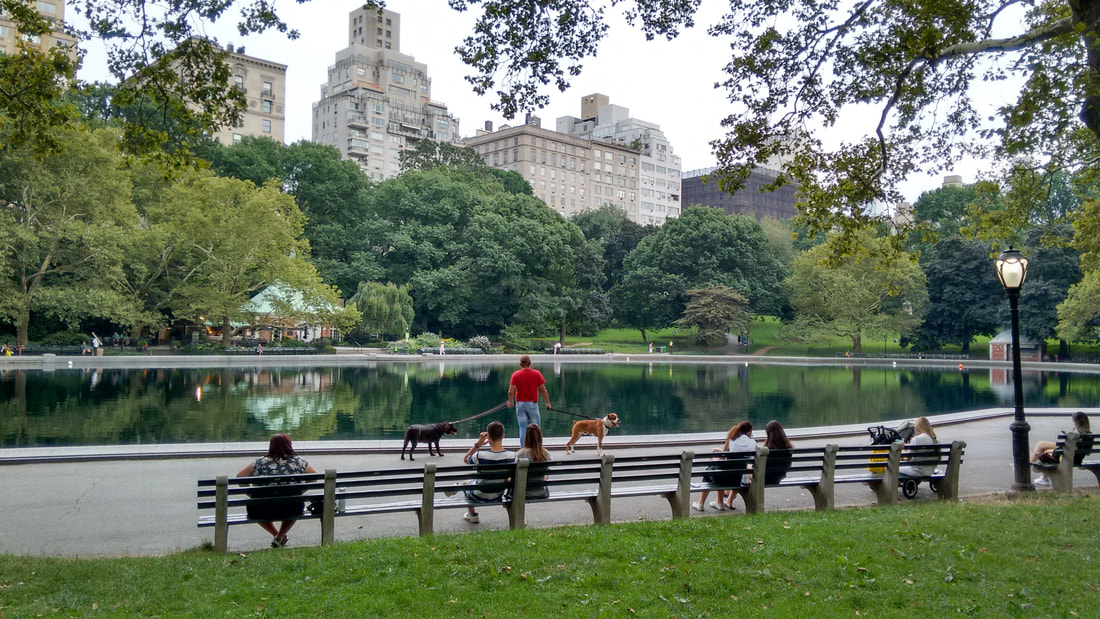 Relaxing in Central Park made easy with benches, clean walkways and something interesting to watch By Mateja Mihinjac Embedded within SafeGrowth practice resides a number of tactics, one of which is CPTED - crime prevention through environmental design. CPTED is often criticized for being simplistic and reductionist in its solutions and for promoting fortressing while displacing undesirable activity. In January, Greg reprinted an article he wrote a few years ago about the exclusionary nature of CPTED when it disregards some at the expense of others. These side effects may seem unsurprising considering that the word “prevention” implies attention to undesirable behaviors. However, years of experience teach us that not every crime problem will benefit from simply restricting behaviors; we also need to provide alternatives and support desirable conduct. 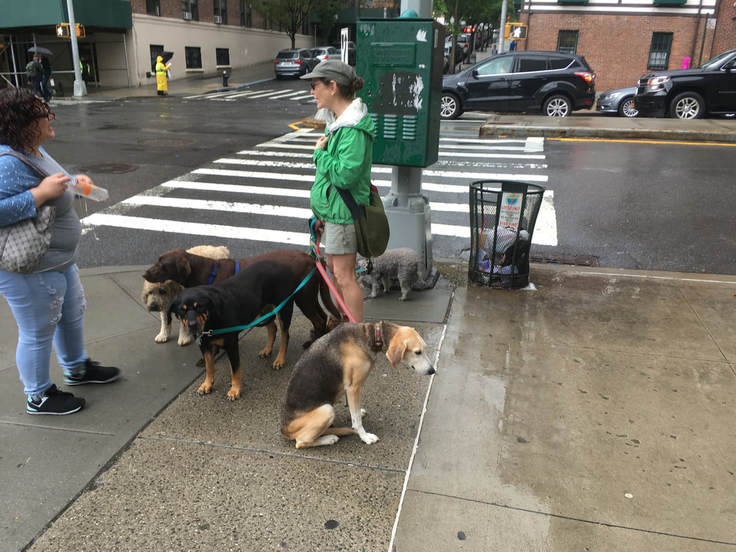 Not all dogs agree, but even in rain, dogwalking is pro-social This does not infer a binary approach to CPTED but rather attention to details because, when it comes to intended and desirable outcomes, context matters! It is therefore prudent to outline some of the 1st Generation CPTED principles using a pendulum between restrictive and desirable behavioral outcomes. 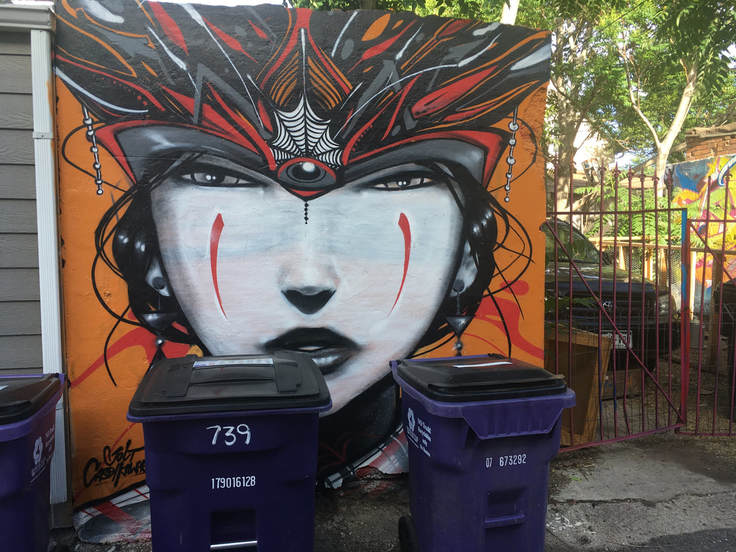 Talented street artists can beautify unpleasant areas THE CONTEXT PENDULUM A broader view of CPTED is nothing new; it can be observed in the early writing of CPTED by the original authors. For example, we know from Oscar Newman’s work on defensible space that territorial influence is most powerful when it combines “latent territoriality and sense of community” when residents care for shared spaces and each other. Tactics to uncover latent territoriality include designing visual contact between residential areas and building semi-private areas where neighbors can congregate, factors that still emerge today in research. Methods to enhance the social climate of an area include getting people to better know, and care for, each other with cultural and recreational activities. 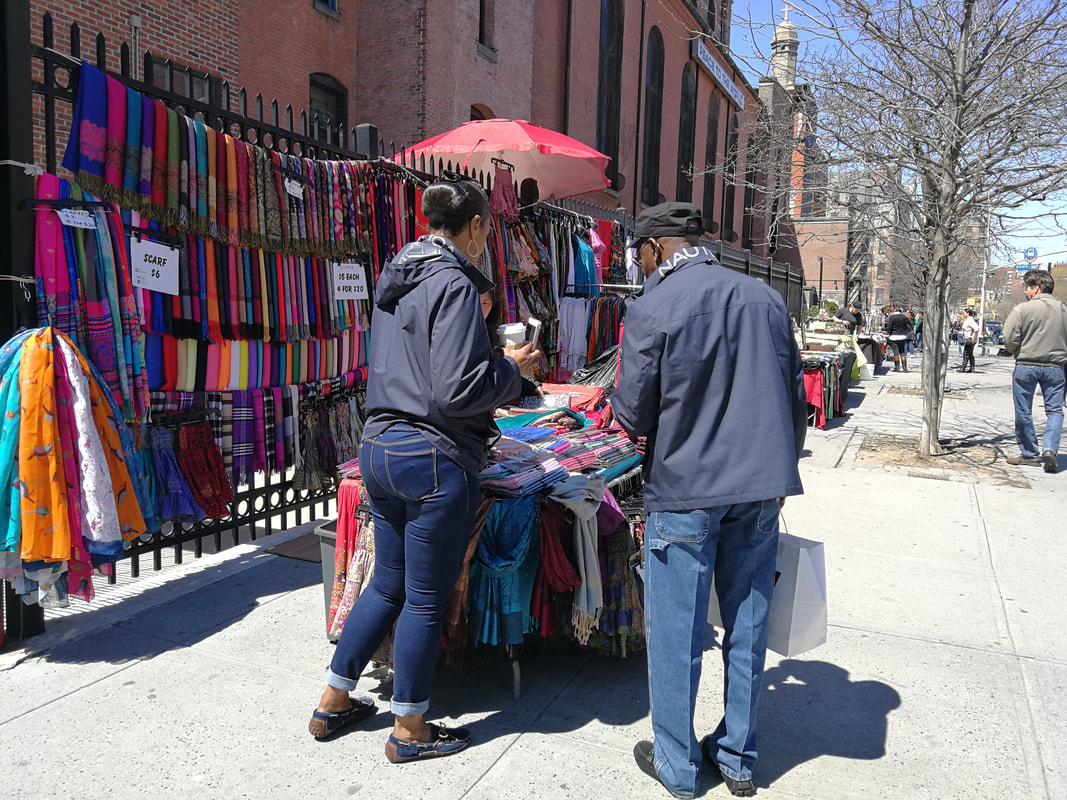 Street markets provide a fun reason for going outside Newman predicted this latent territoriality promotes ownership through supporting pro-social behaviors while concurrently deflecting unwanted use without the need for physical reinforcement. Similarly, Jane Jacobs extended her discussion of “eyes upon the street” and argued that streets are safe when they provide opportunities for desirable activities by offering people a reason to occupy them, as we described in recent blogs on sidewalks and alternatives to bollards. There is no shortage of other methods to create desirable locations, for example through tactical urbanism and placemaking that build pro-social activities and informal supervision. 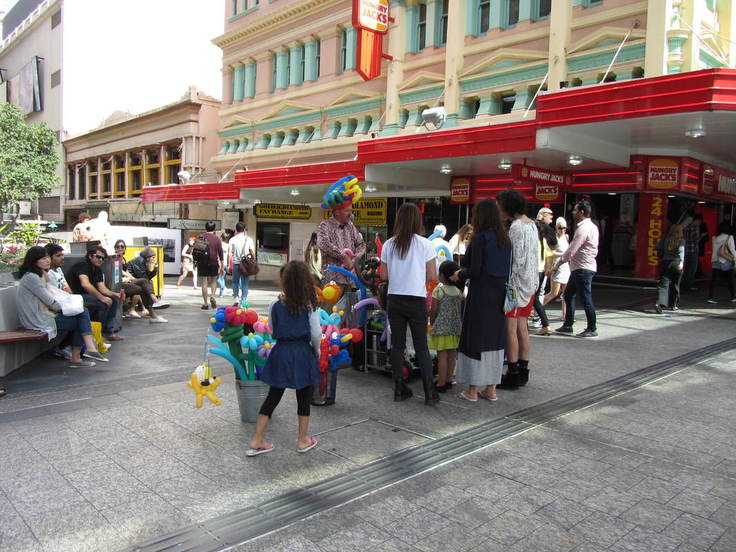 Street busker activating a public plaza FINDING BALANCE Mainstream 1st Generation CPTED continues to undermine the need for investing in social capital as the underlying prerequisite for effective and sustainable crime prevention. In SafeGrowth, we employ 2nd Generation CPTED to promote social cohesion, local pride and social interaction. The goal is to swing the pendulum towards pro-social conduct and away from an anti-social, target-hardening mantra. Ultimately, the key for quality of life in neighborhoods is finding the right balance between the two.
0 Comments
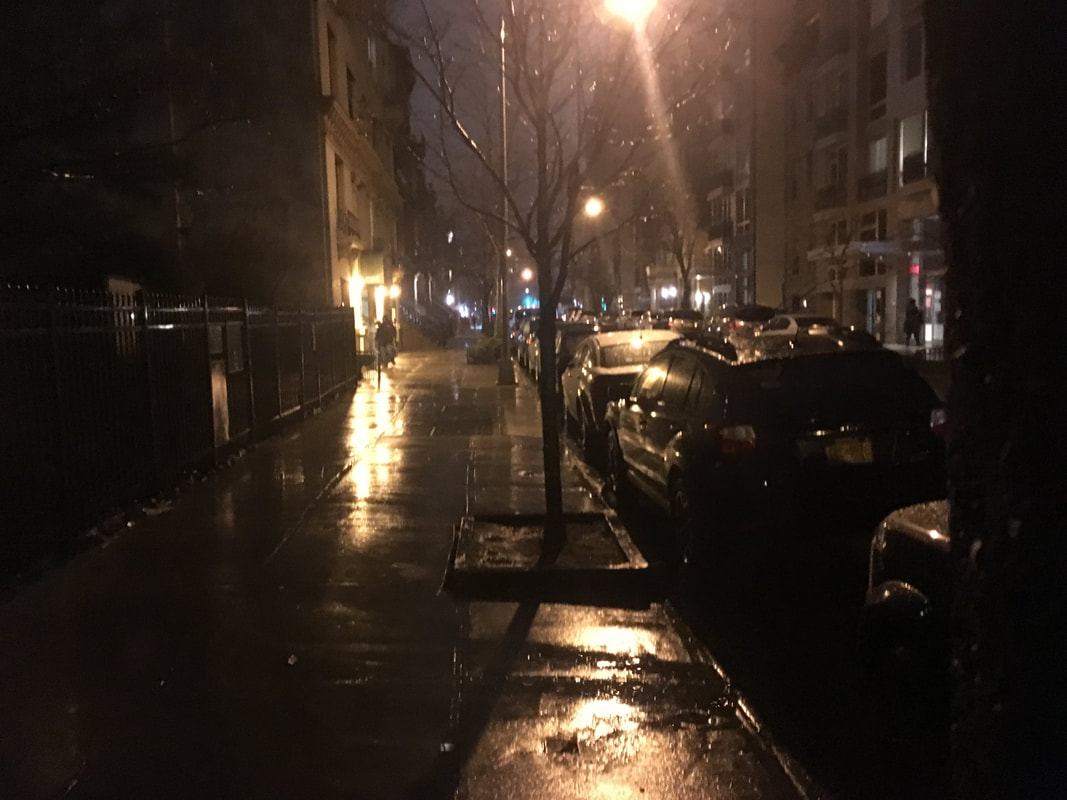 Dr. Jekyll lives on the left. Poorly lit sidewalks with sodium streetlights meant for cars, not people by Greg Saville What’s up with sidewalks? Walkability might be the gateway to a friendlier and safer city, but it requires a high-quality place to walk with interesting destinations. My walks of late uncovered some big-time flops. What are designers thinking when they create sidewalks? 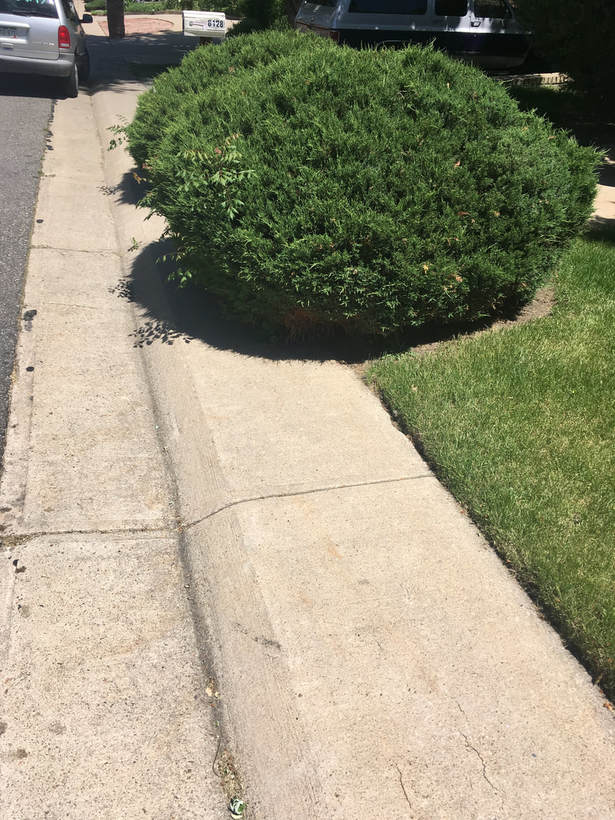 Shrubs 1. Sidewalk 0. Too narrow and obstructed by private landscaping Some sidewalks are inappropriate for people with disabilities. Others have street signs in the middle of the sidewalk forcing walkers onto the street. Yet others are dark at night, in disrepair, too small or are encroached by yard landscaping. 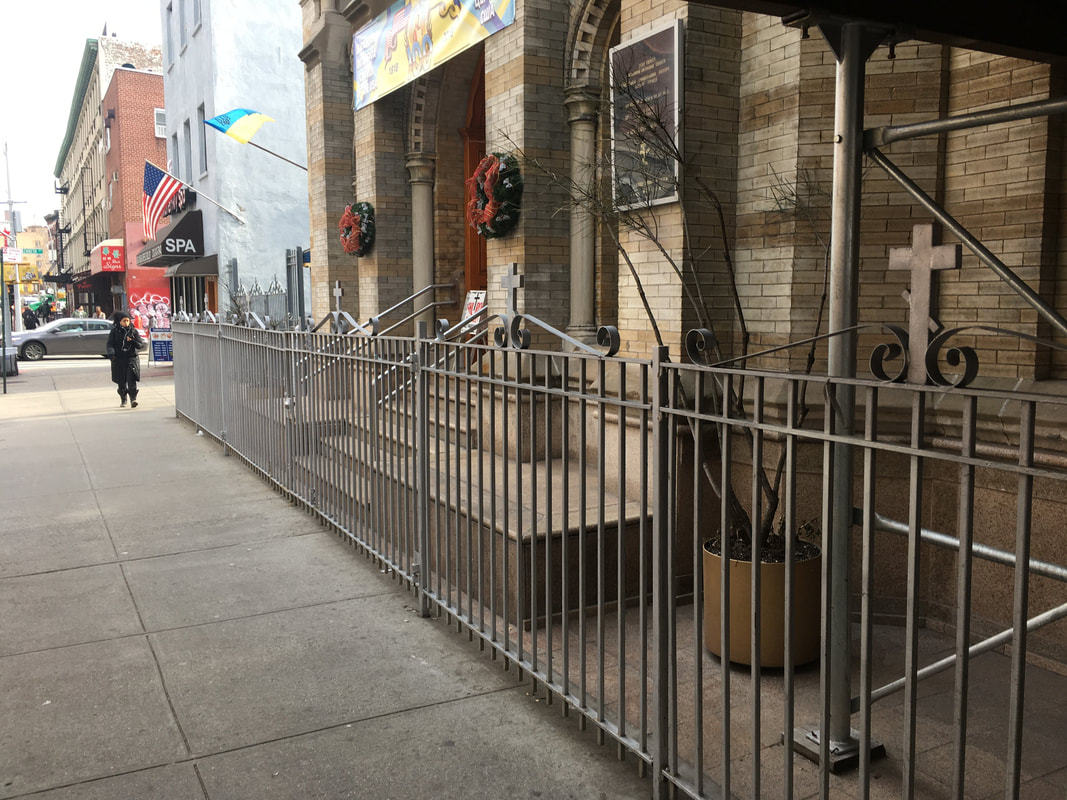 Salvation lies elsewhere. This church dismisses walkers by fencing front stairways Some municipalities require homeowners to keep sidewalks clean in front of their home and, in winter cities, free of snow. That is reasonable. But cities often expect too much, such as when public sidewalks are worn or damaged and homeowners are required to pay thousands for repairs. Too often sidewalks are poorly designed and they end with no destination. 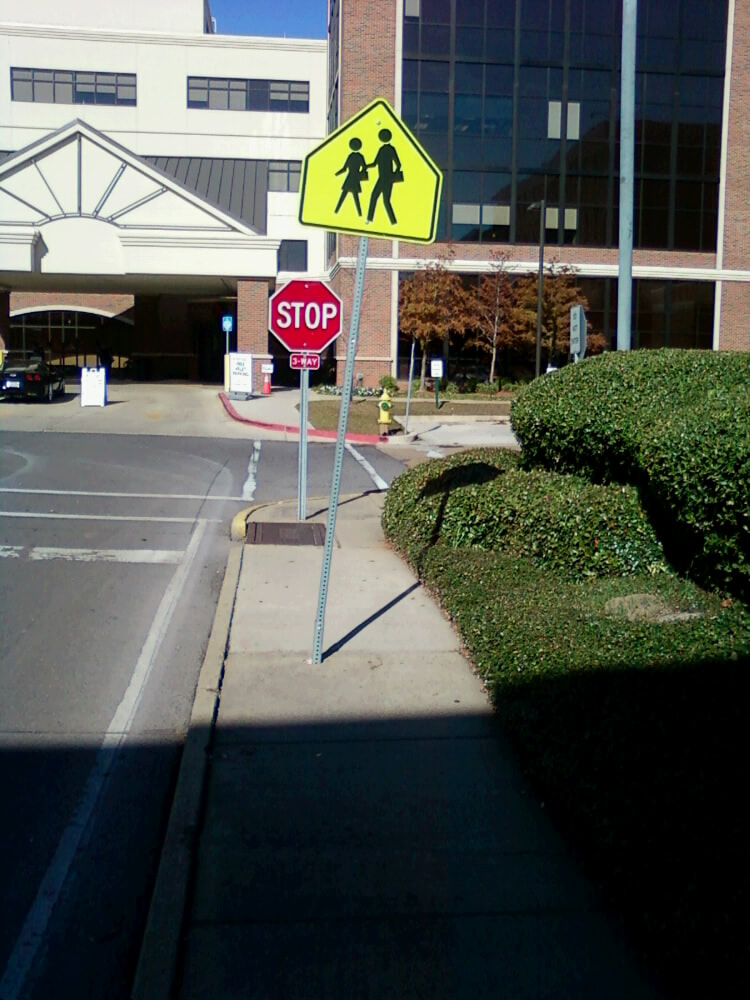 Logic lost! Warning walkers of a crosswalk, but forcing them to walk onto the street to avoid the sign SMART GROWTH In the planning movement called Smart Growth, walkability plays an important role. One attempt to measure walkability is The Walk Score, but it is far from ideal (try it). 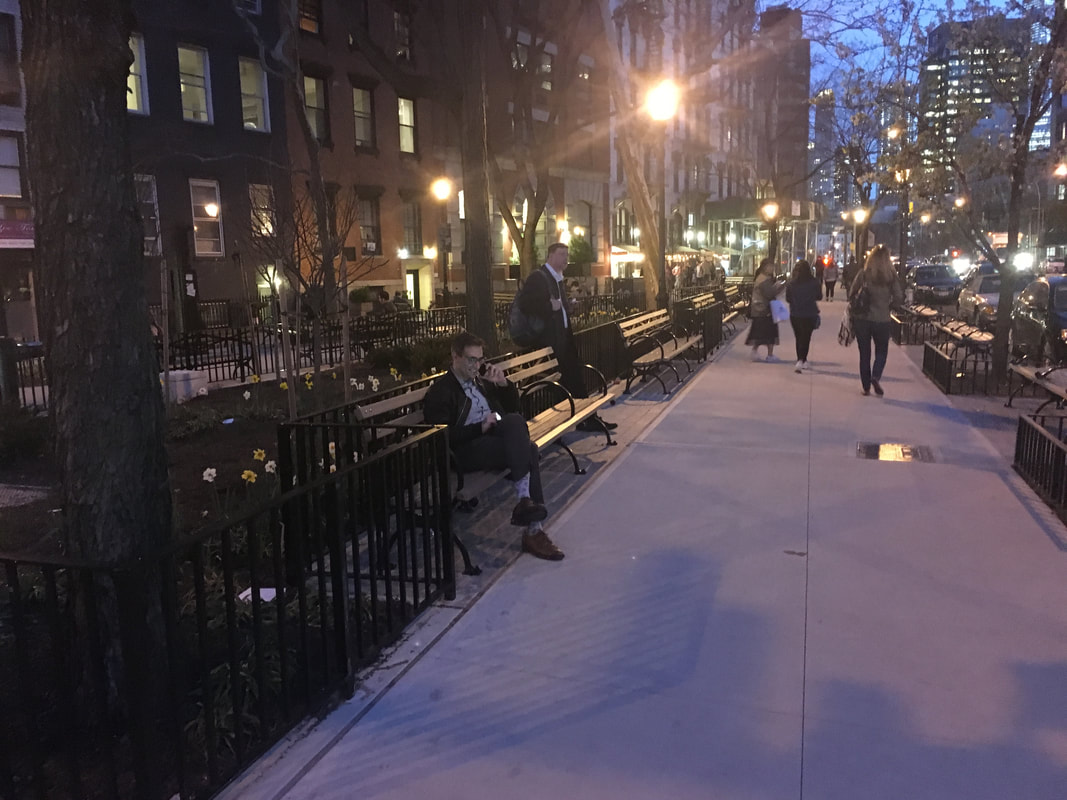 Activating a sidewalk with lighting, benches, and a night-time economy My current address has a measly Walk Score of 46, making it car dependent. Yet, nearby are trails, a lake, park, and mountain views. My former address scored a dazzling 84; In one direction there were great restaurants, parks, a library, coffee shops, school, and trails. Yet, in another, you could just as easily get caught between gang shootings. Obviously, Walk Scores say nothing about neighborhood quality. 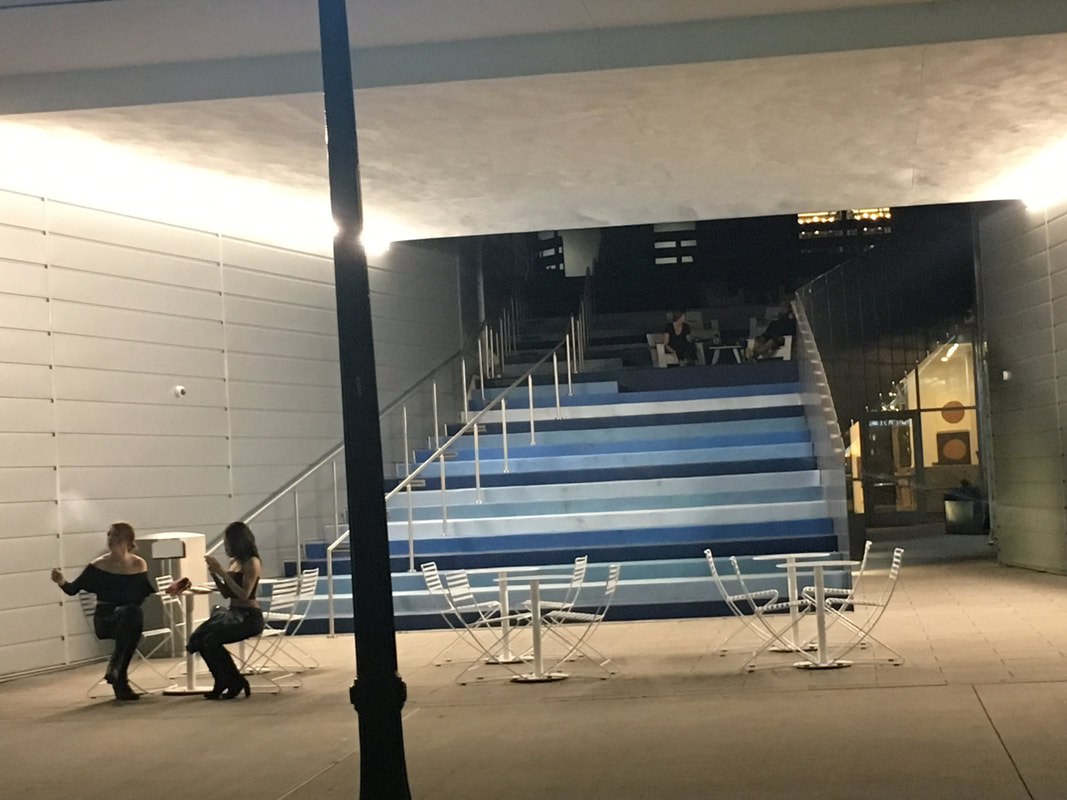 Interesting design, colors & lighting attracts people Recent Smart Growth designs include the SmartCode concept, an attempt to replace restrictive zoning practices of the past. As yet, it’s unclear SmartCode prescriptions are any better at triggering the creative, bottom-up placemaking shown in a few of these photos. But it’s a starting place 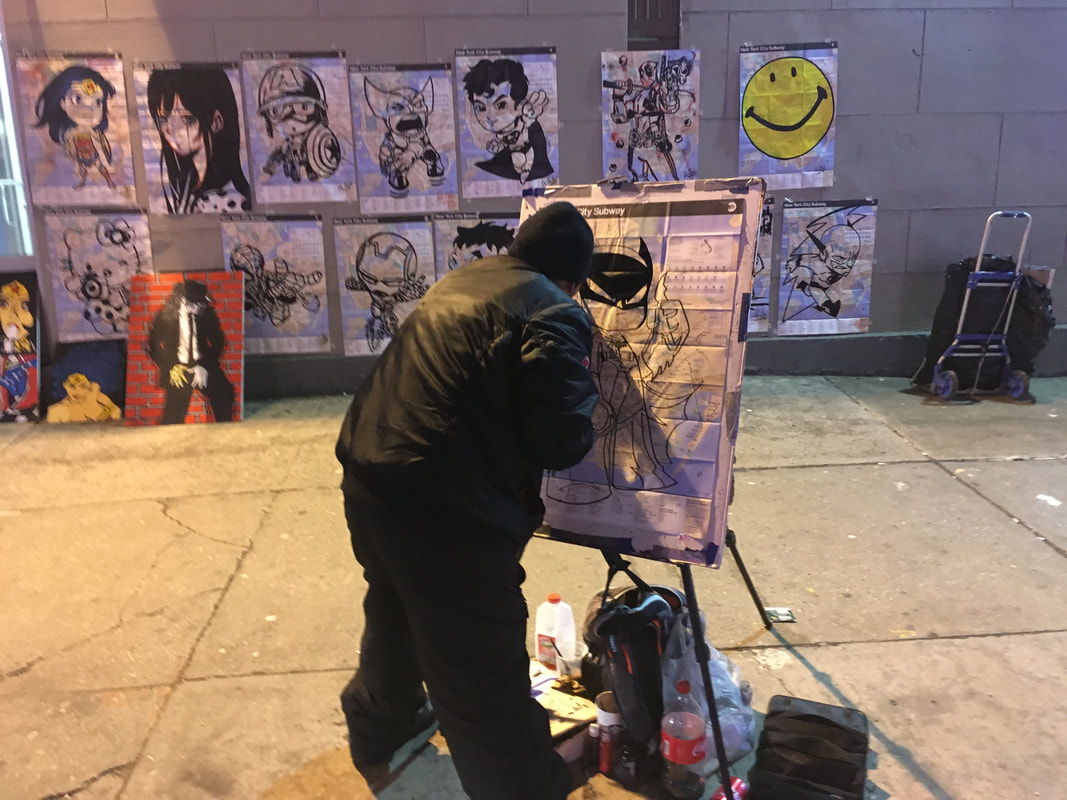 Street artists at night bring culture to dead streets 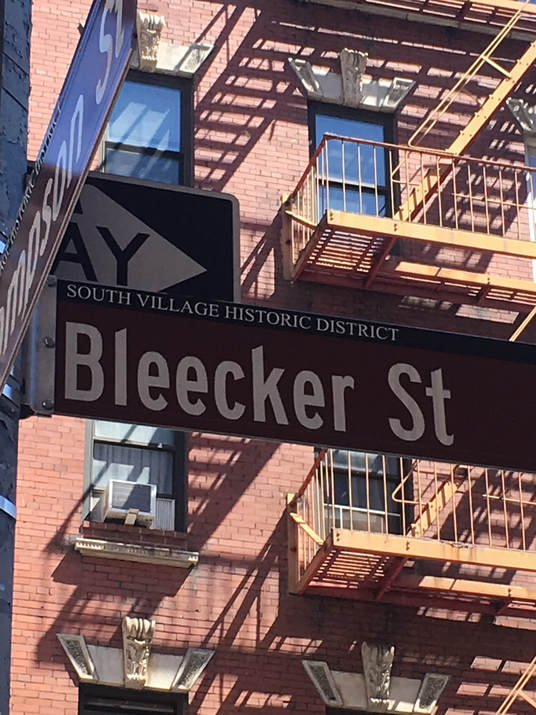 New York's Greenwich Village Fog's rollin' in off the East River bank Like a shroud it covers Bleecker Street Fills the alleys where men sleep Hides the shepherd from the sheep - Paul Simon, Bleecker Street by Greg Saville Walking through Greenwich Village in New York City, as I did last week, is like walking through American history. It reminded me of Simon and Garfunkle's 1960s song Bleecker Street, a nostalgic ode partly about a neighborhood New Yorkers call ‘The Village'. Greenwich Village is the place of America’s first integrated nightclub with Billy Holiday and where Edgar Allan Poe wrote poetry. It’s the neighborhood where Albert Einstein, Arthur Conan Doyle and Charlie Chaplin sat for sculptor Jo Davidson, and where Jack Kerouac and Allan Ginsberg started the Beat Movement. Bob Dylan started here. Jewish intellectuals fled Nazi Germany to the Greenwich Village campus of the New School for Social Research. 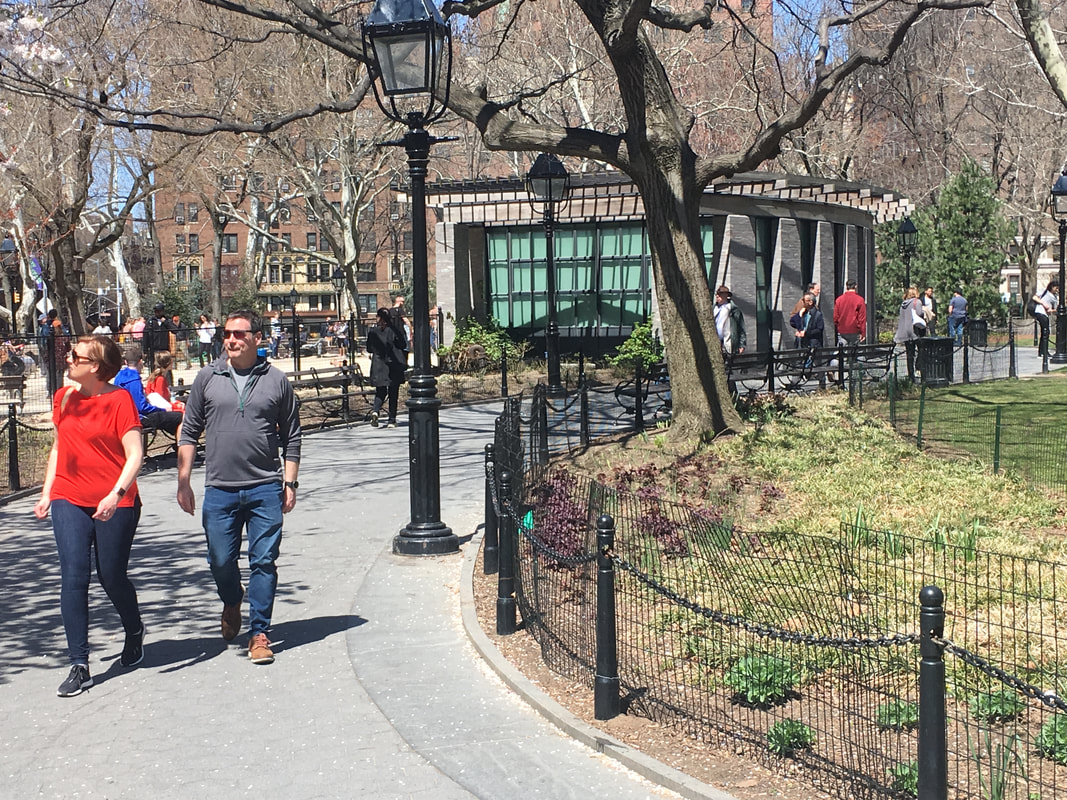 Springtime stroll in Washington Square Park Breathing life into the neighborhood is Washington Square Park, the nexus of public life in The Village. Fifty-seven years ago another Greenwich Village luminary, Jane Jacobs, published her landmark text, The Death and Life of Great American Cities in which she wrote about the attempted destruction of Washington Square Park. SLICING WITH AN EXPRESSWAY In 1961 Washington Square Park was to be cut in half by an expressway and a pedestrian overpass, diced into slices by Robert Moses, former NYC Parks Commissioner. Moses was a leader in the modernist movement of city planning and, more than others, he led an urban renewal revolution to build expressways and expand growth into suburbs. 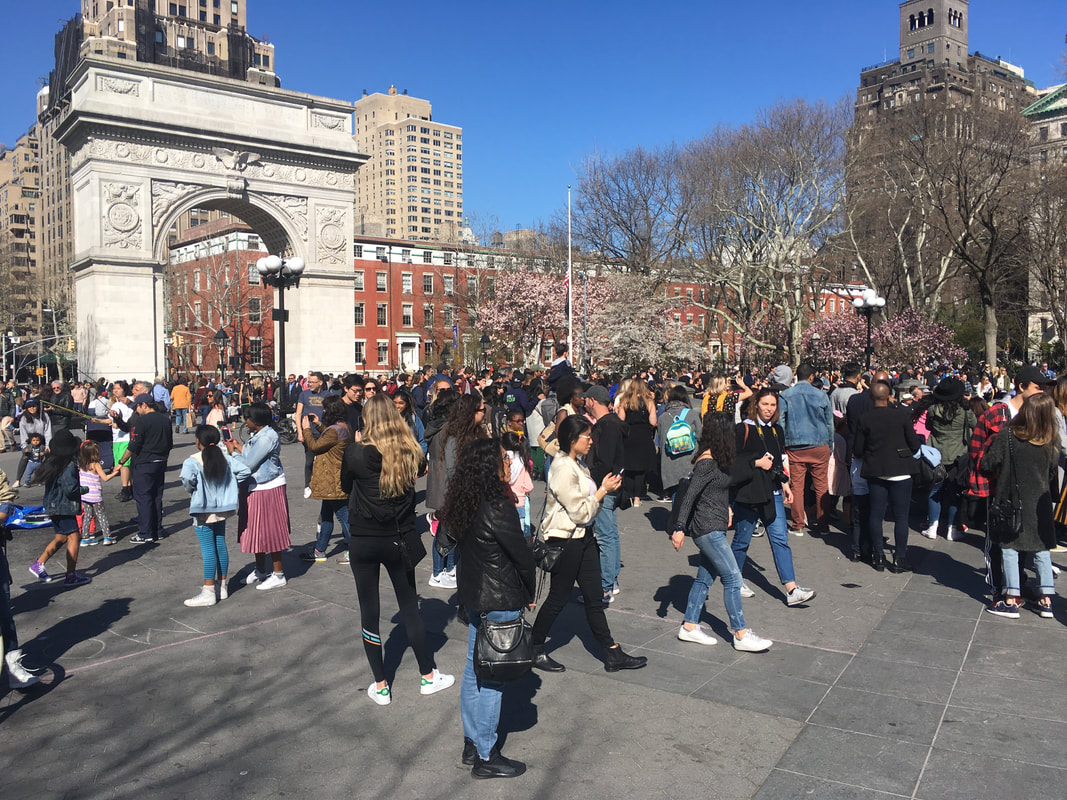 Enjoying an afternoon in the park On one hand, Moses built hundreds of city parks and public swimming pools, but on the other he divided neighborhoods with an orgy of expressway building. In the late 1950s, Washington Square Park, the lifeblood of Greenwich Village, was next in line; that is until Jacobs and her fellow Greenwich neighbors mobilized public support against the plan. It’s difficult to imagine the decimation of Greenwich Village, the heritage it entailed, and the history it enshrined if Moses had been able to plow a wide expressway through the beating heart of that park. In many ways, Jacobs and others launched a crusade against Moses and modernist planning theory. Fortunately for us, she succeeded. 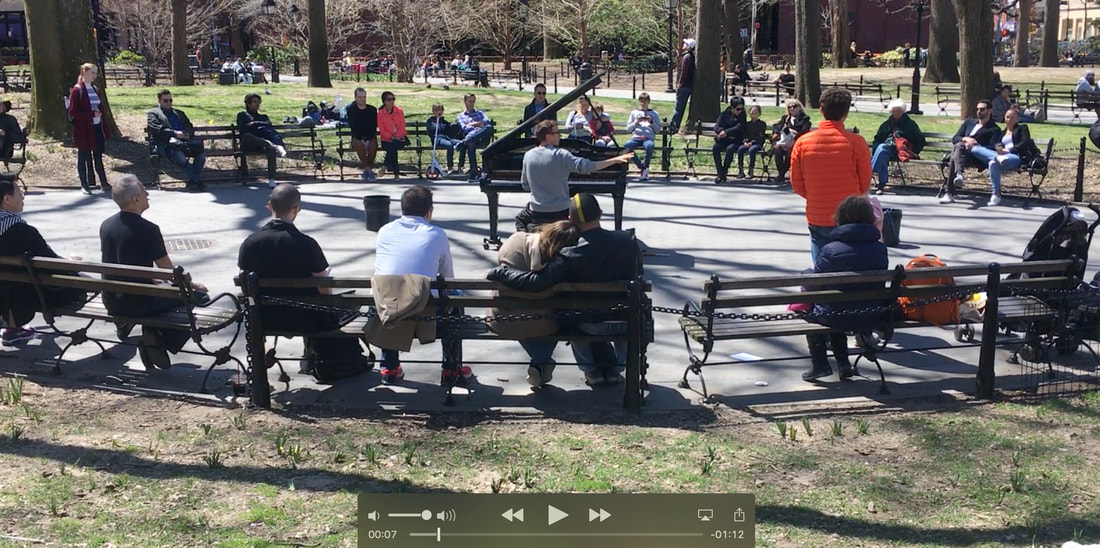 Street piano in the park A half-century after those battles, a stroll through this iconic Greenwich Village park offers tangible proof how, at least in this case, local efforts and bottom-up thinking blew away the master planning fog of some top-down schemers. 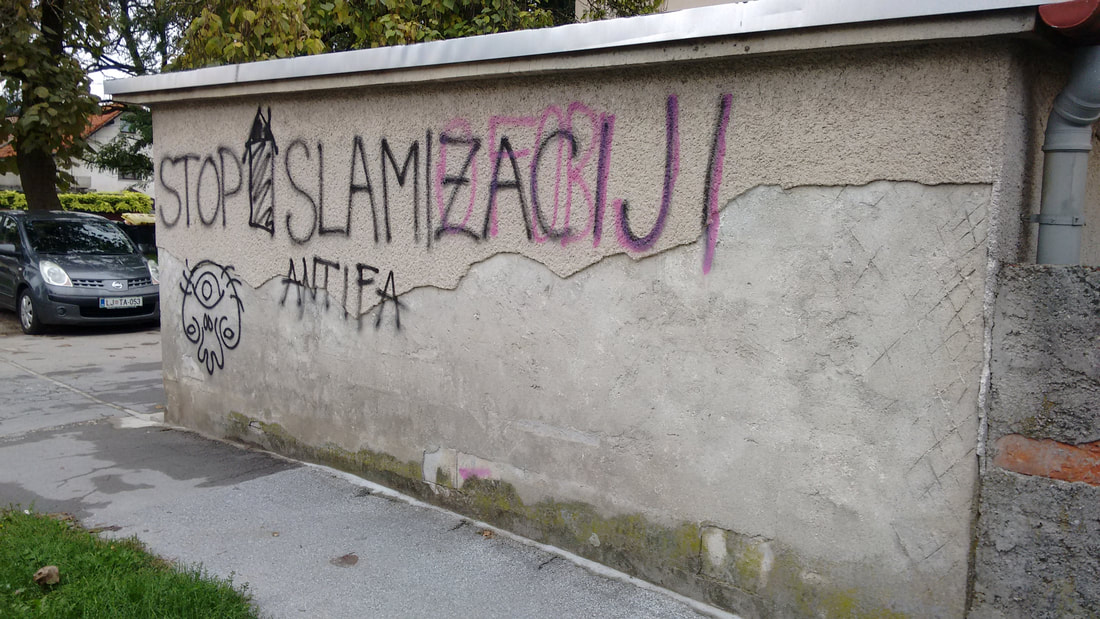 STOP ISLAMOPHOBIA - A negative graffiti tag transformed into a positive message by Mateja Mihinjac Many walls and underpasses in the city of Ljubljana are covered with graffiti. A great number of these are considered non-artistic forms of graffiti or tagging. But there is another perspective worth considering. Crime prevention and CPTED thinking teaches us that graffitied walls signify poor maintenance and lack of ownership thus contributing to crime and fear. In many western cities, authorities counteract this by legitimising the visually appealing forms of graffiti and containing them to particular areas of cities. However, while the question of vandalism versus art has received much traction, the intended messaging behind graffiti has been neglected or discredited as acts of vandalism and youth misconduct. 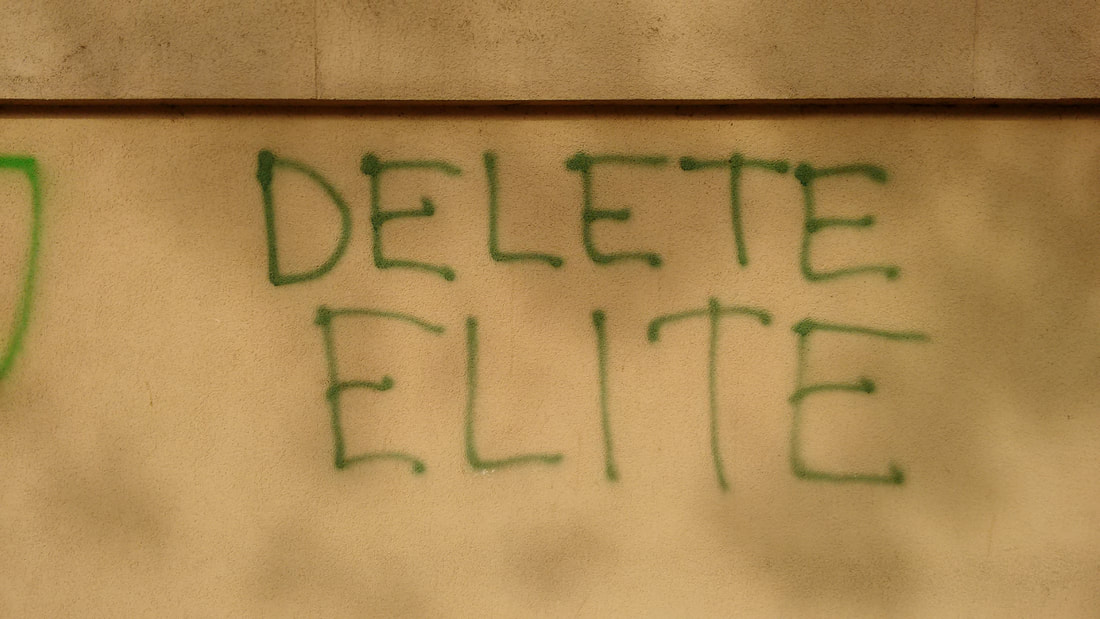 Ljubljana graffiti with political message for social equality URBAN VOICES - A DEMOCRATIC MEDIUM OF COMMUNICATION Ljubljana, the capital of Slovenia, has had a long history of walls covered in socio-political messages. Following the 2nd World War, graffiti has been used as an important avenue for sharing political views and resistance to occupational rule. Today, graffiti is still used as an important medium for expressing dissatisfaction with the current system, and as a form of political activism calling for public protest and social justice. As a bottom-up form of political activism, some scholars consider graffiti the most democratic medium for expressing personal opinions publicly. Graffiti can express values while at the same time encourage a dialogue about conflicting social issues. This has been especially popularised in the work of the famous British graffiti artist Banksy.  Social justice graffiti with a message Through graffiti, young people can also become more active in expressing their political opinions while marginalized groups use it to publicly voice their concerns and respond to criticisms. Despite the view of law and society, graffiti can be one of the most inclusive mediums of public discourse. SOCIO-POLITICAL GRAFFITI AS A MIRROR OF SOCIETY The messaging behind graffiti in Ljubljana demonstrates these points. It communicates several contentious public issues, for example, some graffiti expresses dissatisfaction with the political system and government decisions appearing during the 2007/2008 financial crisis. Graffiti were used throughout the city to call for social change and entice civic organisation to join the protests to preserve social protections threatened by reforms. Graffiti were a form of resistance calling for collective social action. 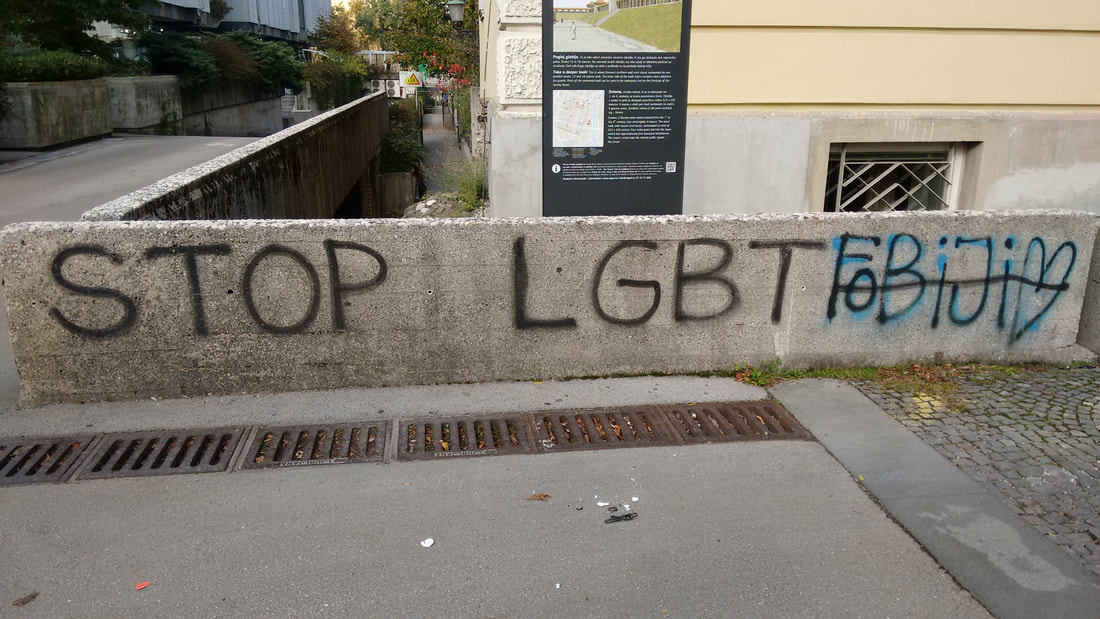 Anti-LGBT graffitii transformed into positive message by social graf writers More recent graffiti reflect an increase in homophobic messages regarding a same-sex marriage referendum and also ethnic-nationalist sentiments concerning the European refugee crisis. This graffiti appeared in response to unfounded community concerns. Realising the powerful effect of forming public opinion through graffiti, graffiti activists have found a way to transform these hate messages. Graffitists do this by rewriting over an existing message or adding to it thus neutralizing negative messaging or transforming it into a positive public debate. This type of graffiti promotes tolerance and counteracts the damage that intolerant messages have on society. 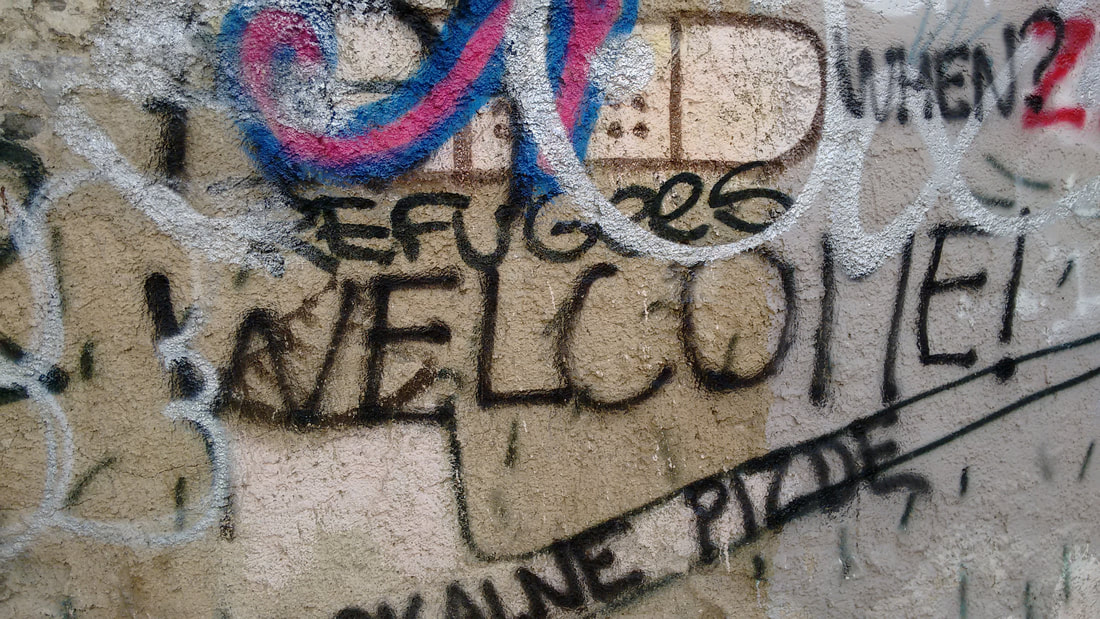 REFUGEES WELCOME - Fighting anti-immigrant bigotry with positive messaging "BLANK WALLS MAKE BLANK PEOPLE" Finding the consensus between graffiti legality and alternative democratic expression is not straightforward. In SafeGrowth we encourage resident empowerment, caring for neighbors, and active citizenship. Such empowered citizens, especially when marginalized, need a suitable medium for expression. Until they find a better solution, they will continue to use walls to speak up. .jpg) The cyberpunk architecture of downtown Shibuya, Tokyo - photo guwashi by Gregory Saville Last week the sci-fi film Bladerunner 2049 opened worldwide to rave reviews. In artistic circles, this is known as exceptional neo-noir filmmaking, or more accurately 80s style cyberpunk. Bladerunner 2049 follows the original Bladerunner film from 1982, now considered a masterpiece. It is based on a book by award-winning sci-fi writer, the late Philip K. Dick. Dick’s themes included dystopian futures, authoritarian corporations, and government conspiracies. Bladerunner occurs on a future Earth poisoned from environmental collapse where cops (Bladerunners) are assigned as bounty hunters to search and eliminate a minority group of human-like androids called Replicants. Written 50 years ago, Dick’s tale foreshadows the environmental crisis, immigrant-purging, social turbulence, and police violence on our streets today. In short, he nailed it! ART REFLECTS LIFE For evidence, take a look at the street architecture of the future Los Angeles in Bladerunner and compare that with what is emerging in our biggest cities. Art, clearly, reflects life! 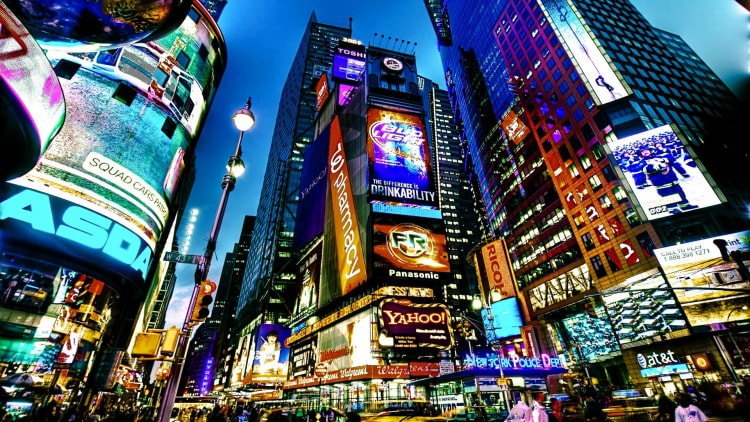 The neo-noir electrification of New York's Times Square - photo DB Desktop Background Very seldom are artistic and cultural movements restricted to galleries and magazines. Even the most outrageous art and music seep out into politics, daily life and, most importantly, ways of thinking. That is because artistic and cultural movements do not arise on their own; they are a reaction to - or against - current affairs. That is why they are a barometer of things to come. Consider how 1960s counter-culture morphed into environmentalism, civil rights, and equality for women, concepts in common parlance today. Or consider the artistic movement called modernism in the early 20th Century that evolved into the International Congress of Modern Architecture and the global planning disaster we now call urban sprawl.  Pruitt-Igoe, the 1960s modernist housing disaster in St. Louis became a rallying cry by Oscar Newman and Jane Jacobs against crime and modernism in urban planning - photo US Geological Survey Bladerunner is art that tells a story: Philip K. Dick’s cyberpunk story of urban dystopia! For real-life examples look carefully at the cores of our most modern cities to see the worship of architectural cyberpunk. If this analogy holds, then what about last week’s horrific mass murder in Las Vegas, the on-going trouble with police shootings, political turbulence, and environmental disasters of late? Are they signals that the Bladerunner story is unfolding as predicted? Never has there been a more appropriate time for a better model of neighborhood safety and urban growth. 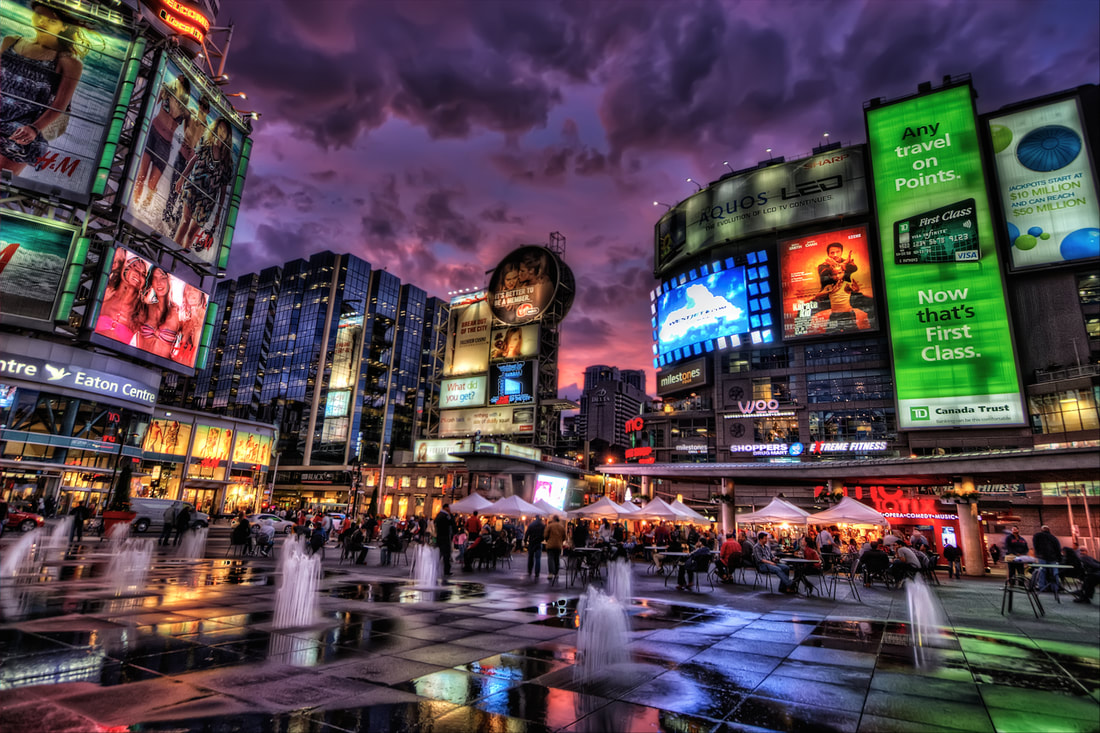 Dundas Square, cyberpunk in Toronto - photo by Pedro Szekely CC by 2.0 via Wikimedia Commons 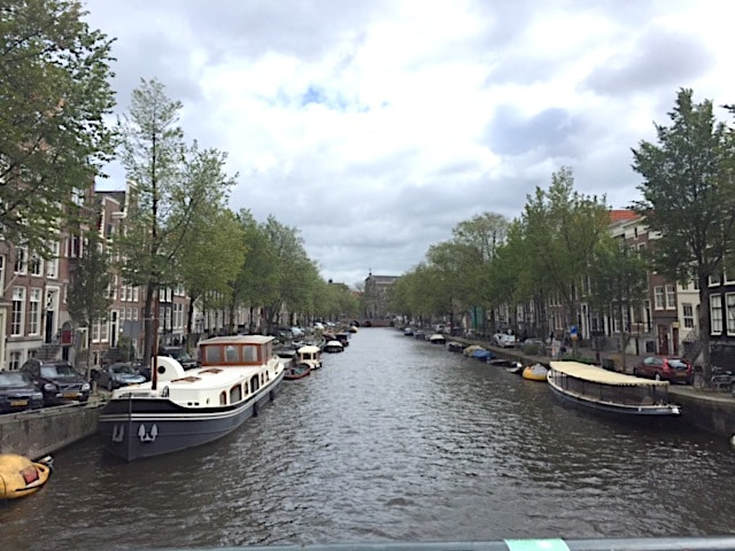 Amsterdam, The Netherlands Tarah Hodgkinson Making streets safer means activating them with all kinds of tactics, including intensified bicycle usage. In 2012 the SafeGrowth blog How the Dutch Saved Their City, described how the Dutch transformed their cities by dramatically changing their road infrastructure and supporting cycling culture. Today, there are almost 900,000 bikes in Amsterdam alone, making it the country with the highest rate of bike ownership in the world. Lately, however, Amsterdam is dealing with an interesting issue. With over 50% of Amsterdam residents using bikes as part of their daily commute, they are running out of space to park their bikes. In fact, the city is now planning on creating 40,000 new parking spots. This issue not only speaks to the significant commitment the Dutch have made to make their city streets safer and more bike friendly but has sparked an opportunity for architectural creativity. PARKING ALTERNATIVES Unlike many cities in North America, with their sprawling, car-dominated cultures, space is a significant commodity in much of Europe. Some suggestions for bike parking alternatives include underwater garages and floating barges. However, these alternatives could pose cost and space restrictions. Therefore, bike parking in Amsterdam has begun to move upwards, rather than outwards. Impressively, architects are building vertical bike parking structures. These mimic many of the new designs for vertical car parking in countries across the world, but with an eco-friendly and street safety twist. 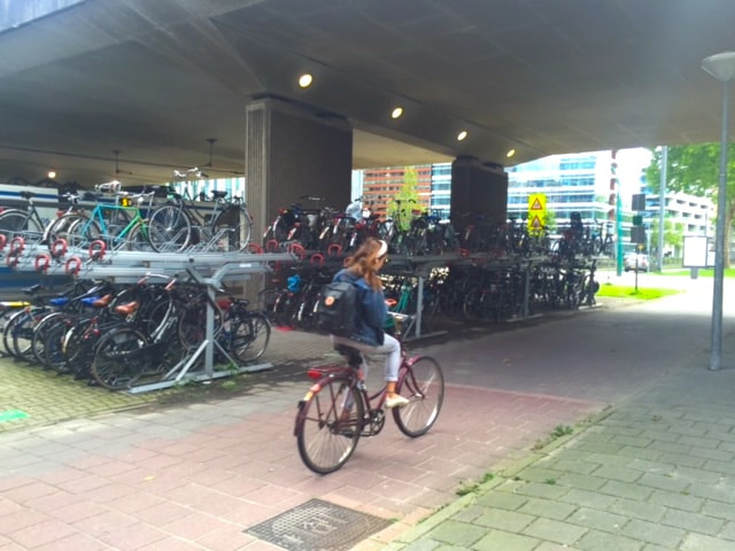 With limited space, the Dutch innovate There is a lot of hesitation among cities to switch to create large-scale bike paths and alternative transportation. Many fear that bike paths will impede the flow of car traffic and increase congestion. This notion is counterintuitive. In Vancouver the bike path network is constantly expanding, and with it, so too are the number of bike trips replacing car trips. That reduces congestion, not the opposite. The attempt to build new and creative ways to park bikes in Amsterdam demonstrates that the bike culture in that city, and other cities in the Netherlands, is going strong. It offers excellent ideas for helping other cities to start rethinking their systems. by Mateja Mihinjac On this blog, we’ve written about the importance of giving youth a voice and engaging them in public life. When they can participate, or even drive, the development of services for their use, they feel especially empowered. EXPLORING LOCAL POTENTIALS I like to explore hidden potentials in cities and one recent discovery in my hometown emerged as I enjoyed an autumn walk. It was a "Pumptrack", a continuous loop track intended for cyclists and skateboarders. Even more exciting for me was recognizing that track was situated adjacent to public housing thus providing youth with opportunities for prosocial activities, in this case, a recreational service. 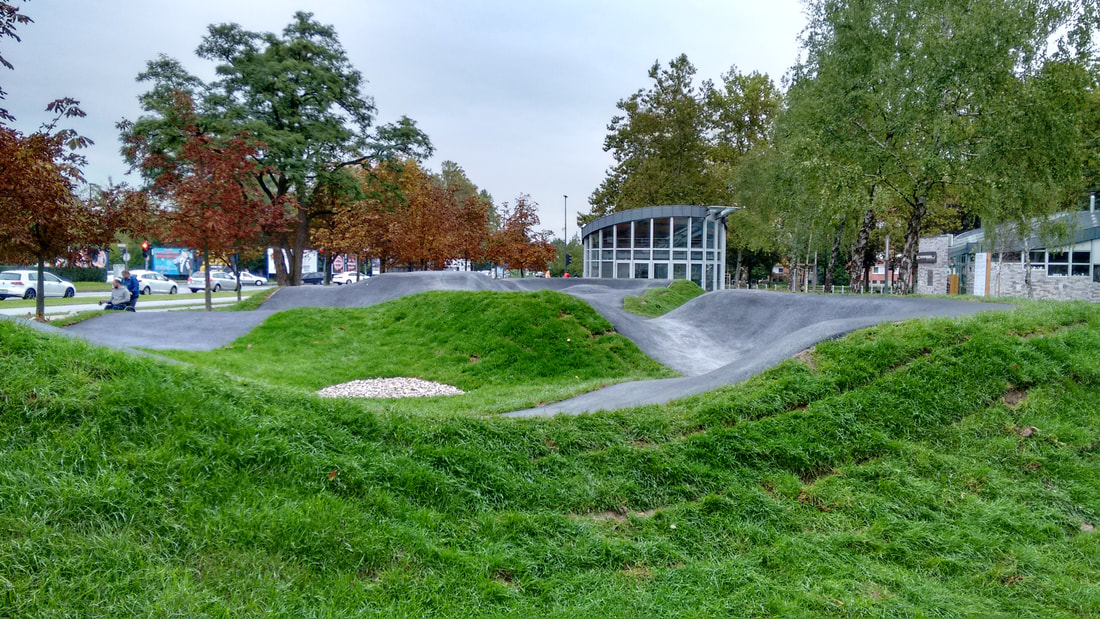 Pumptracks are continuous loop tracks for bikes and boarders The American National Recreation and Park Association stress that parks and recreation represent essential public services. Apart from economic value, health and environmental benefits, the Association recognized that access to such infrastructure reduces crime and juvenile delinquency. From criminology, we also know that providing recreational and healthy activities for youth builds resilience and provides a protective factor against delinquency. 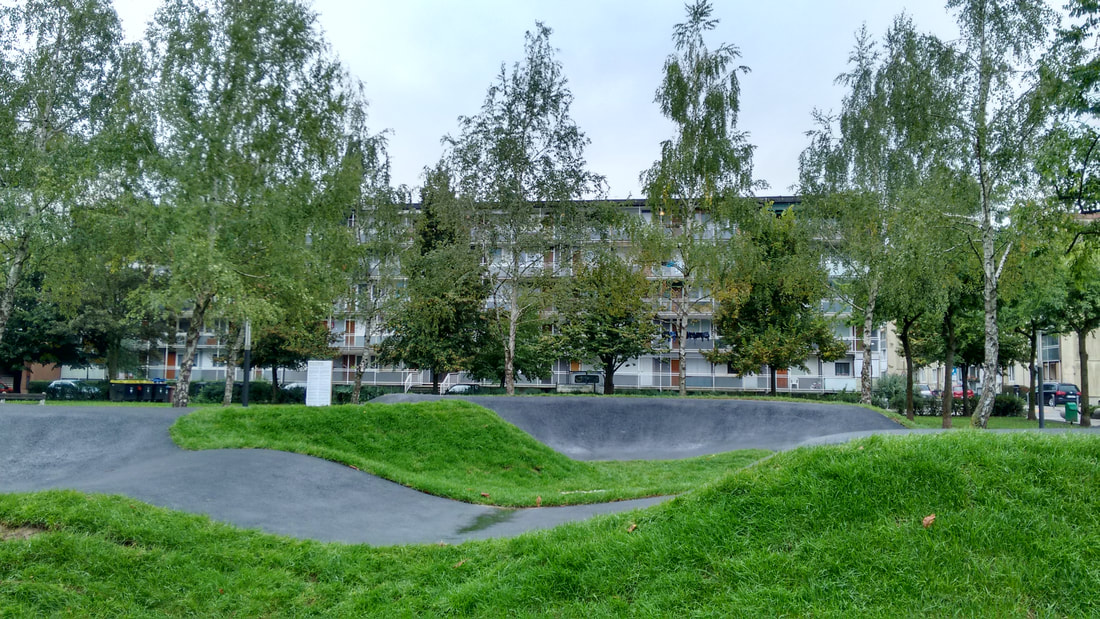 Siting the track adjacent to public housing ensures usage POSITIVE YOUTH DEVELOPMENT When communities invest in their assets to assist with the development of youth and their potential, they communicate to young people that they care for them. Reciprocally, the youth develop an attachment to the community and contribute to its wellbeing. Thus, according to one report, “youth are valuable resources to invest in and not problems to be solved”. Recreational infrastructures in cities are not extras! They offer an ideal platform for engaging and developing youth. Any future vision of the city must include them. 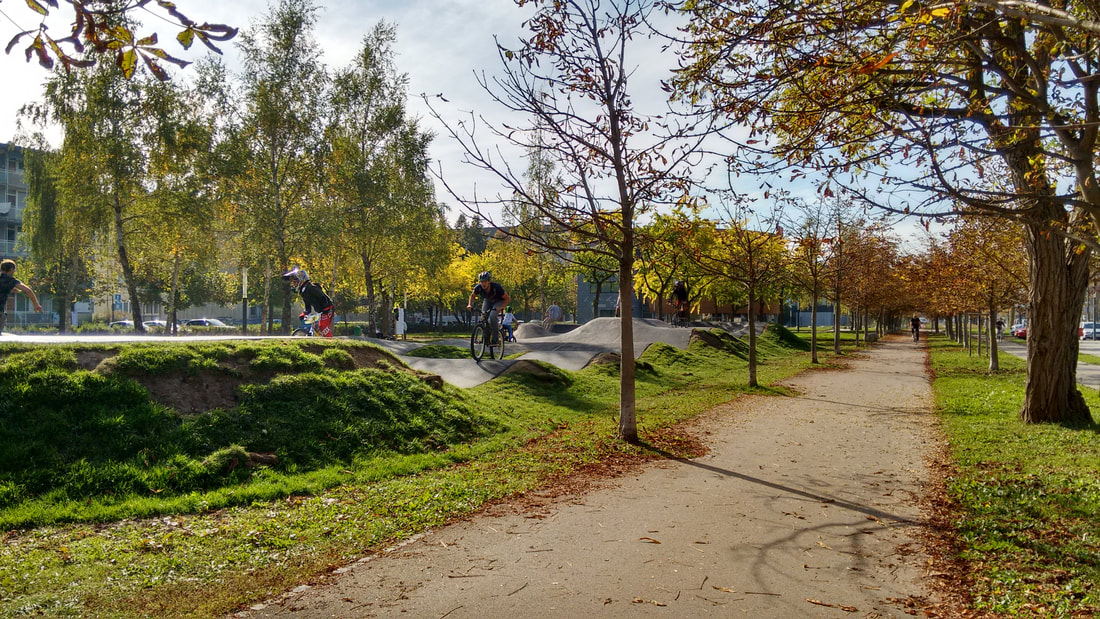 Integrating Pumptracks into urban park infrastructure 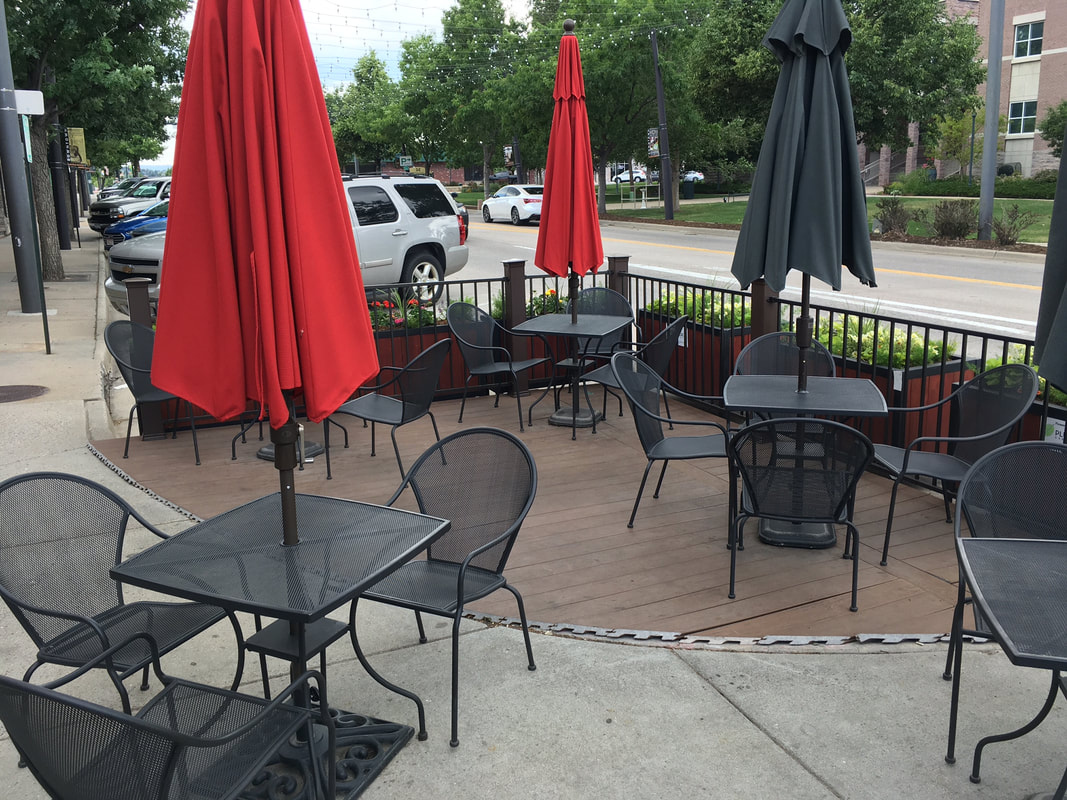 Cities are leasing parking spots to restaurants for rental fees by Greg Saville Years ago I spent an afternoon with the exceptional urban designer Richard Gardiner. Anyone reading encylclopedia references about the beginning of CPTED will recognize Richard Gardiner’s name, especially his 1978 book Design for Safe Neighborhoods, the first attempt to transform CPTED into a comprehensive planning system. In our chats, Richard described how he had moved away from CPTED and began focusing on the serious congestion problem of street parking. He had developed an ingenious parking management program to tackle the assumption that “free parking is actually costing governments and institutions millions of dollars each year without their actually being aware of it. Public parking in cities constitutes the third-highest hidden cost that U.S. cities face each year.” 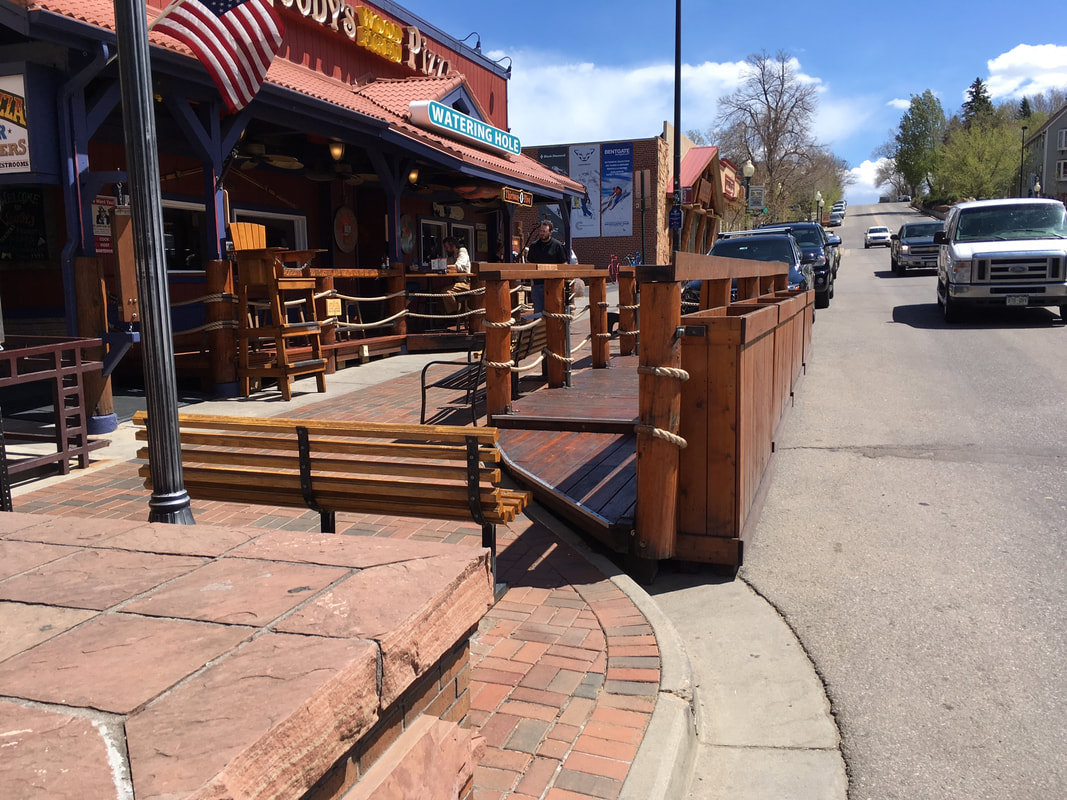 A "waiting area" where patrons stand in line for food and entertainment inside the bar I'm embarrassed to admit I just didn't get it. Urban land economics wasn't my thing back then; it seemed unimportant. But in the years since then, I came to see the huge impact on both safety and urban finance. This was especially the case when I observed the Portland Intersection Repair program where residents reclaimed their neighborhood by reclaiming their local intersection. PARKING SPACES FOR LEASE Lately, I’ve seen a fascinating variation on this theme: Municipalities that lease the street parking areas in front of restaurants and bars. The bars turn this area into outside sitting areas, eating areas or other uses for their patrons. 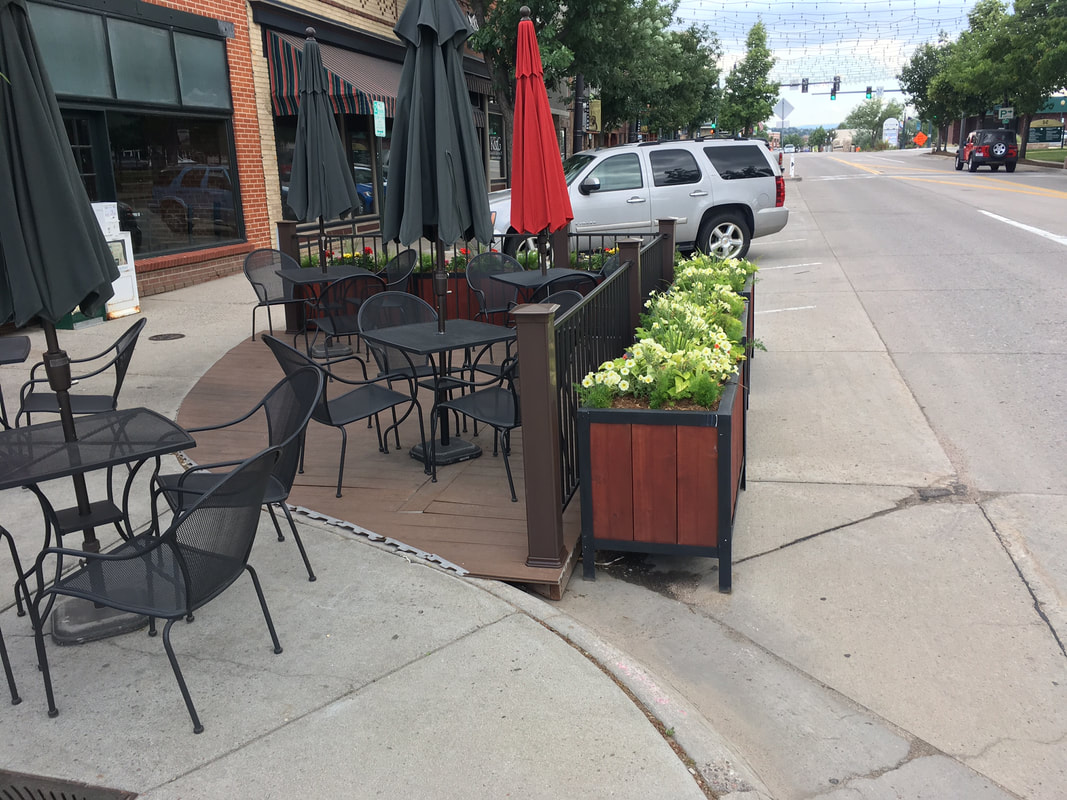 Landscaping to beautify former parking spots - Is this a proper use of public land? Does this help make sidewalks and streets safer by putting more eyes on those streets? Does it make those streets less safe at night if those same bars have poor management and thereby trigger drunken street brawls and drunk driving? Obviously, funds from leased parking spaces will feed city coffers and that might help recover the hidden costs of free parking (or with few meters, minimally costed parking). Those funds might help cash starved municipalities reinvest into their cities. But what, I wonder, does this mean for other types of transportation, such as bicycle riders who still have inadequate and safe parking spots for their bikes? 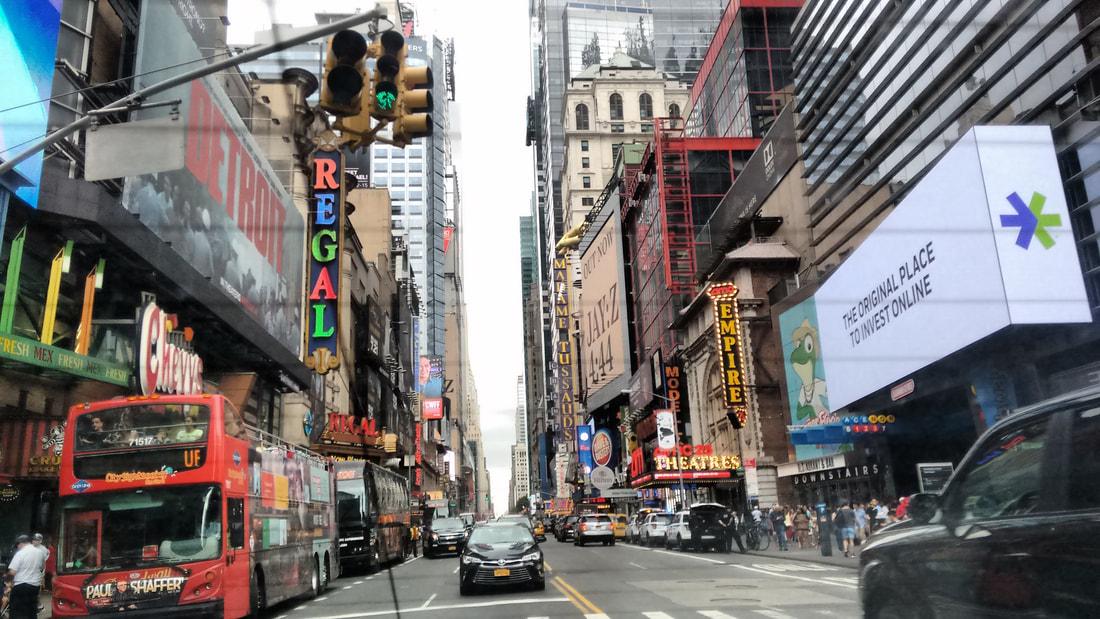 Biking Manhattan - A scary proposition without proper design by Mateja Mihinjac During my recent visit to New York City, I was thrilled to witness the upsurge in cycling in this iconic city. As an avid cyclist, I love when cities provide infrastructure for bipedal commute. Promoting physical and social connections through design, such as increased bike usage, fosters interaction and establishment of social ties. In SafeGrowth we know that this also influences safety and perception of safety. New York City, the metropolis well known for its traffic congestion and yellow cabs, has followed the lead of several European and Australian cities and in the past decade expanded its cycling infrastructure. Cycling in the city has since 2005 increased by an astounding 260%, currently amounting to 450,000 daily trips. In 2013, the city also introduced the nation’s largest bike sharing program Citi Bike, which currently offers 603 bike stations and 10.000 bikes across the city’s five boroughs. These bikes are extensively used by city dwellers and tourists alike. Exploring Manhattan on a bike CYCLING FOR HAPPINESS? Replacing motorised commute with biking impacts health and social connectedness, two of the three most important contributors to happiness in urban environments. Moreover, planning for environmentally sustainable cities that prioritize cycling and walking is intrinsically linked to socially cohesive communities. 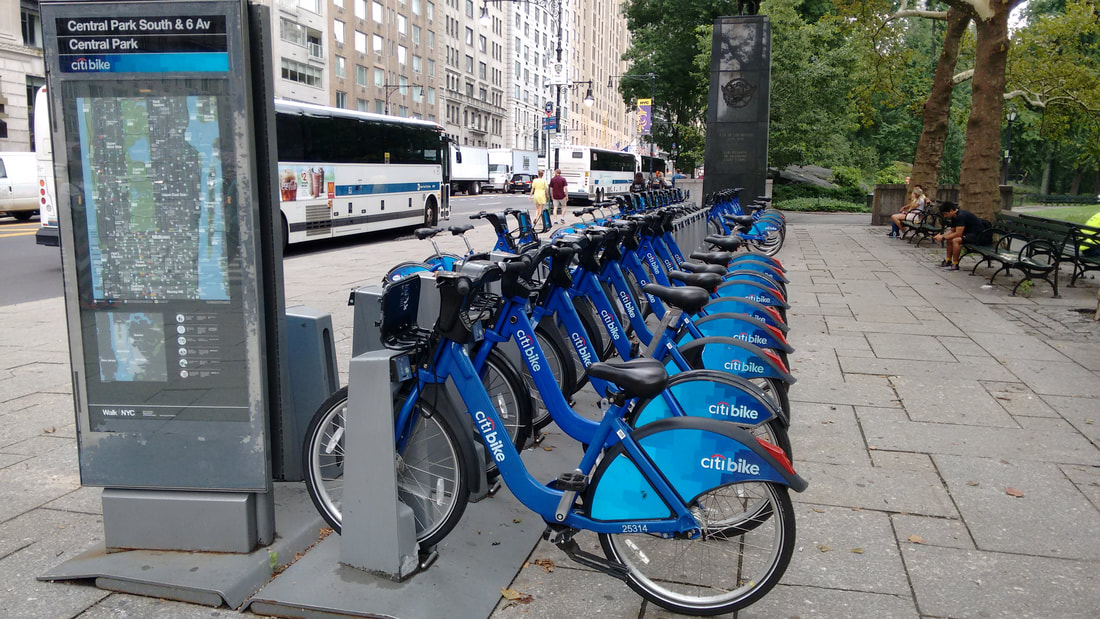 603 bike stations and 450,000 daily bike trips across New York City IMPROVING CYCLING INFRASTRUCTURE Talking to locals revealed that despite great progress, cycling infrastructure could benefit from several improvements. The first was more bike lanes and Citi Bike stations outside downtown and affluent areas, a common need in other cities. Ironically, those living on the peripheries of the cities and those less prosperous are the ones who would most benefit from biking connectivity. The second issue concerns safety. A 2015 article reported 90% of bike lanes in New York City were unprotected, meaning the majority were lanes without a safety buffer between cyclists and cars. This is surprising knowing that protected bike lanes can reduce the risk of injury by 90% and also increase ridership. 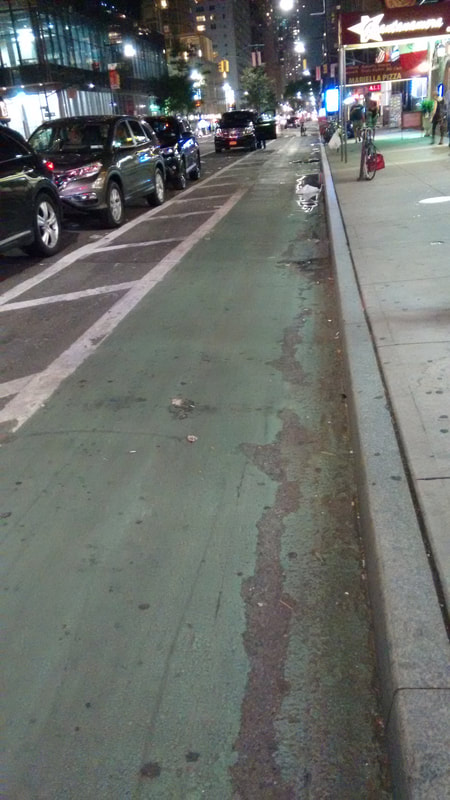 Buffered bike lanes are a necessity for safety CYCLING FOR CITIES OF TOMORROW Promoting cycling in progressive cities like New York is an excellent avenue for developing environmentally and socially sustainable cities. Planners should encourage future expansions of bike infrastructure in less affluent areas and designers must follow guidelines for safety and buffered lanes. Designing future cities around cycling will contribute to overall healthier and happier cities.  Downtown telecom company bricks in windows and leaves us with a blank wall by Greg Saville Walking downtown a few days ago I came across a large telecommunications center that dominated an entire city block with blank walls. It is a sight that appears with increasing regularity in cities everywhere. The telecoms want to keep their innards secure, but they choose to locate downtown. When meeting someone new we generally say hello, shake hands, and exchange pleasantries. The pleasantries are often meaningless. “Nice to meet you”! Perhaps. Perhaps, not. But it is polite to greet someone well. It sets a tone for a civil relationship. There are consequences if you present an obnoxious face in public, or worse if you ignore them. It makes you look like a rube. You may think laws keep chaos at bay, but that is a legal conceit. In fact, sociologists, anthropologists, and well-trained criminologists will tell you it is everyday civil behavior - norms - that keep us civil and safe. 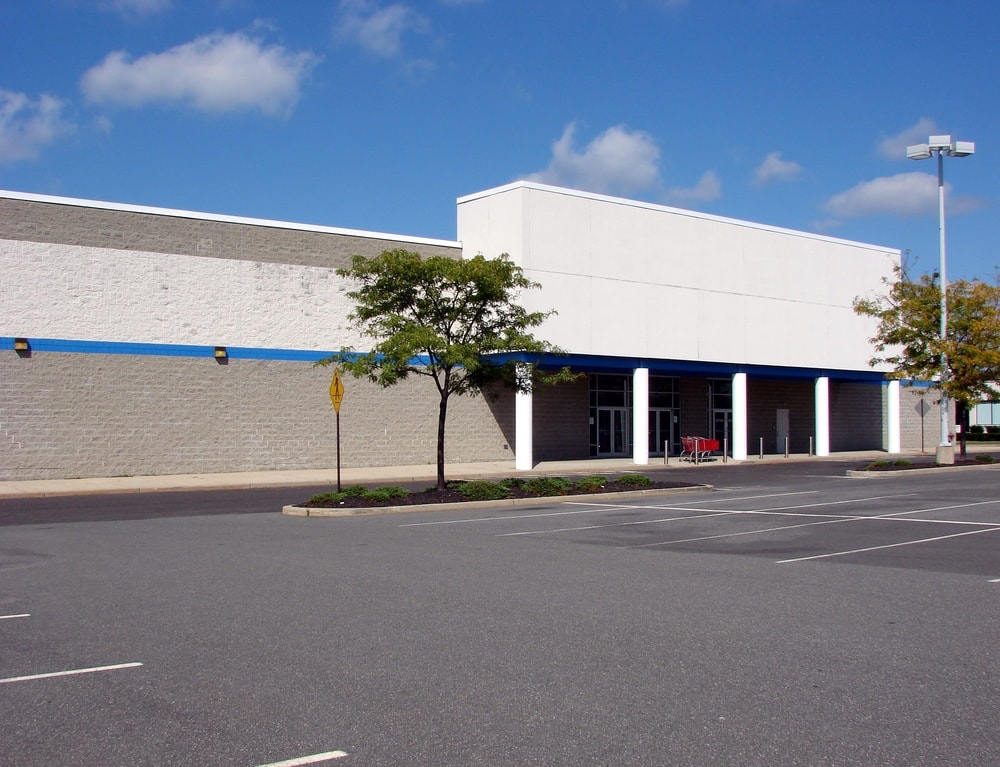 Shopping malls are the worst blank wall offenders HOW TO ADDRESS THE STREET It is no different for architecture in public places, especially downtown streets. Walking to downtown shops, waiting at bus stops, or simply enjoying a stroll are activities that make places hospitable and civil and mitigate uncivil behavior. We are embraced, or assailed, by how buildings address the street with their architecture. If they ignore the street with blank walls, they assault us. If they address the street in a civil way, they welcome us. This is called streetscaping. Architects have many tools to do this well; building massing, permeable designs, paying attention to the pedestrian experience. Some call it placemaking. New York blogger Andrew Manshell has a great blog on this topic. 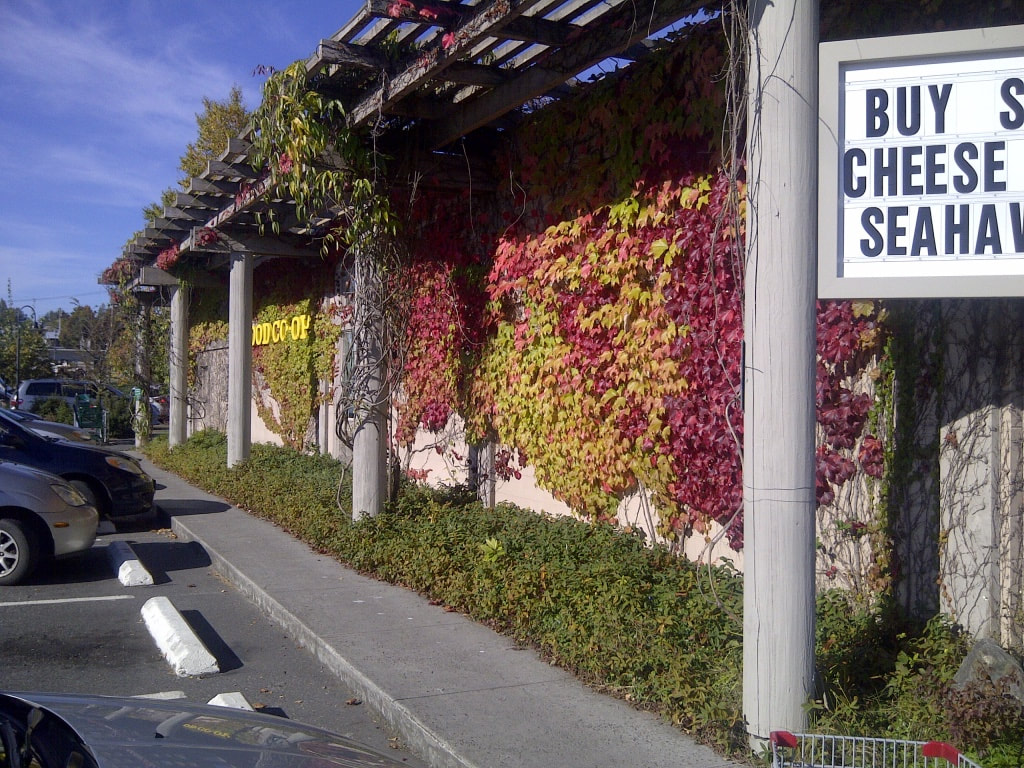 Community owned food co-op gets it right Streetscaping does not mean addressing the street with blank walls, walls that ignore the street and the people on it. Blank walls on public streets are obnoxious, like the obnoxious rube. They tell us we don’t matter. Blank wall owners might benefit from our public utilities, public streets, and our fire, police and other services, but they could not care less how they address us on our streets. So their massive blank walls make our streets inhospitable... so what! Sound familiar? That is the behavior of the sociopath. No consequence! 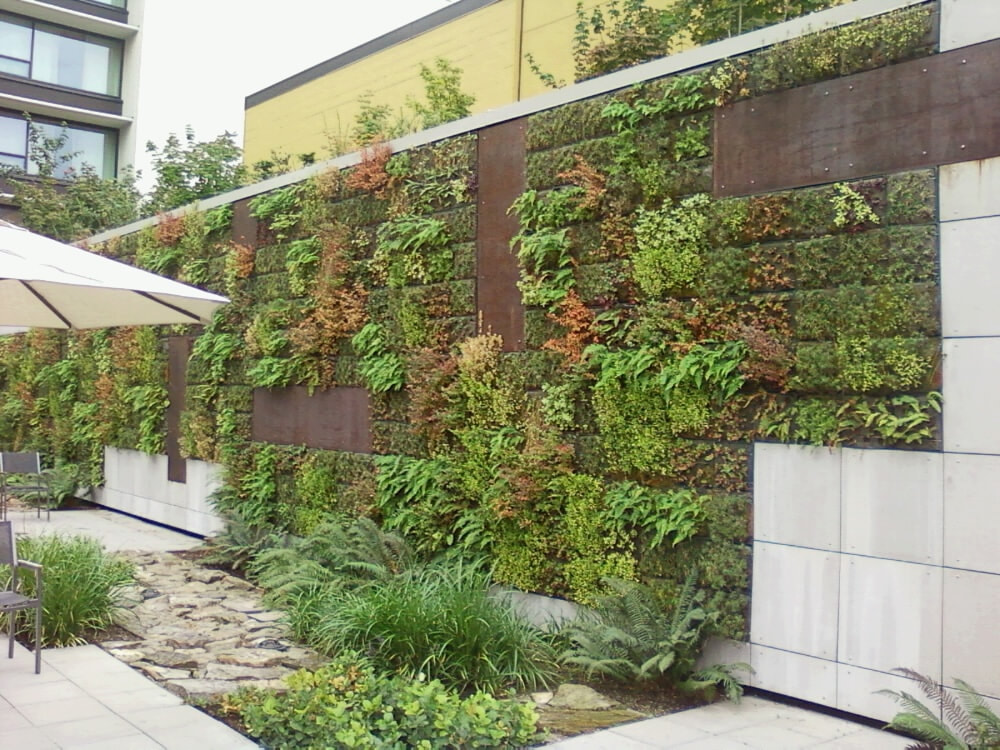 Green walls are in DESIGN SOCIOPATHY Blank walls are the architectual version of design sociopathy. Back in the 1980s, William Whyte wrote about the poisonous effect that large blank walls had on city life. Boring convention centers, government buildings, megastructures, and parking garages with large blank walls on public streets all fell under his wrath. But in City: Rediscovering the Center it was telephone companies that offended most, especially a 55-storey blank wall in New York. Since then it seems the telecoms have not changed. Sociopathic blank walls kill sidewalks and suck the energy out of urban life. If there is anything contemporary planners (and CPTED practitioners) must do it is to kill blank walls in downtown architecture. There are many ways that can be done creatively - green walls, murals, tasteful windows placement. We need to purge the scourge of architecture’s sociopath. 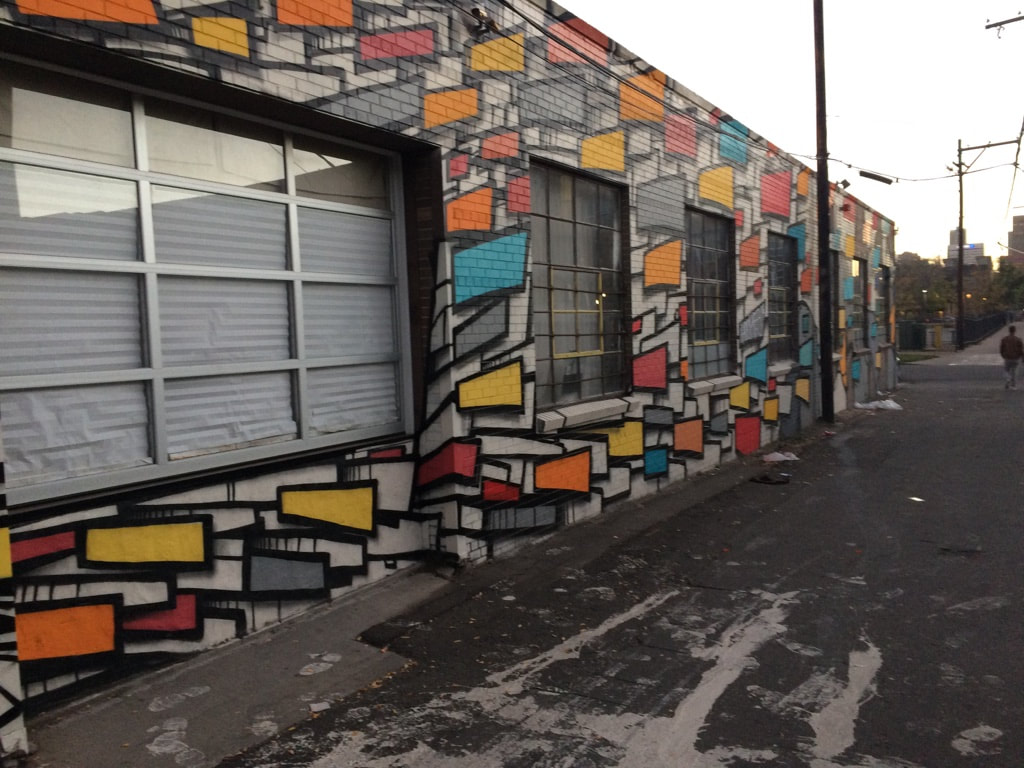 Creative paint schemes are an easy fix to blandness 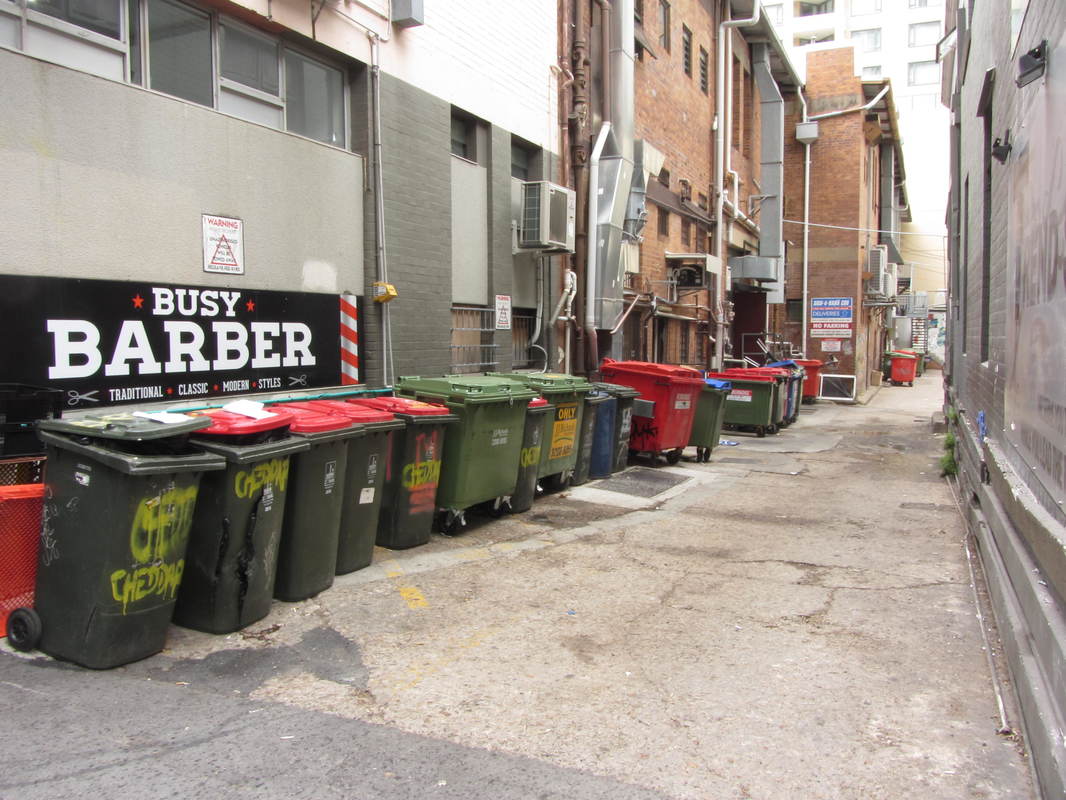 Unattractive laneways attract undesirable behaviors by Mateja Mihinjac Towards the end of the past Century, a gruesome downtown rape shocked Brisbane, Australia. The incident occurred at 9 am in a laneway surrounded by the pedestrian corridor of the busiest spot in Brisbane, the outdoor Queen Street Mall. This horrific incident went unnoticed by the city workers rushing to their offices. The victim, a young woman, remained helpless in the shadows of the bland gray facades of the surrounding buildings. FAST FORWARD 20 YEARS Today numerous Brisbane laneways have undergone a remarkable visual transformation aiming to imitate similar successes in Melbourne and Sydney. Burnett Lane is Brisbane’s oldest laneway with a dark history of a prison exercise yard during the early penal colony days. 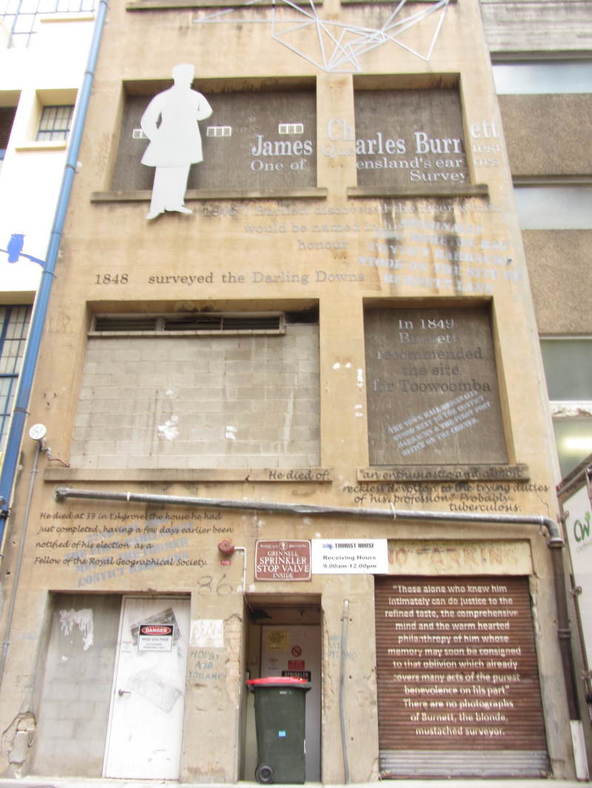 Burnett Lane buildings feature its long history It was the first to undergo rejuvenation. The 600-foot laneway now boasts creative lighting and artwork that characterize its cultural and historical identity. It has a few small restaurants, cafes and bars, the largest vinyl record store in the Southern Hemisphere and a wine bar with late evening hours. Winn Lane and Baker Lane, situated in the middle of the night entertainment district, also offer a mix of diverse opportunities in one place. They host day and night cafes, eateries, service shops and small retail shops that attract Brisbane’s artisan community. 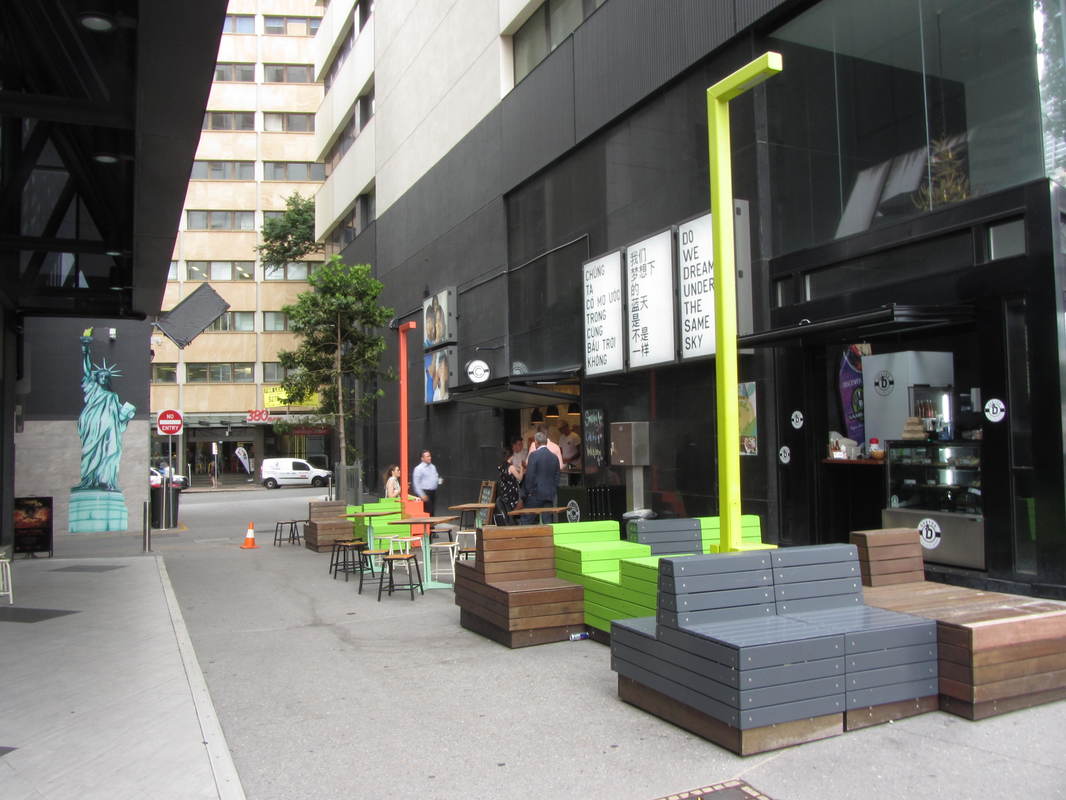 Eagle Lane cafes Once a forgotten place surrounded by tall buildings, Eagle Lane now offers a bar and a café, street parties, artistic installations and live music with pop-up gigs in the evening hours. It has become a popular post-work venue for city workers in the financial district. IF YOU BUILD IT, THEY WON’T COME? More than a dozen other laneways across Brisbane’s CBD have sprouted since the City’s Vibrant Laneways program was introduced in 2006, and more are pending. However, according to critics the program leaves much to be desired since laneway culture in the city has yet to truly flourish. They suggest that the City’s domination of the Vibrant Laneways program resulted in mechanically built laneways that failed to evolve over time. Instead, as predicted by SafeGrowth theory, they recommend the laneways should grow organically as a product of the creative and entrepreneurial activities of locals whereby the city assumes a cooperative rather than the leading role. 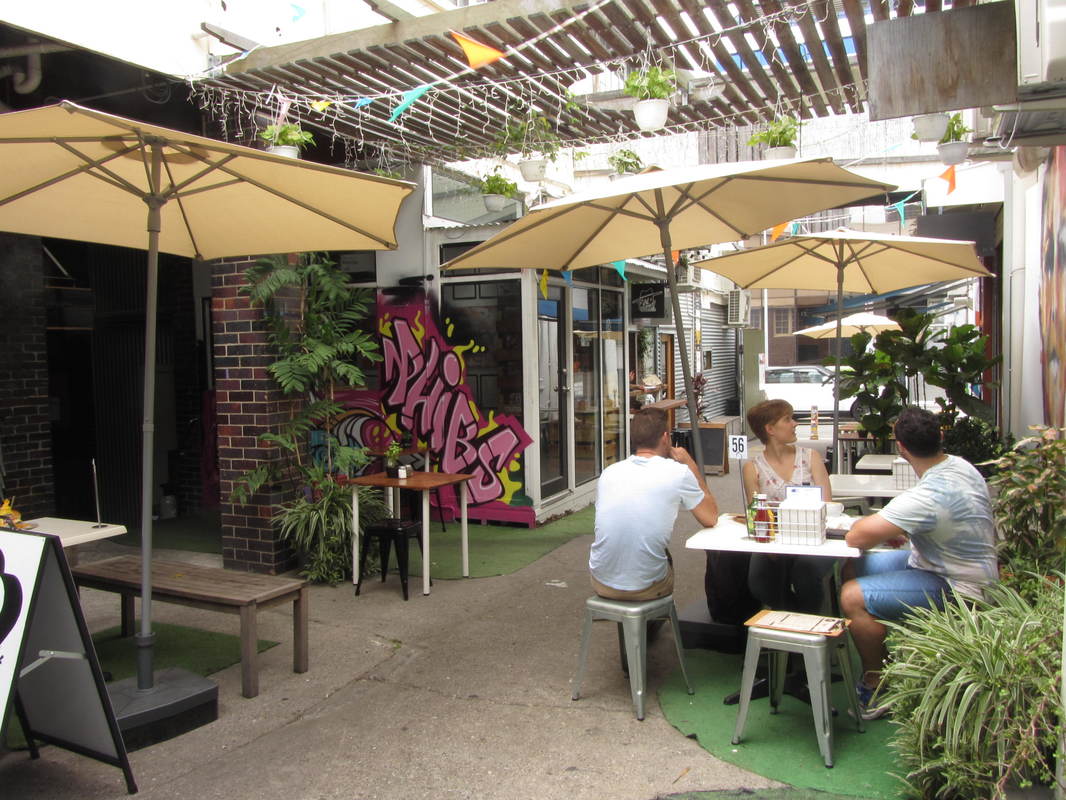 Relaxed dining in Winn Lane Confirming this idea is that fact the laneways attracting most people in Brisbane are those able to capitalize on their creative and economic potential to develop imaginative places. Elements that promote their vitality include permeability, accessibility, the absence of vehicular traffic and a positive image. Truly vibrant laneways convince people to stop and linger, which in turn activates the area and reduces the potential for undesirable activities like serious crime. 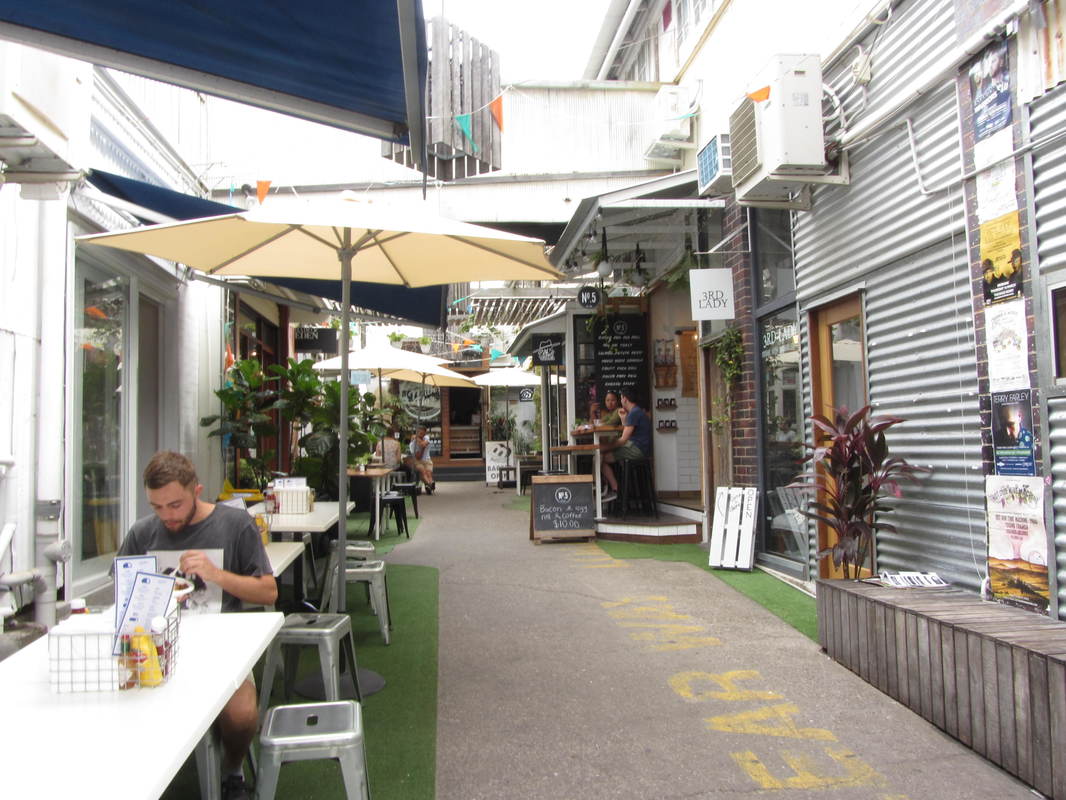 Combining cafes, dining, retail and services in Winn Lane SAFE LANEWAYS For laneways to be safe, they need to move away from what Woodhouse describes as “forgotten space within cities, trapped in the dark and quiet spaces” offering nothing more than pedestrian thoroughfare and service delivery access. Instead, as Carmichael claims, with collaboration between business planners, interest groups, and local governments, these precious micro-spaces can facilitate social interaction, promote safety and evolve into assets and anchors for community life in the 21st Century. 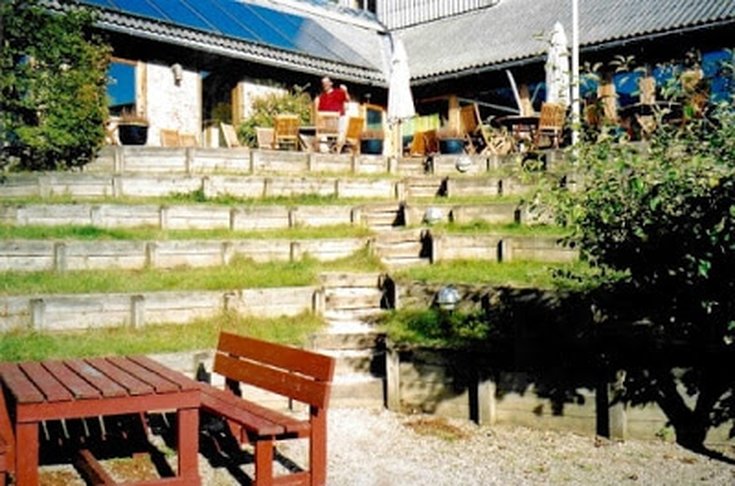 Common outdoor gathering area in Danish cohousing by Gregory Saville Fifteen years ago, I visited Skraplanet in Denmark, one of the world’s first cohousing communities and spent an afternoon with architect and founder, Jan Gudmand-Hoyer. In 1964 Hoyer gathered with friends to figure out how to purchase homes in the pricey Copenhagen real estate market. Home purchasing then – as today - offered few real choices of importance. Hoyer and friends discovered house architecture was boring and designed by someone else. Land developers already answered (or ignored) the critical questions of neighborhood living before residents even showed up:
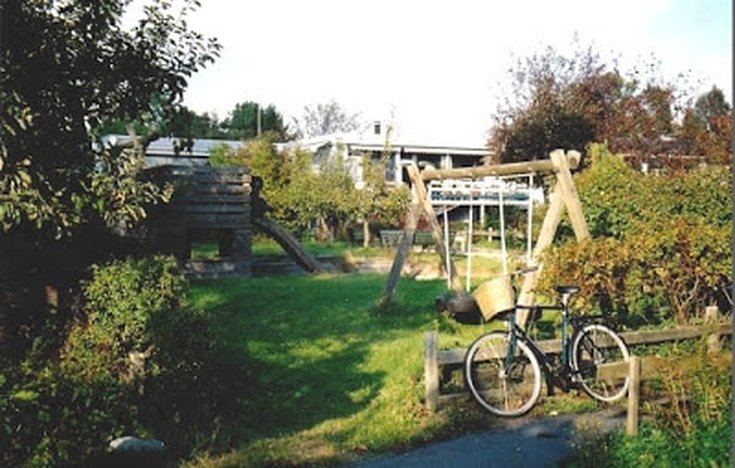 Children's play area designed by residents at Skraplanet cohousing Hoyer described this in his 1968 article The missing link between utopia and the dated one-family house. The result was cohousing – a new type of village, a style of intentional community in which residents form their own development company, hire their own builders, and create their own neighborhood. When cohousing migrated worldwide in the 1980s, it offered a unique form of equity housing and village living - usually within or nearby existing cities. 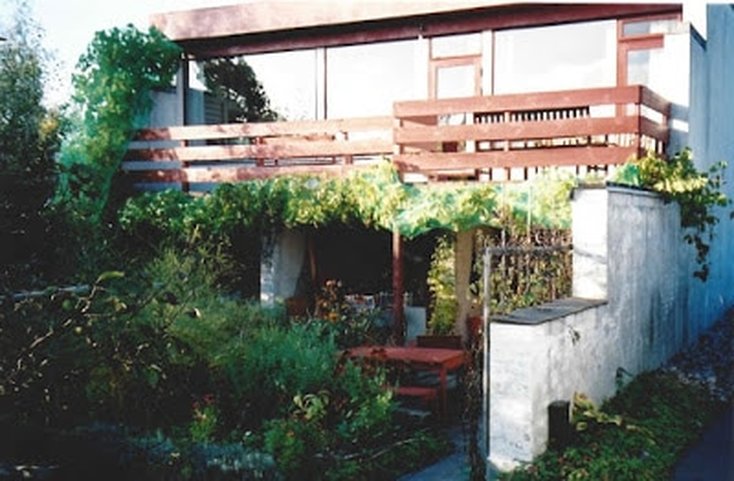 Private residence at Skraplanet with balcony and private gardens Ultimately, cohousing became a safer and more sustainable housing option. It has appeared here numerous times in An alternative future and Avoiding a wire-esque future. 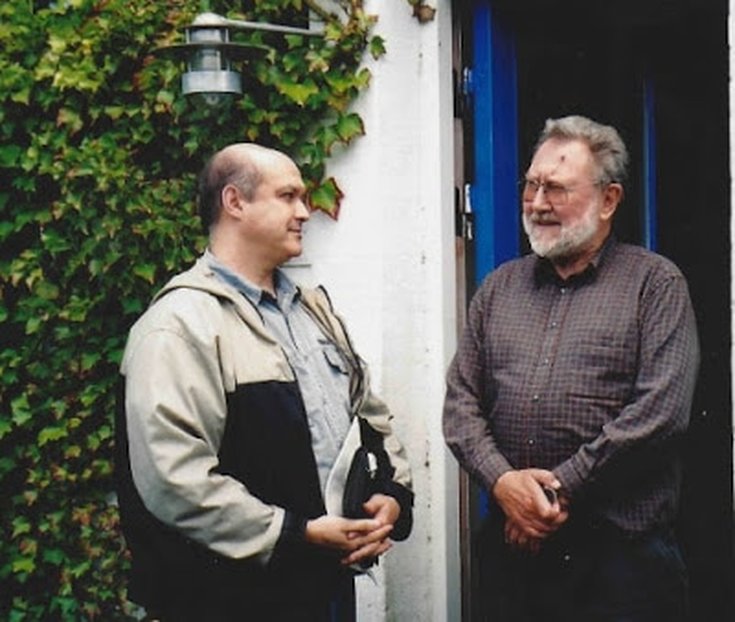 Posing with Jan before our tour at Skraplanet TOURING WITH THE MASTER Jan Gudmand-Hoyer taught me the nuances of cohousing planning. He proudly described some of the clever design techniques unique to this housing form. His community, Skraplanet, used modernism, an architectural style popular in the 1960s. At the time of my visit, the community was 20 years old and had found a green niche in the surrounding forest. Jan died yesterday at 81. He and his cohousing pioneers offered the world a new kind of village for the 21st Century. Thank you, Jan. May we live up to your dream! 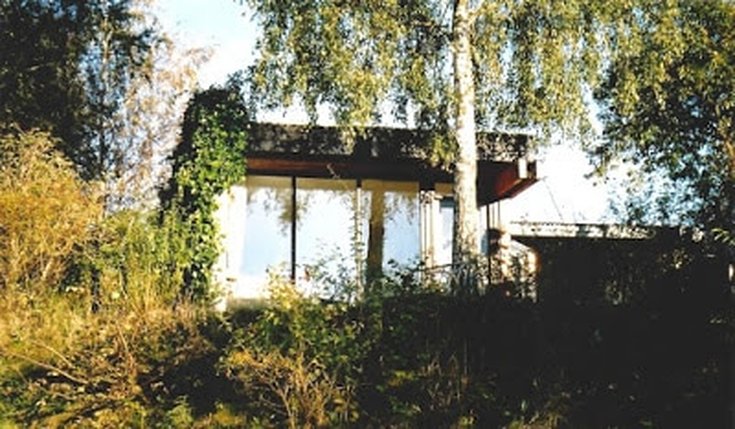 Modernist design with plenty of window views and greenery 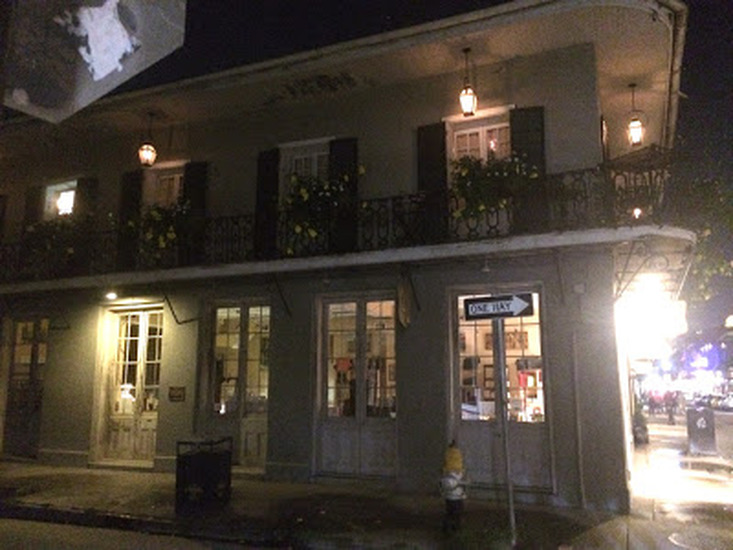 Search Conference participants enjoyed the French Quarter after sessions GUEST BLOG - TARAH HODGKINSON Tarah is a senior researcher in the Integrated Risk Assessment Instrument Research Group in Vancouver, Canada. She is a certified SafeGrowth Advocate and is completing her PhD in criminology at Simon Fraser University. **** Two weeks ago, the ever expanding SafeGrowth program, in partnership with Louisiana AARP, held our third SafeGrowth Summit. Six teams from across the country joined us in New Orleans, including Chicago, Los Angeles, Birmingham, Baton Rouge, Los Angeles and of course New Orleans. Our week included a very special visit from Nobel Laureate for Storytelling, Katrice Horsley from the UK, who was an incredible addition to our team (this will be the focus of an upcoming blog). Suffice to say, many of us walked away with a plethora of new skills for neighbourhood development. 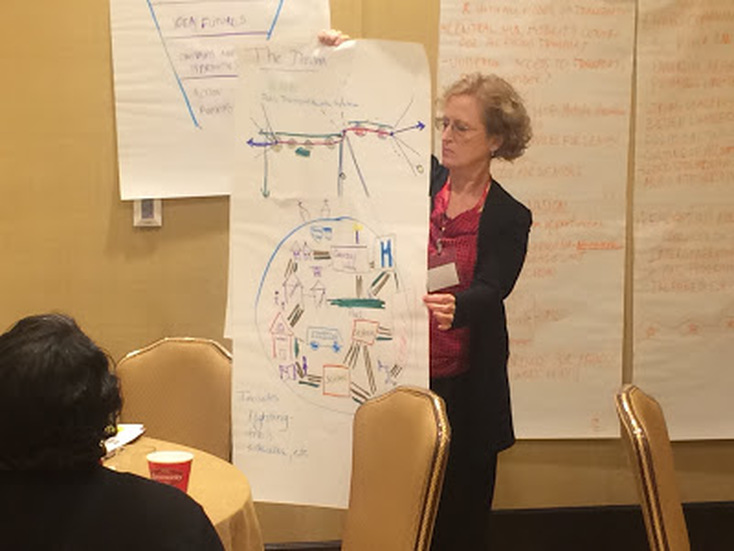 One conference participant presenting preliminary SafeGrowth plans As always, the search conference involves a stage of visioning. Sometimes this part is as important as the action plan. Participants envisioned a future where people could work, live and play in their neighbourhoods. They envisioned places that were no longer car dependent. They envisioned extensive public transit networks, renewable energies, and neighbourhoods full of festivals, diversity and acceptance. The results of this session were inspiring and resembled similar results from other search conferences. We realize that today, when groups are asked to envision a desirable future, what emerges are ideas for walkable, diverse, multi-use, and sustainable neighbourhoods. The results of the planning stages of the search conference included numerous plans for changing each of the neighbourhoods represented at our event. 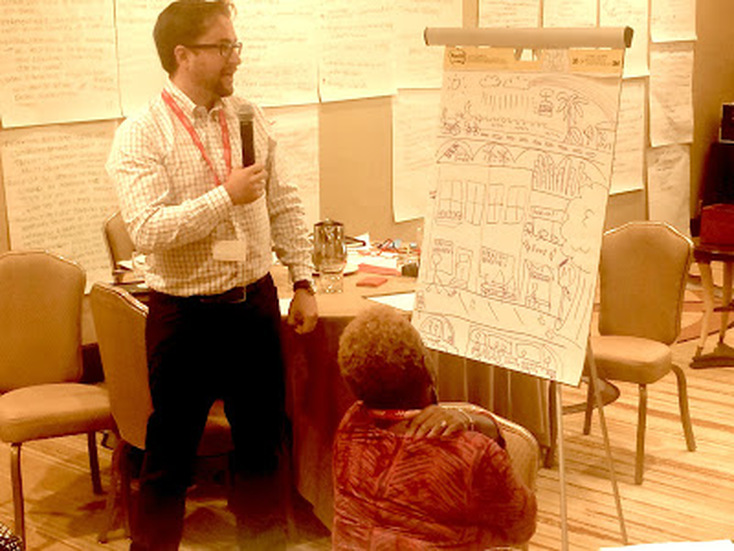 Additional work occurred throughout to refine plans In one city, discussions focused around expanding community engagement strategies on a new metro transit system. In another, engagement included safety on possible shuttle service and a Rails-To-Trails project. On yet another, sidewalk and intersection safety initiatives are leading to the possible development of a cross-city neighborhood exchange program to help build social cohesion between different neighborhoods in the city. FUTURE PROSPECTS By the end of the event the teams began to incorporate tactics to work with neighborhoods, residents, and stakeholders early in the planning stages. They saw the value in directly involving neighbourhood organizations before moving forward with any changes. The concept small is beautiful resonated throughout. Finally, the conference highlighted the storytelling skills of Katrice who entertained with her unique way to share lessons of change and hope. We agreed that this will definitely become an important feature of SafeGrowth in the future. 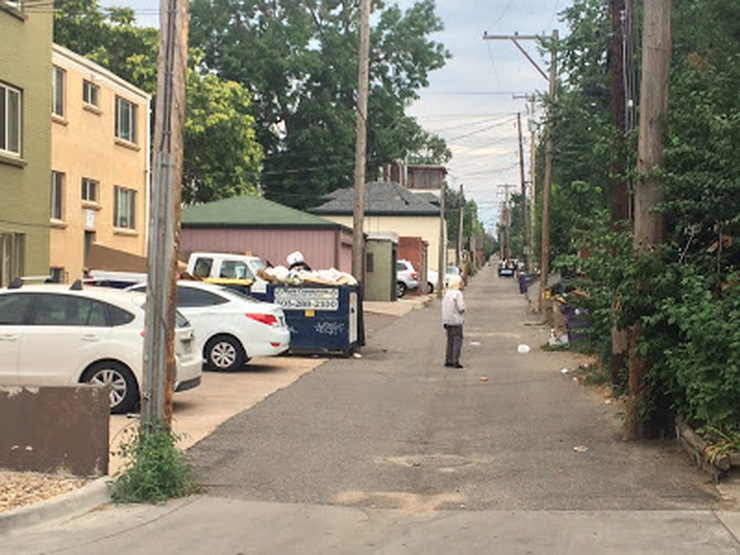 Navigating most urban laneways is an unsafe and unappealing journey A recent walk in some urban laneways brought to mind mystery stories of Sherlock Holmes’ chasing murderers lurking in dark, foggy alleys. In real life, laneways are a hidden and complex urban landscape we seldom consider in our formulations for safer cites. We write about them in our stories, but not until the New Urbanists reintroduced them as a modern feature of their residential street design did we refocus on them as a crime location. Most experienced beat cops walk downtown laneways, especially at night, because that is where things happen. Burglars frequent them because they offer easy access to the rears of homes. And kids vandalize and steal from cars in them because laneways are traditionally hidden from view. 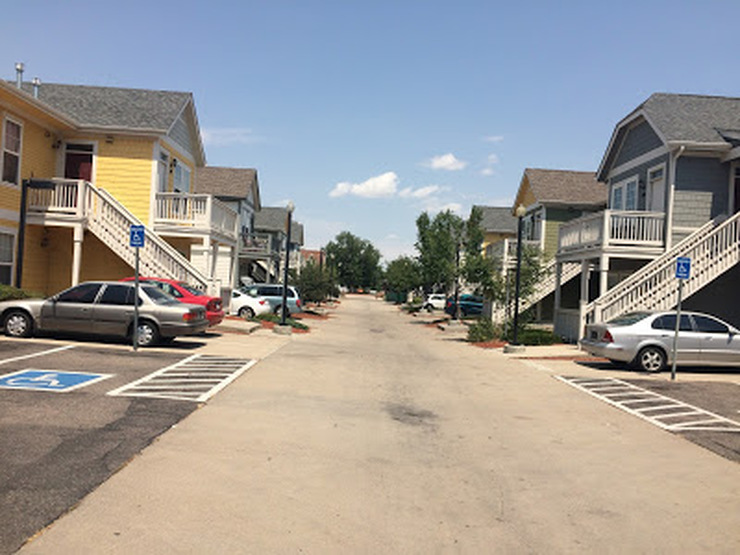 Attractive laneway design providing more than trash pickup As I compared some lively laneway designs with others that were not (the top photo), it was obvious poor laneway design is not inevitable. Laneway research is emerging revealing other options. I have posted blogs on laneway life, laneway chic, and permeable fine grain design. 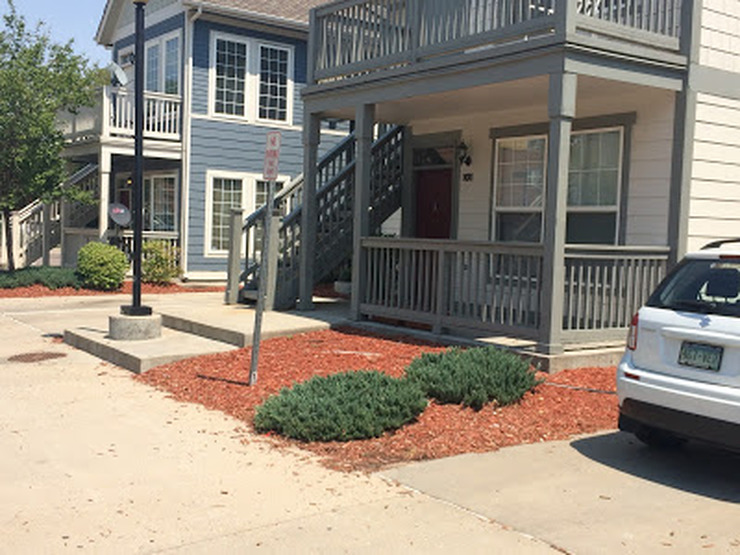 Landscaping and porches at the rear laneway - no chain link fences needed One Australian study on laneway crime suggests designers pay more attention to width/length, visibility from the ends, and the number of residences. But our work in SafeGrowth, and my recent walks, suggests something different: laneway activation is much more than physical size and shape. It is also about creatively figuring how to retain car parking and trash disposal uses, while at the same time creating interesting places for socializing. 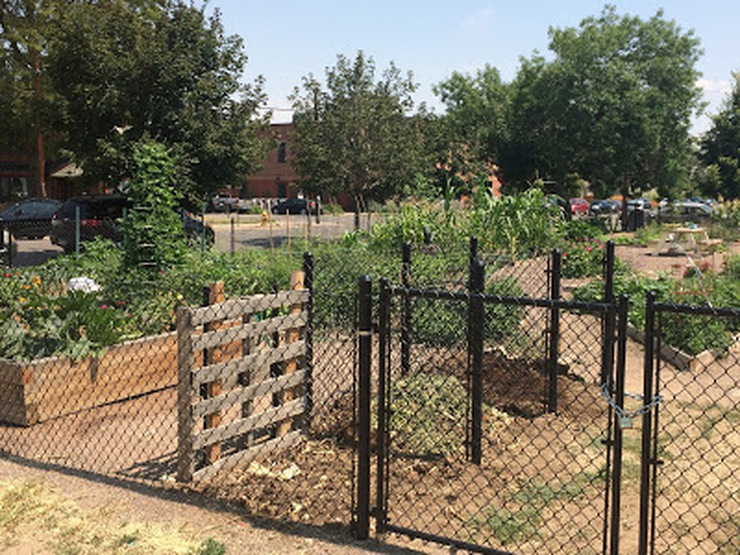 Territorial marker at the end of the laneway - a community garden That might sound unappealing at first. Yet the cool laneway in these photos features streetscaping, decorative lighting, a community garden at the end, and rear door porches to encourage laneway socializing. If designers provide an interesting option that residents need, they will use it and also keep it safe. 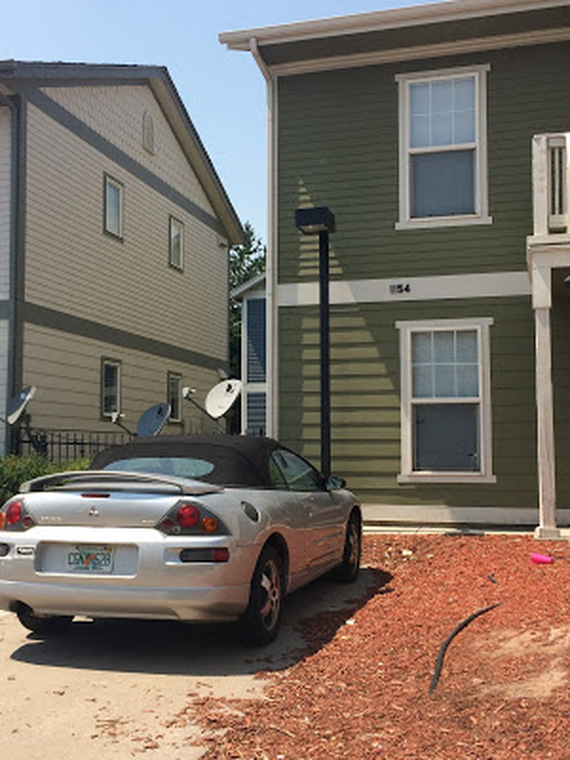 Providing lighting and window sight-lines to protect vehicles  Sunset over New York Public housing is an enigma in the fabric of the city. On one hand, most public housing is decent, safe and important. It provides an invaluable service offering affordable housing to those who, for various reasons, are left out. On the other hand, far too much public housing results in the projects, unsafe warrens of drug dealers and crime. In some ways, the worst side of unrepaired and ignored public housing emerges as a shadowland across the modern city, places that breed gang activity and fear. Our early SafeGrowth work began in such a place in Toronto. The original defensible space writing of Oscar Newman was based on public housing in the 1970s, much of that in New York. 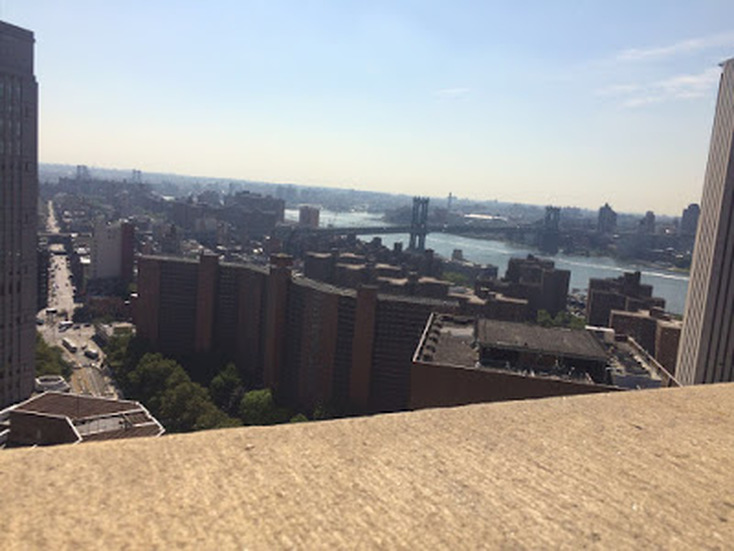 Public housing in Manhattan along the Hudson River I recently spent time working in New York City. Anyone who studies or practices crime prevention will know the work of Oscar Newman, a Canadian-born, New York architect who created defensible space theory - also known in some circles as crime prevention through environmental design - CPTED. Jake Blumgart’s Next City article about public housing in New York highlights the work of Newman with the New York City Housing Authority. It discusses his early conclusions about design flaws and crime opportunity - the basic principles of 1st Generation CPTED. It also describes Newman’s conclusions about the larger role of social structure of public housing - concentrating poor residents in one project, youth-to-adult tenure policies, and percent tenants on welfare. Those familiar with the Second Generation CPTED will recognize those as the Capacity Principle. Second generation strategies in public housing have had considerable promise, as reported by DeKeseredy. 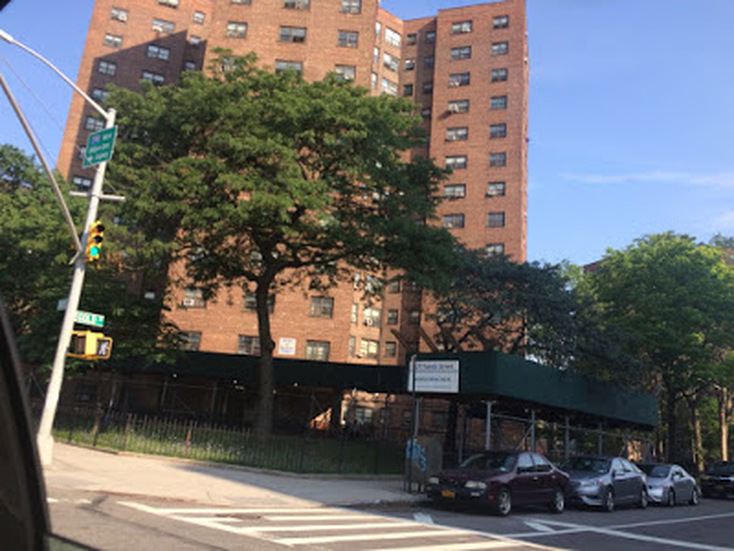 Repairs underway at a public housing apartment in New York COMMUNITIES OF INTEREST A careful reading of early Newman’s Defensible Space, and especially his later Community of Interest reveals that he always considered design only one part of the crime opportunity equation. He was saying this as early as 1976: "Research on residential crime patterns in 150,000 New York City public housing units has established that the combined effect of the residents' social characteristics and the projects' design affects the crime rate." Still, I doubt that Newman really calculated all the complicated shadowland equations of public housing. There is much work yet to be done. Urban planner Jeff Speck equates dense, well-built and walkable cities with economic growth, environmental resilience and a safer, more livable life. In his book Walkable City he provides plenty of evidence to prove it. This week I visited Edgewater, a small city (population 5,000) enveloped by the urban fabric that is Metro Denver. It is medium income, has diverse ethnic groups and comprises mixed residential with a commercial street of a few blocks. It is close to what Speck describes. 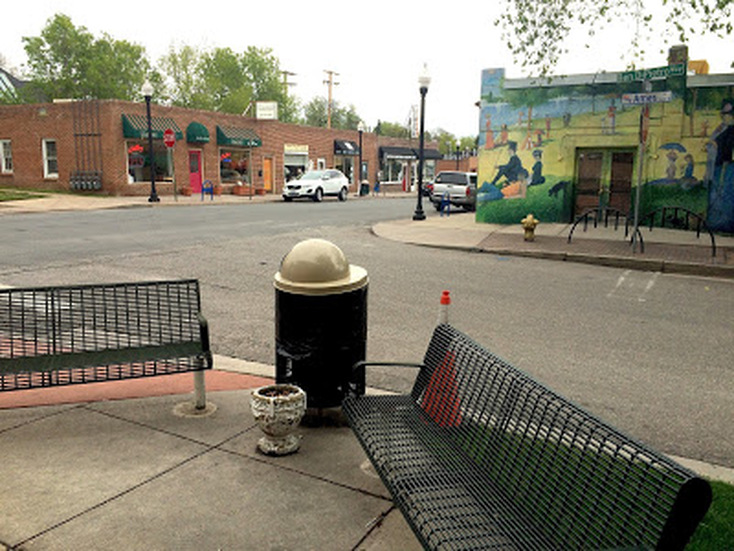 Edgewater street furniture, walkable streets, and human scale From a city map it is undistinguished from surrounding Denver suburbs, until you look at its crime. 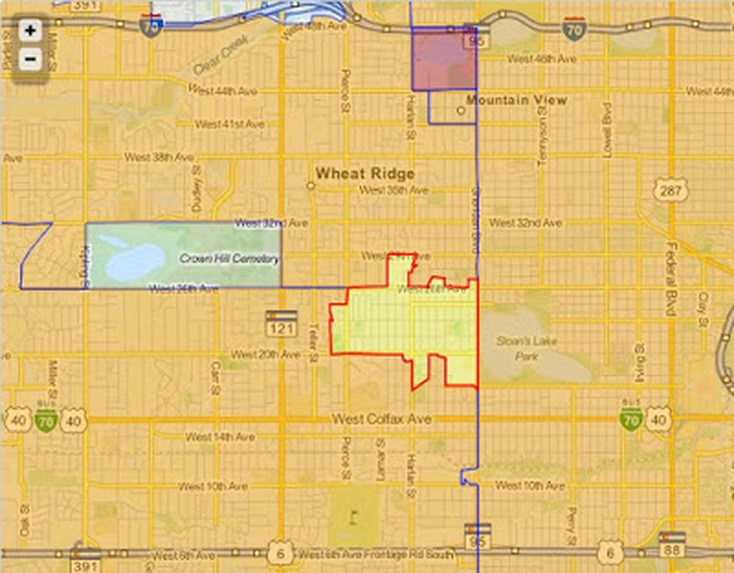 Orange and red areas showing higher crime areas, Edgewater shows lower crime rates in yellow - crime map from city-data.com As the map above shows, except for a few crimes, its crime rate is far below surrounding neighborhoods particularly one crime hotspot to the north. The question is why? Urban design is not the only reason, but as I’ve shown in blogs on permeability in Langley and High Line Park in Manhattan, it can matter a great deal. PLANNING AND URBAN DESIGN Planning students learn about early movements to plan cities. One history textbook that some read is Land Use Planning from 1959. A phrase in that book is instructive: “The unit of design in New Towns is no longer each separate lot, street or building; it is the whole community; a co-ordinated entity…beauty as well as convenience is produced by the rational relations of the individual parts…” Unfortunately that philosophy did not survive. Instead, land hungry developers gobbled up huge swaths of city edges to build suburban sprawl, regional shopping malls, supersized box stores and pedestrian-hostile commercial strips. The idea of planned and walkable neighborhoods was lost. But not, apparently, in Edgewater. 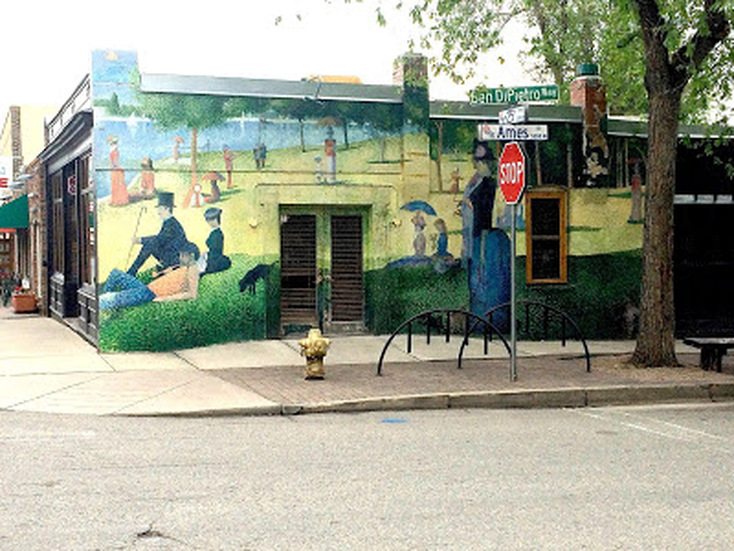 Murals, bicycle racks, and even-grade sidewalk curbs for handicap accessibility EDGEWATER Edgewater clearly works - even the quiet afternoon when I visited had walkers for whom I had to wait before taking photos. There are no more cops here than elsewhere, yet people feel safe and comfortable while walking. Why does it work? Speck says there are four ingredients to walkability: a reason to walk, a safe walk, a comfortable walk and something interesting to see and do. Edgewater seems to capture most of them. The residential streets are narrow and tree-lined. Most of them are within a 15 minute walk of the mini-downtown. That downtown is neatly streetscaped and has diverse uses such as restaurants, coffee-shops, a local pub, and other amenities that provide locals a reason to come here. The downtown has only 4 blocks and they are short, about 75 feet each. 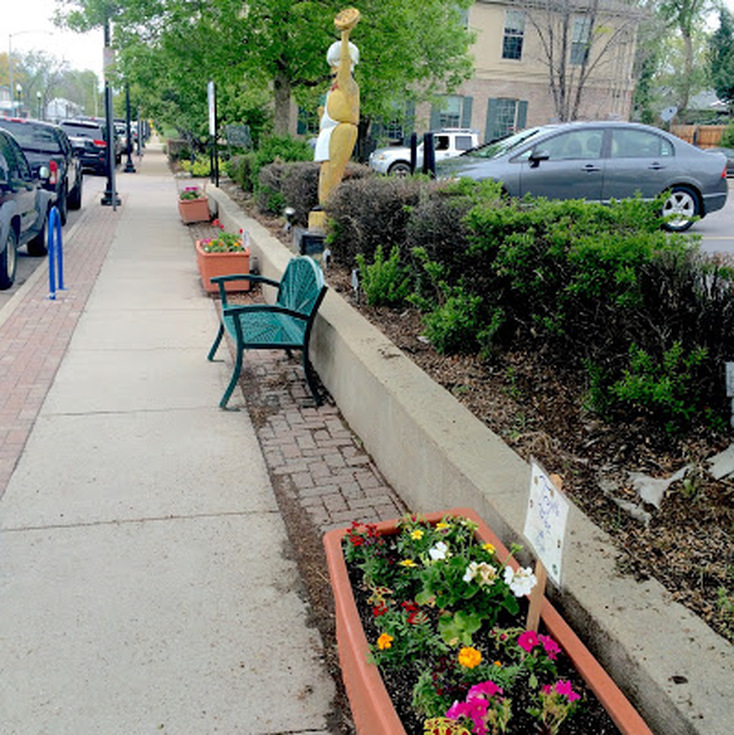 Color, flowers and sculptures - Edgewater sidewalk 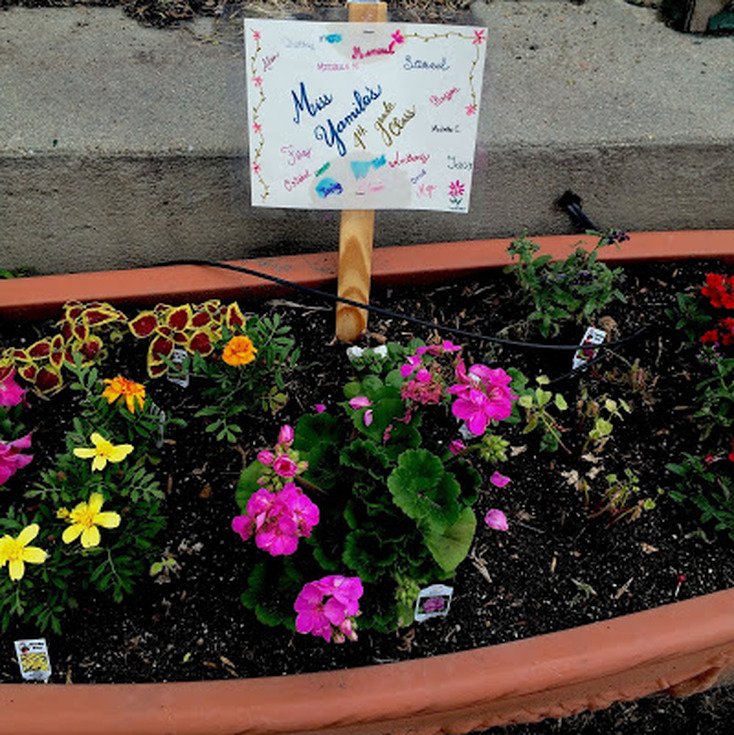 Flowers sponsored by students from a local 4th Grade class Shops are also easily walkable - the distance of one store to another, door-to-door, is no more than 15 feet. Street flower pots are planted by local school children, murals cover blank walls and street furniture, like angled benches, provides both interest and comfort. THE ALTERNATIVE - THE LIZARD KING Only a few blocks outside of Edgewater, in yet another pedestrian-hostile commercial strip, the automobile remerges as King. You can almost hear it holler: I am the Lizard King, I can do anything. (Apologies to Jim Morrison). 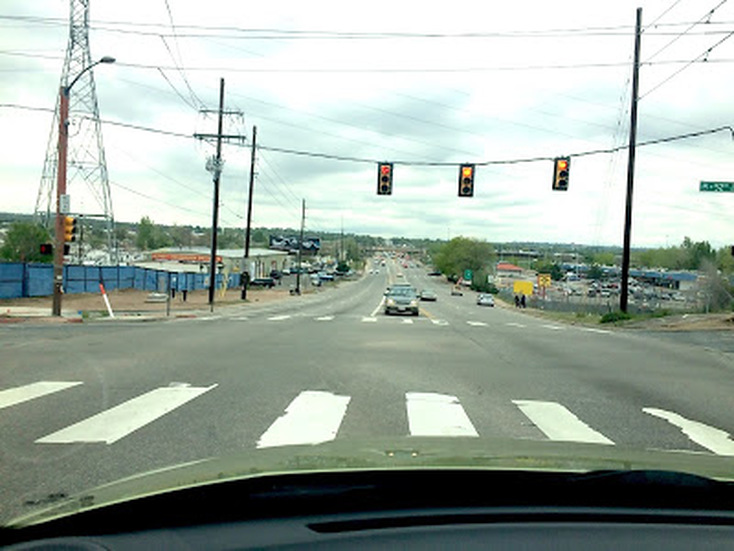 Just outside Edgewater, hostility awaits the walker - Cars are the Lizard King Here intersections are ugly and vast, speeds are high and walkers are treated like invaders. Such places force people to stay inside their car and avoid all social contact except during moments of road rage. Speck says: "The worst idea we’ve ever had was suburban sprawl…the reorganization and creation of the landscape around the requirement for automobile use." We will probably need autos for a long time to come, but we need walkability even more. Let's get our priorities right.  There is a group I call the storytellers-in-the-sky. They are researchers who tell stories of predicting and analyzing crime from the vantage point of far above the reality on the street - usually employing Big Data to slice and dice stats and find some mysterious crime patterns that will, presumably, help us resolve crime. We’re still waiting for that last part. In the meantime there are others who do street research - action research - the hard work that makes a difference block by block. Evaluations of this action research is slower to arise and tedious to collect. But it is promising and shows real results. Now and then, the sky-people and the street people meet up. Such was the case with some decent research lately uncovering what street research types like SafeGrowth and CPTED practitioners have been saying all along! If done properly, two-way streets cut traffic speeds and crime at the same time. TWO-WAY STREETS A recently published online study in the Journal of Planning and Education Research shows how to reverse unsafe conditions on city streets. And even though traffic flow increased on the two-way converted street, traffic accidents went down. The study, Two-Way Street Conversions discovered road safety improved with two-way streets and simultaneously revealed impressive crime declines in both auto thefts and robberies by over 30 percent. 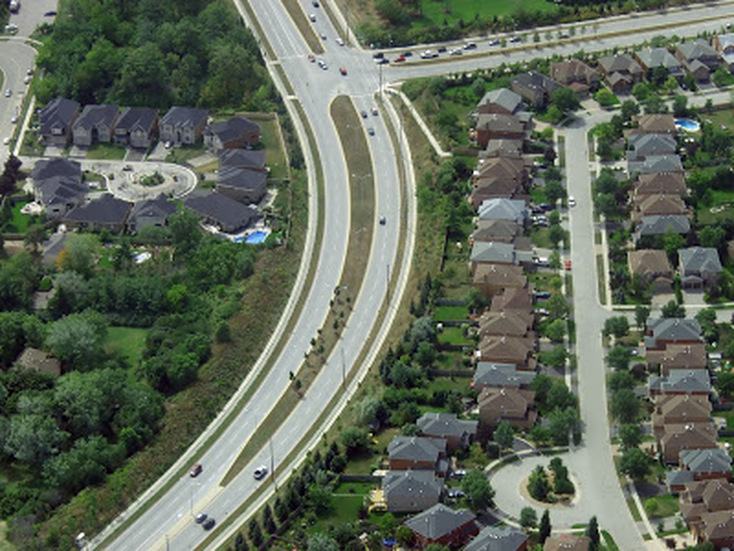 Two-ways vs one-ways to cut crime Action-based research like that is exactly what we need to transform neighborhoods. We don’t need more macro, sky stories, for example research trying to figure out if crime is a social epidemic. The epidemic hypothesis is simple, if duh-inducing: A high crime area infects nearby neighborhoods like a virus which, if untreated, spreads to other neighborhoods. It’s the obvious implication that gets sky-like: To fix the situation we need to come up with a vaccine to protect unaffected neighborhoods. Presumably we then treat the sick neighborhood with some preventive cure. I’m not sure if that’s exactly how the sky-plot goes but if so, I’m reminded of Sheldon’s line from Big Bang: Bazinga! CRIME BY INANIMATE OBJECTS Sadly, sky-storytellers see crimes as inanimate objects with no social history. They call them crime generators and crime hotspots, presumably to better measure such things and remain objective like the scientist studying the lab rat. Hotspots and crime generators are real things of course, but they definitely do have a cultural and social history not to be ignored. More to the point, crime generators are places like fast food restaurants frequented by the indigent and drug addicted looking for cheap food. Crime hotspots are places like taverns frequented by the poor and jobless looking for alcohol-relief. The message lost on the storytellers-in-the-sky is that the conditions creating such places are the very conditions that trigger both crime motives and opportunities in the first place. That’s the message of action-researchers and it’s as simple as a two-way street. 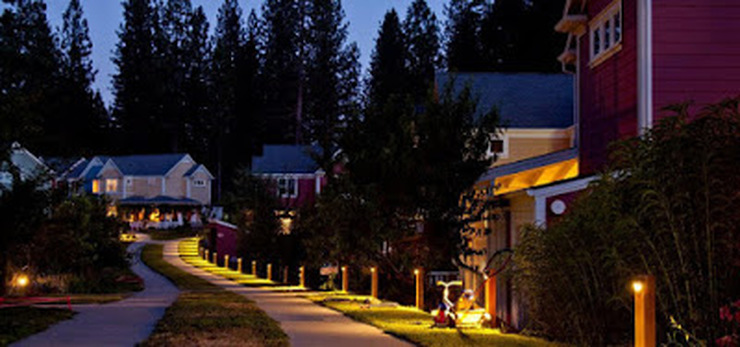 Night lighting along cohousing common walkway - photo McAmant & Durrett Given the unsustainabity of sprawl, the persistence of crime hotspots, and the unending call for a stonger sense of community, there is a thirst for on-the-ground examples of cohesive, safer and resilient neighborhoods. Cohousing is one. I’ve been visiting cohousing projects around Denver over the past few months and working with a group establishing an art and culture oriented cohousing community. Here is what I’ve learned. Cohousing is not for everyone. Some prefer towering condo apartments. Others prefer remote homes hidden in the bush. Those, of course, are legitimate choices. However the overall trend is in the opposite direction. Over 80% of the developed world lives in urbanized cities. The UN says the majority of the world is now urban. More people migrate into cities than ever before. The truth is, cyber-creep notwithstanding, we are urban and we are social. COHOUSING I’ve been following the cohousing movement for 20 years. I described cohousing here 5 years ago - Avoiding a wire-esque future and Fernwood Urban Village in Victoria, BC. Most cohousing projects look like 25-35 unit condominiums with private residences and amenities similar to those anywhere. Yet cohousing communities are designed differently because they are designed by and for residents themselves in collaboration with architects. Cars are kept to perimeter parking and pedestrian walkways, gardens, and common greenspace areas are in the center. 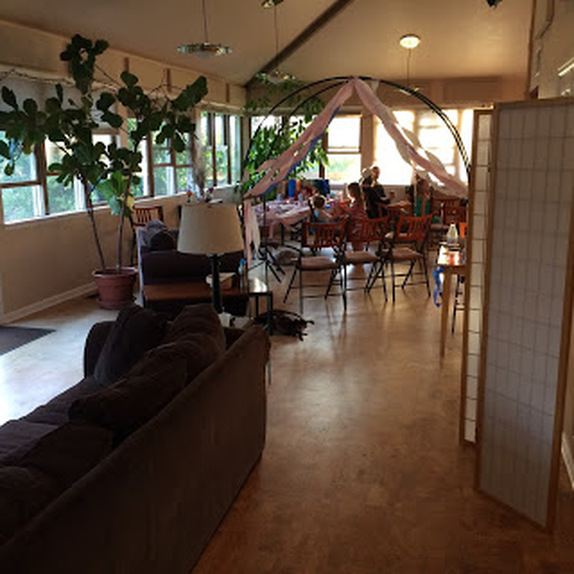 Tour of community house dining room at Nyland Cohousing - Lafayette, Colorado Cohousing governance is painfully democratic, intricate, and based on extended friendship networks. Those networks emerge from things like carpooling, shared childcare, sharing tools and common facilities like workshops and community gardens. Networks emerge from regular training in conflict resolution, mediation, and governance methods - the latest version is sociocracy. In the cohousing group I work with we are offering training in emotional intelligence skills. Cohousing architecture includes a central common house with a library, guest rooms, play areas for kids and a large dining/kitchen area for community meals a few times a week. 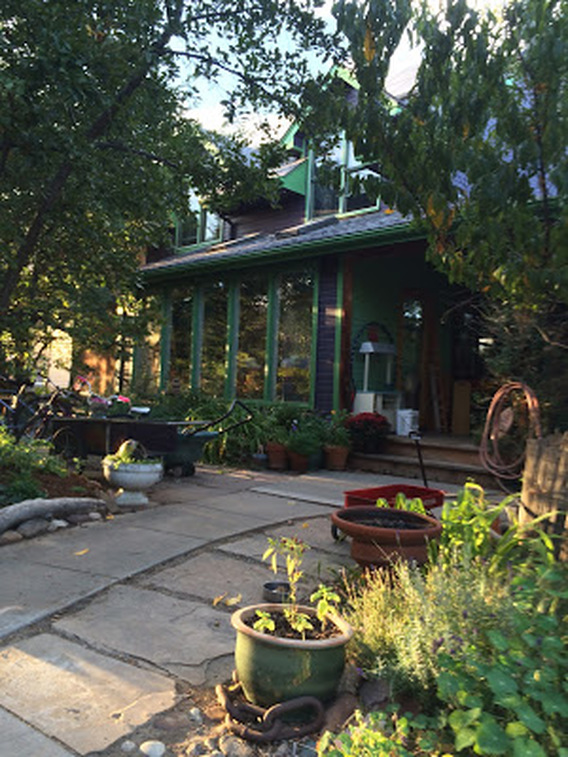 Homes along the common walkway at Nyland Cohousing REVEALING DATA A few years ago the Cohousing Association of the United States funded a national survey of the cohousing phenomenon. How successful is cohousing and how does it differ? Here is what it found:
 Lounge and fireplace at Nyland common house - a place to relax In my experience, cohousing has lower crime and a greater desire for collaboration on difficult problems. They live more sustainably with shared gardening, recycling and ride sharing. And at the very core of social sustainability, they seem to call police less frequently to solve most problems that they instead solve themselves. There are still issues to resolve in cohousing. For example internal conflict is lessened but it is not absent. But on whole cohousing is the most cohesive, safe and resilient neighborhood design I've seen yet. It’s a model worth considering in the 21st Century city.  Shanghai at sunset, as seen from the observation deck of the Jin Mao tower. The sun has not actually dropped below the horizon yet, rather it has reached the smog line. Photo Suicup - Creative Commons Unpleasant, polluted, and uninteresting downtowns trigger an exodus of legitimate eyes on the street. Without that it's impossible to achieve a critical mass of fun things to do: play chess in the park, go to bars, bicycle to music events, lounge on street furniture, listen to music from buskers, and people-watch during a relaxing stroll. What empties downtowns? For one thing, pollution. This week, yet again, there were more headlines about life-threatening smog choking Chinese cities, smog that comes from, no surprise, polluting industries and millions of gas guzzling, carbon emitting vehicles. 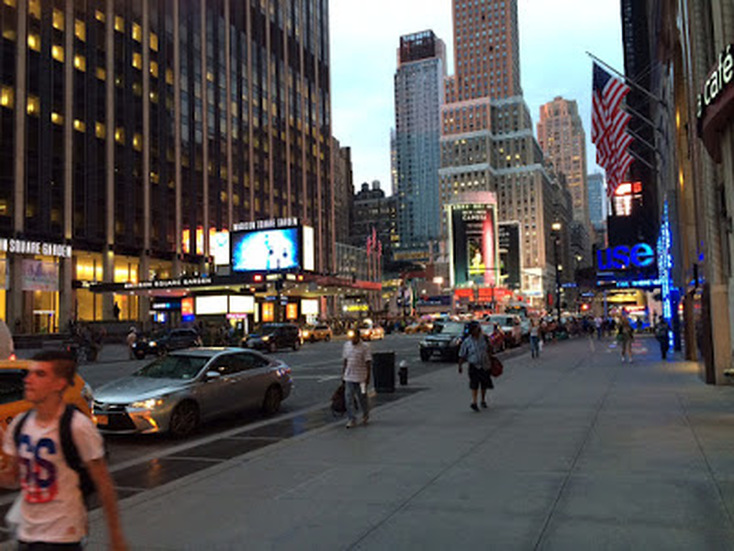 Madison Square Gardens streetscape. New York has worked on improving the downtown experience. Colors and lights play an important role. Tied to air pollution is suburban sprawl, another poison to downtown life. Bound as it is to excessive driving and greenhouse gas emissions, American sprawl triggered the exodus from downtowns and led to inner city crime. Today a friend sent a YouTube of a historic video from the 1960s. It tracks the genesis of the expanding suburbs long before we knew the impact of large expressways and acres of free parking on acres of asphalt surrounding thousands of new shopping malls. 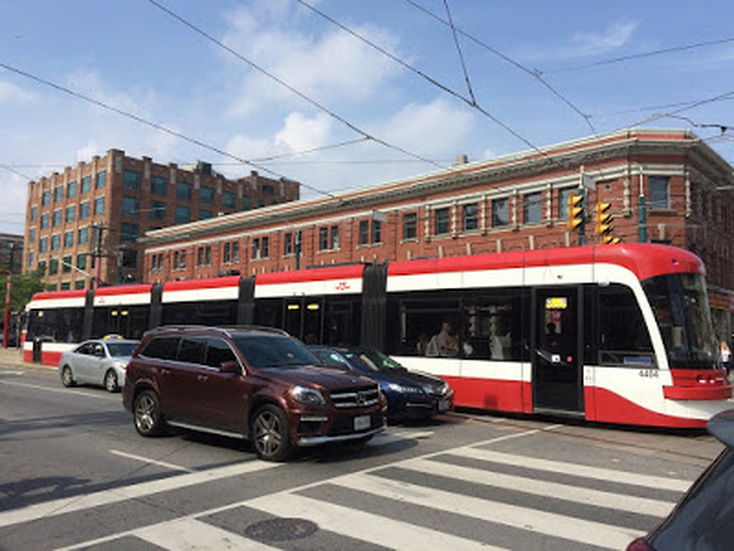 Toronto enhances the downtown pedestrian experience with modern and attractive light rail options. Photo Kallan Lyons The video shows life at the very beginning. City centers were in rapid decline, crime was skyrocketing, and after a decade of romance with drive in eateries, there was a new love affair with convenient drive-in everythings. Nobody walked anywhere! It was the beginning of the sprawl generation. The video is set in St. Louis. Ferguson is a 17 minute drive away. How little some things change. 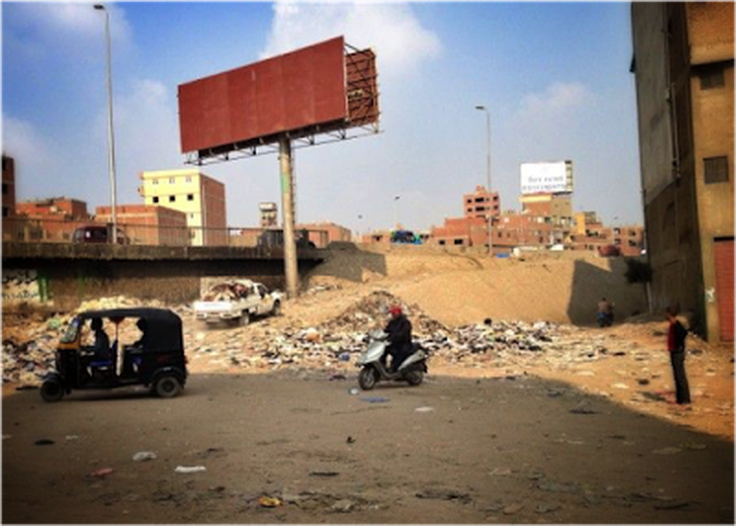 Photo Joseph Dana Next City GUEST BLOG: I met Angela LaScala-Gruenewald during work in New York City and she later attended our Philadelphia SafeGrowth training. Angela is a recent college graduate with research currently focussing on criminal justice initiatives and public safety. She offered this blog on tactical urbanism in Cairo, Egypt. **** The image above depicts what appears to be a strategic piling of dirt and trash; it serves multiple purposes -- an informal structure, a small seed of resistance, a necessary public good. I first learned about this Do-It-Yourself highway exit ramp while taking a class at the University of Chicago. A teacher’s assistant flashed this photograph on the lecture hall wall and launched into a discussion on the control of space in Arab urban centers, and the tension between private and public, formal and informal, recognized and subversive movements – all motivators of the endless conflicts in the Middle East. Take for example the use and transformation of public squares, from Tahrir Square to Yemen’s Freedom Square on the doorstep of Sana’a University. While there is nothing new about protesting in squares and fighting for control of space during periods of political change and popular uprisings, the significance of the transformation and importance of these spaces still hold. The highway exit ramp in the peripheries of Cairo plays a role in this narrative as much as the large downtown plazas. While thousands of protestors fought for control of Tahrir Square, smaller transformations took place across the city through growing informal construction projects in these peripheries and informal areas known as ashwa’iyyat (slums). SLUMS COME TO LIFE The ashwa’iyyat contain over 60% of Cairo’s population, but are largely ignored by Egypt’s government and denied access to public goods, such as highway exit ramps.The Cairo highway ramps served as examples of innovative urban design, part of the Do-It-Yourself movement, but less couched in the concept of the political. Meshing these two perspectives together highlights the importance of informal transformations of public space, especially in communities fighting for access in the face of a negligent regime. The highway exit ramp in Cairo’s ashwa’iyyat brings the two together. It is a quiet protest simultaneously delivering a necessary public good. It is political and it is practical. 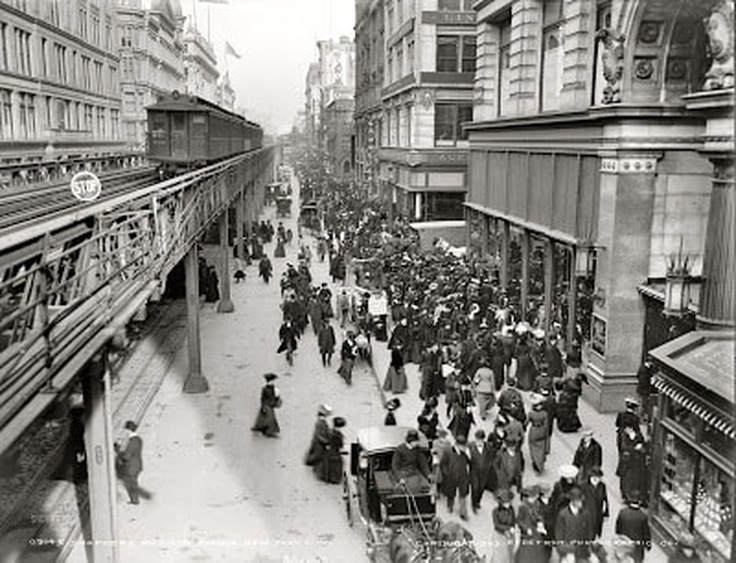 1903 - streets for people - photo by shopy It felt strange looking at a faded, black and white wall photo of a downtown street from 1900. No expressways. No cars. Only horses, buggies and Victorian dressed pedestrians. The Model T Ford was eight years away. I wonder if those pedestrians had the foggiest notion of the transport tsunami that would befall their children a few decades forward? Expressways and cars changed everything. Horses and buggies vanished. Expressways depleted cities of the middle class and led to deserted high crime downtowns. They triggered sprawl and, along with vanishing streetcar lines, the decline of urban villages. In return cars offered individual freedom to roam and opportunity to escape congestion and crime in congested downtowns. CARLESS CITIES Last week another mobility tsunami emerged - car free cities! Norway announced that the central area of the capital city Oslo will be car-free in 4 years. The Oslo council plans to permanently ban vehicles from their central city. It’s hard to argue the plan isn't futuristic. SafeGrowth blogs in the past describe similar visions, a theoretical design called The Venus Project and an urban experiment called Masdar City, currently under construction. Oslo, however, is the first existing major city with over a half million residents to attempt it for real. It is unclear how 60 kilometers of new bike lanes will help residents navigate Oslo’s -5C, snowy winters. Horse buggies perhaps? Yet their plan to create a carless city heralds a truly visionary future. The latest tactical urbanism in San Francisco is called the Market Street Prototyping Festival. It symbolizes the 21st Century form of public engagement. Public engagement is a linchpin for success when it comes to placemaking, SafeGrowth and all sorts of good things urban. Safety and crime prevention too depend on it, at least if you believe in life beyond target hardening. Tactical urbanism is the key. Tactical urbanism, coined from the book with the same name, is what Portland has been doing for ages during the Intersection Repair projects. It is a low-cost and learn-by-doing strategy reminiscent of so many social action strategies of the 60s except this time the result is physical changes within neighborhoods that avoid long planning processes. San Francisco is the latest to try tactical urbanism by welcoming artists, urban designers and others to set up their innovations along Market Street. A few selections occupying the upper register of my cool-o-meter: Data Lanterns that glow brighter to announce arriving trains, metal walls that turn into a musical instrument on touch, and street seats made from compacted mushrooms for composting afterwards. Beautiful places and streets attract people. They put eyes on the street, a basic principle of urban safety. I was recently reminded of a master architect of beauty, the award-winning Arthur Erickson, an architect the New York Times called Canada's pre-eminent Modernist architect.
While in Vancouver this week I spent time with Erickson's closest colleagues and friends, an impressive group who just like Erickson were concerned about both social equity and aesthetic beauty. Modernism has not always had a good rap. Arguably, CPTED would not exist if not for the modernist planning and architecture that Jane Jacobs so bitterly attacked. Inappropriately applied modernism led to the demolition of the Pruitt-Igoe social housing in 1960s St. Louis, the project dubbed indefensible and crime-ridden in Oscar Newman's Defensible Space. Arthur Erickson showed another way; modernism done right! An example of his work appeared here previously regarding Vancouver's Robson Square. The first Erickson building I ever entered was the Canadian Pavilion at the Expo 67 fair in Montreal in 1967, a kind of inverted pyramid. At the time I had no idea about architectural modernism. It just looked cool. Later I studied at the Erickson inspired Simon Fraser University atop Burnaby Mountain in Greater Vancouver, a kind of spaceship in the sky. It too was very cool and futuristic - a fact not lost on film directors who have filmed there (BattleStar Gallactica, The Day the Earth Stood Still, Underworld Awakening). Erickson taught it is the work quality, not the theory, that matters most in constructing beautiful places. The problem arises when modernism is done badly and applied inappropriately. This is the case in Pruitt-Igoe, Chicago's Cabrini-Green, Toronto's Jane/Finch, and the Chichy suburbs of Paris. Unsurprisingly, crime festers in such places. The takeaway? Build sensitively and in social context. Don't throw the baby out with the bathwater. Yet too many new architectural forms do the latter and too few architects do the former. In Erickson's own words: "…the reaction to the bareness of ill conceived modernist buildings was to revert in the 80's to a revival of historicism in the guise of "post-modernism"… That Dark Age is thankfully over but cultural insecurity is always there, hidden in the basement of our psyches - ready to spring out whenever brave confidence falters. It lingers in the gated communities where make-believe has become an adult panacea. It lingers with the developers who promote kitsch because it sells. It lingers with the newly rich and the establishment who need to consolidate social standing with class accepted standards. It lingers in every shopping centre, multiplex, restaurant, Vegas casino where illusion is needed to disguise the emptiness within." - Arthur Erickson, 2000 There are these new urban regeneration schemes called malls-without-walls, one example being the Liverpool One development in the UK. They bring to mind Oath of Fealty, a science fiction by Larry Niven and Jerry Pournelle. They raise a thought worth pondering. The Liverpool One land development is owned by the British Duke of Westminster. It privatizes 35 downtown streets and spans 42 acres all controlled by a private security force and CCTV. Of course big shopping malls are not new but they are usually relegated to the suburbs far from the downtown core. Not this one. LIVERPOOL ONE The Liverpool One land development project turns a new corner. Costing up to $2 Billion it is a central city shopping mall on steroids - hotels, plazas, shops, golf course, apartment towers, open air designs all policed by private security. Decades ago Oath of Fealty prophesized a massive high-tech, city-in-a-city called Todos Santos, constructed following race riots and walled away from the chaos of Los Angeles surrounding it. A thousand feet tall, single-structured super city, Todos Santos residents lived with constant surveillance in return for safety away from the grime, crime and bedlam that was a future Los Angeles. (Imagine the opening sequence of the film Bladerunner). Residents gladly offer up their Oath of Fealty for the benevolent Todos Santos security blanket.  In 1981 Oath of Fealty prophisized a new kind of city Liverpool One is nowhere near that. It is a mega mall on steroids, not as sophisticated as the futuristic arcology, Todos Santos. It looks like a well-designed, upscale mall. Its private streets are subject to regular city by-laws. Thus far. Yet it is more interconnected than most open air malls and has abundant private security and pervasive CCTV. And like all evolutionary trends it exists in a context. FEAR Consider the fear triggered from watching the Ferguson mayhem this week, dozens of riots in cities around the world in recent years and, in spite of declining crime rates, millions who now live in gated communities. In all these contexts there is one constant. Fear! Who wouldn't want to live in a beautiful, secure place of the future? Consider the comments about Liverpool One by Roy Coleman, criminology faculty at Liverpool University: "The rules for the newly privatised city centre fabricate an ideal citizen - aspirational in consumption and thinking big with urban pride." That sounds very Todos Santos. It leads me to ask some elephant-in-the-room questions: If we have the resources and desire to build safe mini-cities within cities where people can freely choose to live, is that a good thing? Or if it is such a bad thing, why are so many of them showing up? 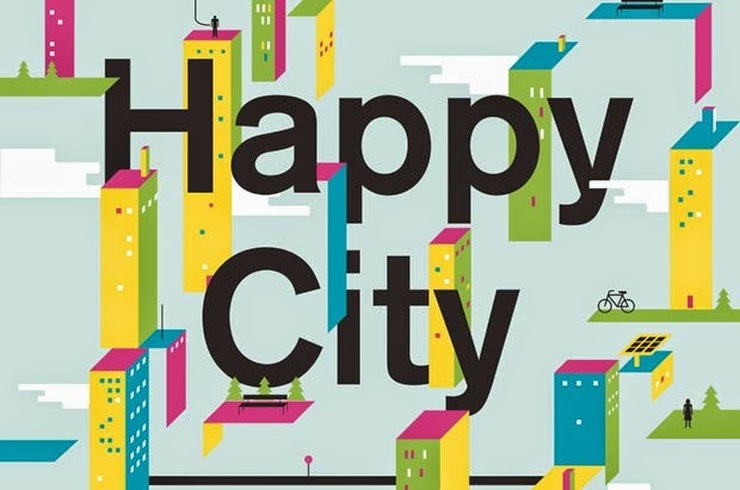 Montgomery's new book - Happy City - provides an antidote to dispersed cities During a hectic month of business travel with little time for blogging I read the recent book by Charles Montgomery, Happy City: Transforming Our Lives Through Urban Design. Montgomery says: "If we are to escape the effects of dispersal, then dense places have got to meet our psychological needs better than sprawl." That idea resonated during an afternoon walk in the prairie city of Brandon, Manitoba where I worked this week. Brandon is one of those mid-western cities with wide streets and sprawl suburbs. Yet even here I found an interesting (and dense) lower income multi-family townhouse project that Montgomery would appreciate. 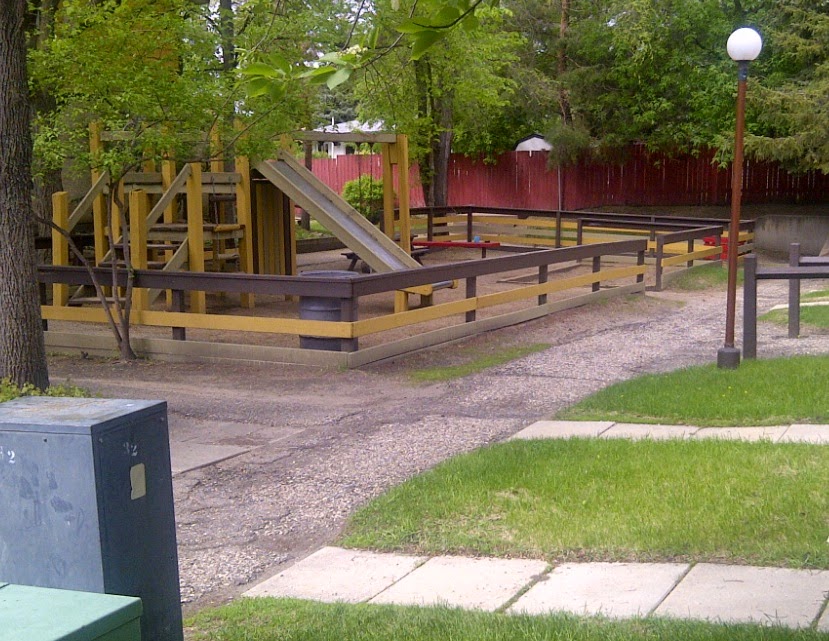 Play areas inside the lower income multi-family housing. Good visibility, easy access There is a tendency to think of low income, multi-family housing as crime-ridden. Yet this attractive, well designed multi-family complex had plenty of social mojo. Kids enjoyed a playground in clear view of nearby windows, walkways and grounds were clean, and dozens of people enjoyed their small front yards, barbecues, and common garden areas. 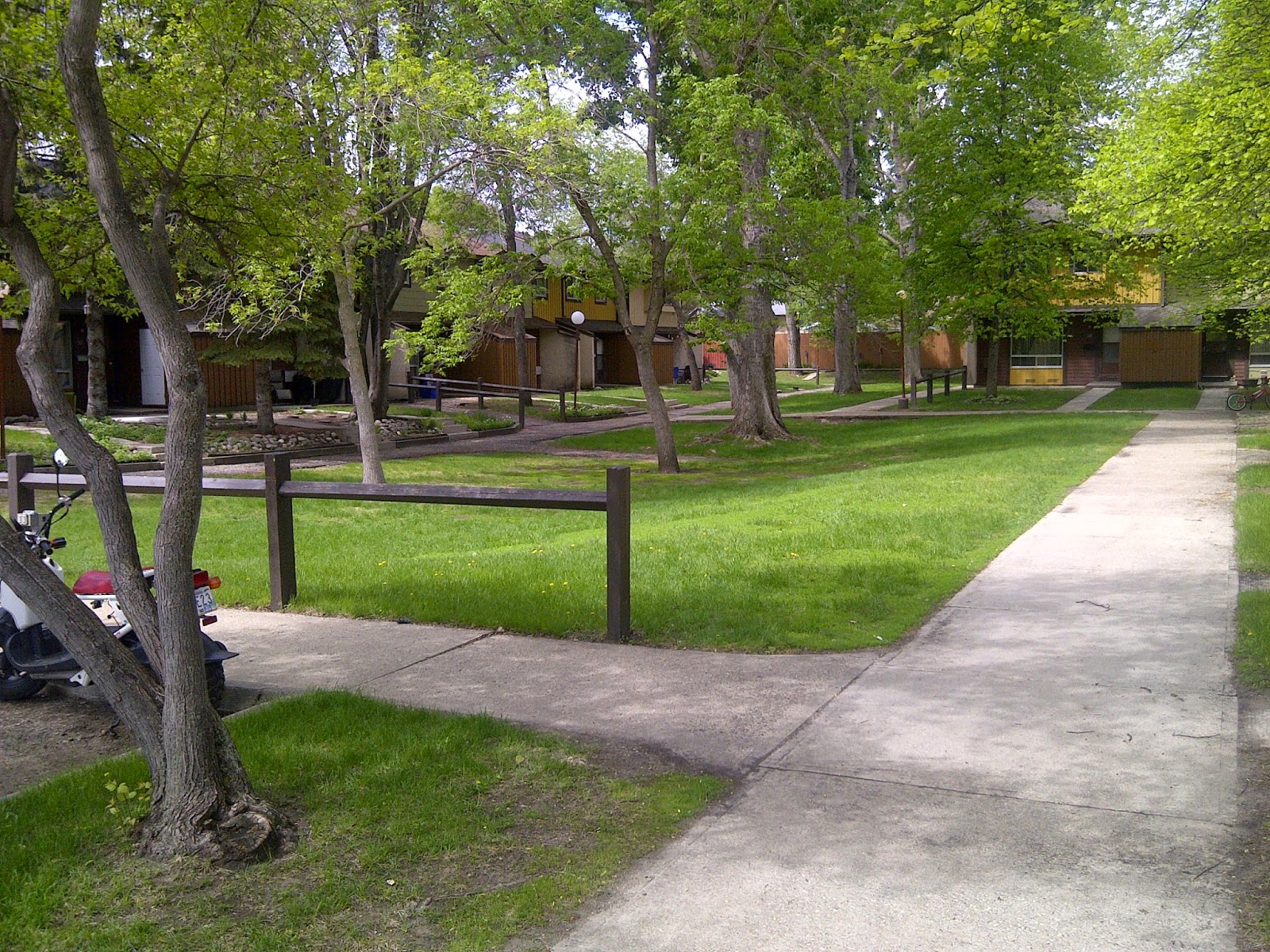 Interior courtyard, green and clean Police told me there were few calls for service here even though it housed 300 residents in a hundred units, very high density compared to the nearby sprawl. Nearby, as Montgomery might predict, a traditional suburb was vacant, graffitied, and sparse. In my hour-long walk there I uncovered only a few people, mostly working on cars. Few streets had sidewalks and I saw no one on their front lawns. 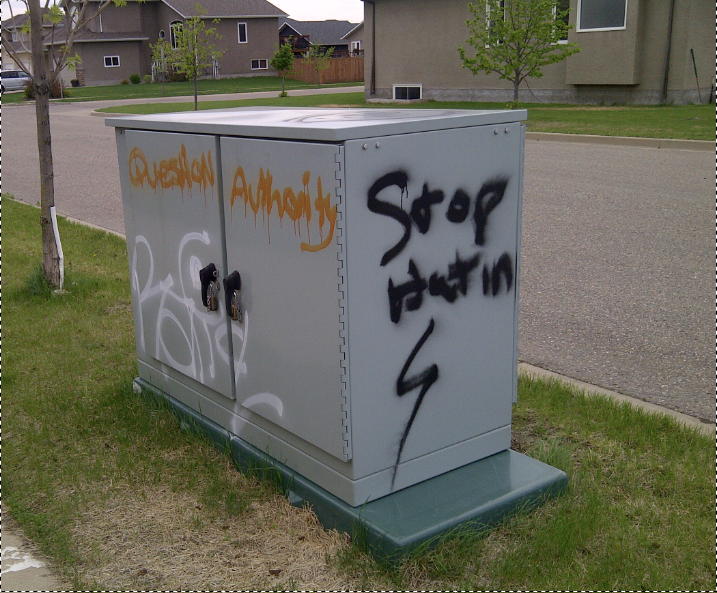 A few blocks away in a traditional suburb - Millennial messages The New York Times says about Happy City, "It was only a matter of time before someone figured out that if there were new things to say about happiness and a new interest in the evolution of urban life, the two subjects could be linked together." Montgomery has chapters on How to be Closer, Convivialities, and Redesigning for Freedom. They fit what I saw here. 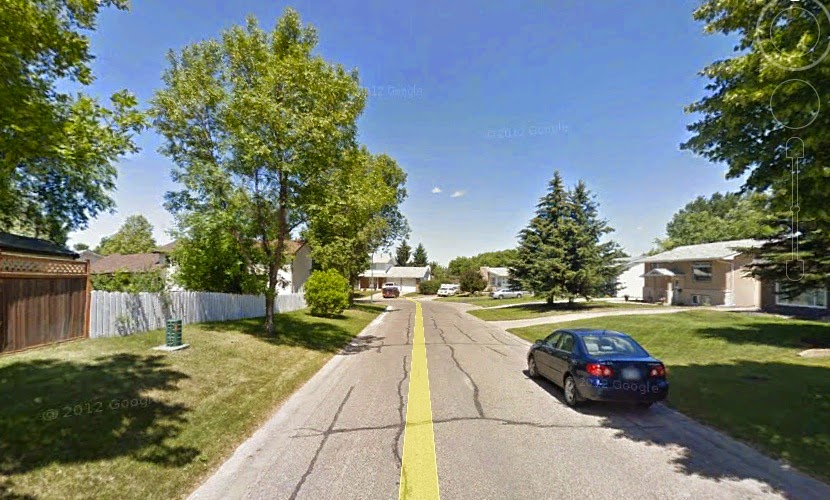 Adjacent streets - no sidewalks, fencing to isolate the road |
CONTACTSafeGrowth.Office@gmail.com
|

SafeGrowth® 2007-2024
|
SafeGrowth® is a philosophy and theory of neighborhood safety planning for 21st Century.
|